

His filed patent and disclosures from the Salk included in-vivo RNA transfection, mRNA as a drug, mRNA production, transient gene therapy and also methods for mRNA stabilization. These are available for review and can be found in the link below this statement.
When he left the Salk Institute, he moved his research over to Vical in 1988. He brought over mRNA, constructs, reagents that were developed at the Salk institute by Dr. Malone. The first in-vivo mammalian rat experiments were designed by Dr. Malone in January, 1989: this included dosing amounts for the in-vivo experiments. As he had brought his constructs, plasmids, reagents from the Salk Institute, he was easily able to ramp up his research program at Vical – where he was the only employee actually working on this technology at the time. The first in-vivo mouse experiments were performed in February, 1989 when mRNA and DNA was sent to Dr. Jon Wolff via Fedex. Dr.Wolff and his technicians at the University of Wisconsin injected mice and rats. The initial patent disclosures for RNA and DNA vaccination were written by Dr. Malone in 1988-1989. Dr. Malone was also an inventor of DNA vaccines in 1988 and 1989. He wrote the patent disclosures (again found in the the link below) and helped design the initial experiments, which were carried out by Dr. Gary Rhodes – in consultation with Dr. Malone.
THE INITIAL mRNA VACCINE EXPERIMENT EVER PERFORMED WAS FIRST CARRIED OUT IN 1989 AND IS WRITTEN UP IN THE ORIGINAL PATENTS. THERE ARE IMAGES OF THESE EXPERIMENTS FROM THE PATENTS FOUND AT THE BOTTOM OF THIS PAGE.
This body of work resulted in nine patents and numerous publications, yielding about 7000 citations for this work. The paper was the first showing data for DNA and RNA side by side for in-vivo (the first paper for in-vivo DNA):
Direct gene transfer into mouse muscle in vivo. Wolff JA, Malone RW, et al. Science. 1990;247(4949 Pt 1):1465-8. Cited in 4,750 articles, is the result of that work.
In 1989, research was performed that gave rise to the groundbreaking patents on mRNA vaccination, all with a priority date of March 21, 1989. This is the same priority date as the Salk Patent application, showing that the two institutions were working together. These patents are the first published research on mRNA vaccination. The titles and links to the patents are listed in the documents below. These patents have proof of principle experiments on mRNA vaccines – that clearly document that the invention worked and that these are the first experiments showing this.
Vical told Robert that they would license the Salk Technology (see Vical meeting minutes in the linked document page). Instead, they hired Robert’s thesis advisor from the Salk and soon after, the Salk dropped the patent and Vical never pursued a license from the Salk. Due to an employee contract with Vical, this stopped Robert from working in the field commercially for a decade. Vical claimed all the Salk research happened at Vical and sent a cease and desist letter.
Dr. Malone carried on his research into mRNA and DNA vaccination during the 1990s, culminating in a mucosal patent that was issued in 2000 and had a priority date of 1996. He also helped revolutionize the field of cationic liposomes for the use in RNA and DNA vaccinations. This work was so far ahead of its time, that only now is the world turning to mucosal mRNA vaccination as a method of immunization. For a listing of some of his work, see the publications on the links at the end of this page.
Scientifically trained at UC Davis, UC San Diego, and at the Salk Institute Molecular Biology and Virology laboratories, Dr. Malone received his medical training at Northwestern University (MD) and Harvard University Medical School (Clinical Research Post Graduate) , and in Pathology at UC Davis, He has almost 100 peer-reviewed publications, and has been an invited speaker at about 50 conferences.
For the full backstory on the discovery of mRNA vaccination, as written by Dr. Malone’s partner and wife, please download the PDF located in the section below:
Documentation (patents, papers, notebooks, meeting agendas, etc) on the invention of mRNA vaccines and DNA vaccines.
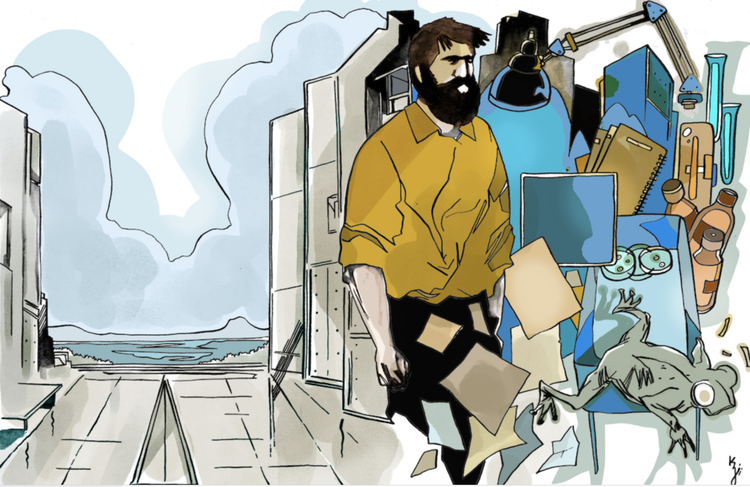 A Scientific Education: The Early History of the Discovery of mRNA VaccinesFor the full backstory on the discovery of mRNA vaccination, as written by Dr. Malone’s partner and wife, please download the PDF below:PDF Link
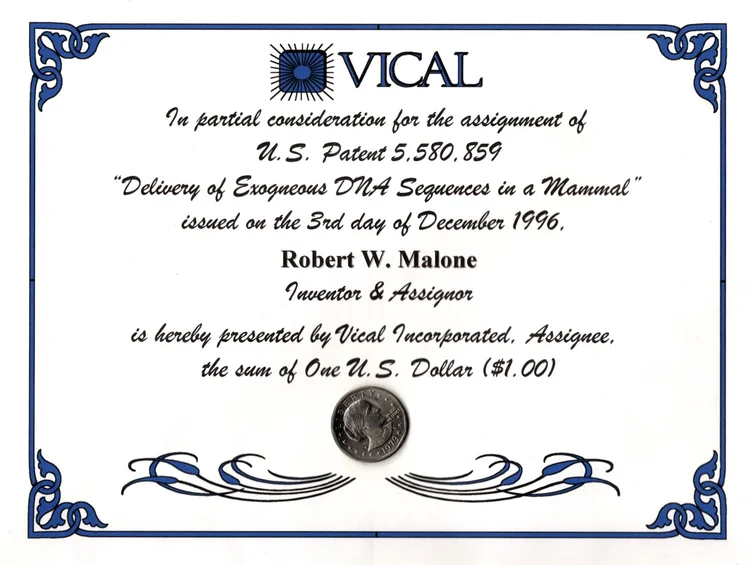 Original Patents and PapersmRNA Vaccine and RNA Transfection/Delivery Papers and Patents directly derived from Robert W Malone’s research Page link
 Dr. Robert W Malone’s RésuméCurrent CV for Dr. Robert W. MaloneRésumé
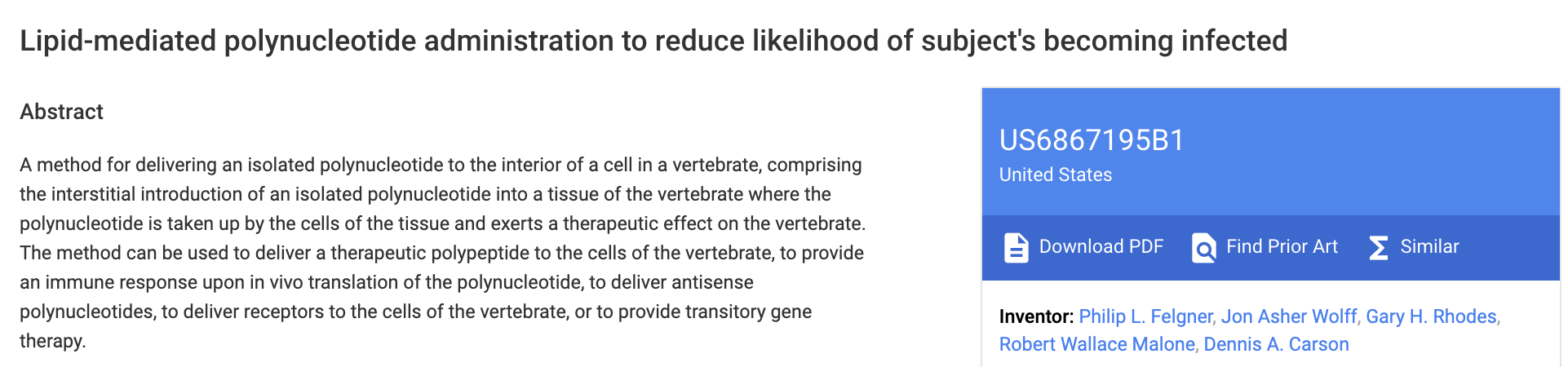
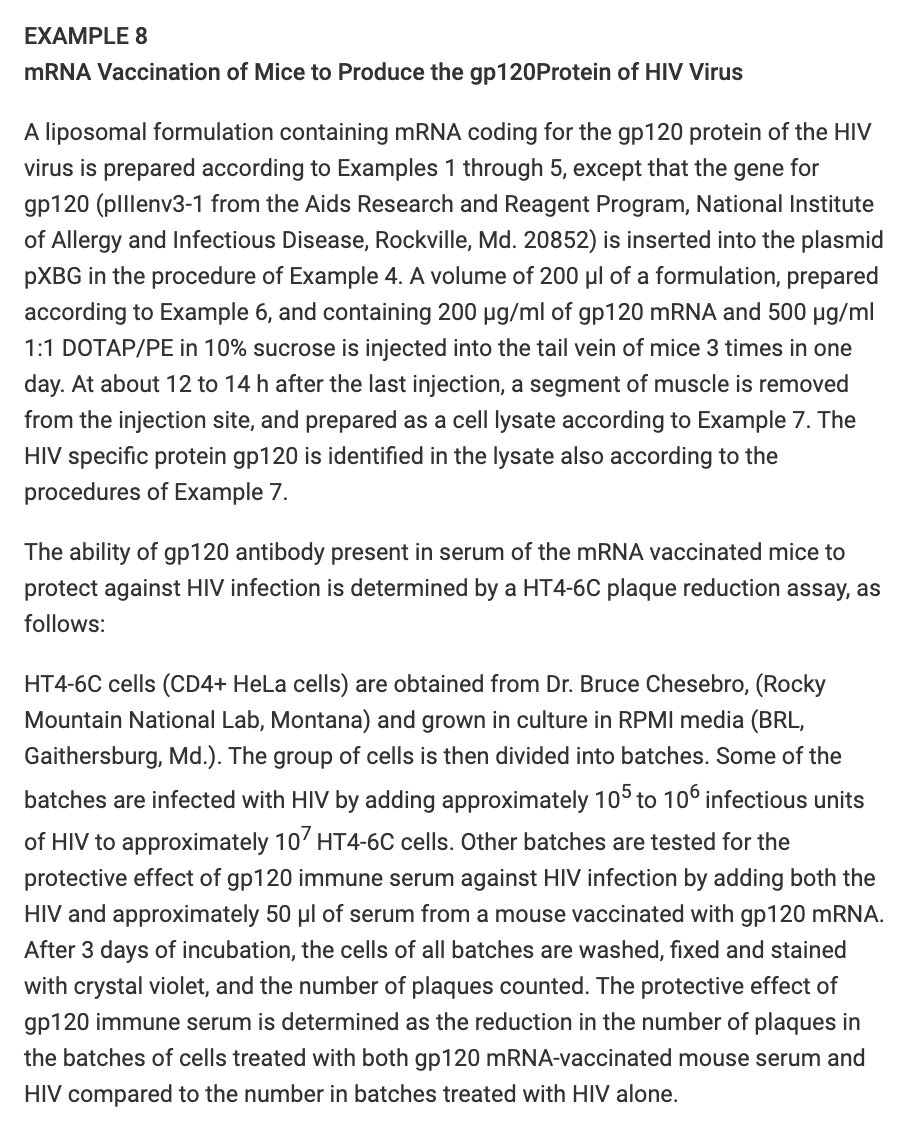
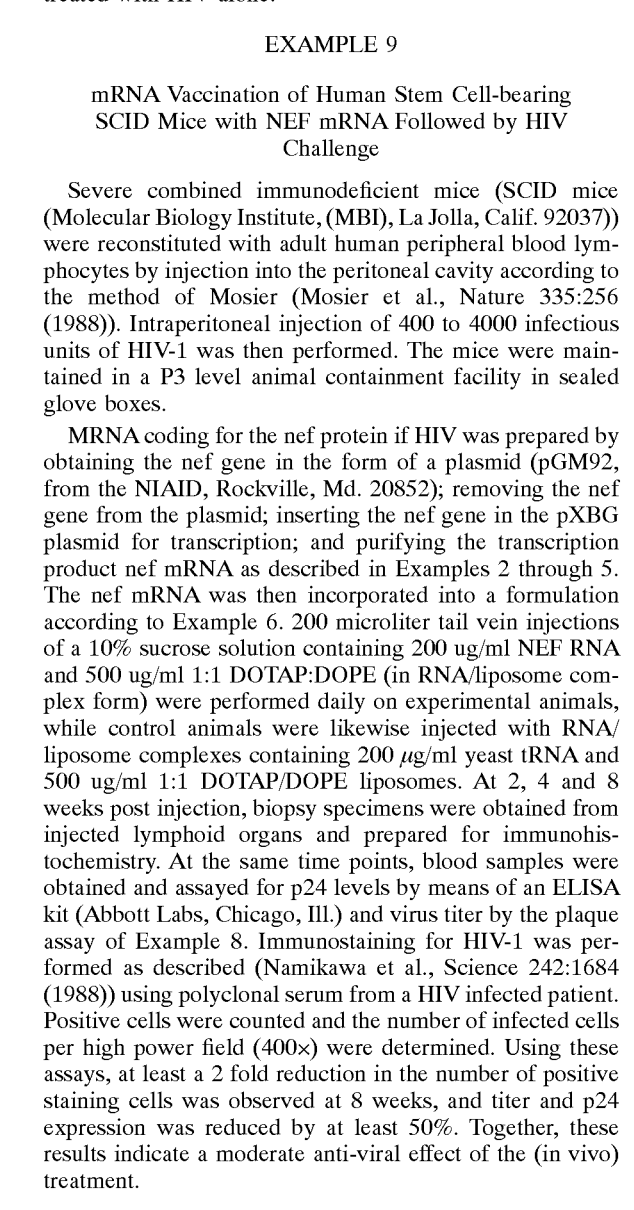
First mRNA experiments performed in mice, 1989-1990. First conceived and designed by Dr. Robert Malone and then refined and conducted by Dr. Gary Rhodes and his crew at Vical.
From US PATENT #US6867195B1 (one of ten issued patents)
Risk Benefit Analysis
KEY POINTS https://www.rwmalonemd.com/rick-benefit
These are not classical vaccines. These are gene therapy products whose long term consequences are unknown. FDA have not followed their own guidelines in this matter.
- A number of important safety studies in animals that would be expected have not been done (cancer, genotoxicity, studies in juvenile animals)
- Pfizer’s quasi vaccine data for children has not been verified by FDA . Many statistical issues cast doubt on Pfizer’s estimate of 91% efficacy.
- Pfizer have changed the formulation from the one that was tested, without any further safety of (see)
- FDA ‘s risk-benefit analysis (comparing no vax vs. full vax) for children is off by 26 times to give (conservatively) a 4x RISK more than benefit. Several new factors modify this:
- – lowered benefit of vaccine against omicron (unknown, but assume only (50%)
- – even assuming lower risks of myocarditis based on recent CDC numbers (which appar flawed) STILL gives a higher RISK.
- Why limit contraindication to Janssen? Using same criteria revisit EUA/BLA for all C19 quasi-vaccines. Transparency: Emergency ACIP Meeting Dec 16 2021: A second open letter to Dr. Grace Lee, ACIP Chair
- This video goes through the Pfizer 6-month data shows that Pfizer’s COVID-19 inoculations cause more illness than they prevent. Plus, an overview of the Pfizer trial flaws in both design and execution.
- The Canadian Covid Care Alliance Power Point Presentation
READ https://www.rwmalonemd.com/reuters-factcheckers https://www.rwmalonemd.com/newstories
Why are we vaccinating children against COVID-19?
Author links open overlay panelRonald N.KostoffaDanielaCalinabDarjaKanduccMichael B.BriggsdPanayiotisVlachoyiannopouloseAndrey A.SvistunovfAristidisTsatsakisgShow moreShareCitehttps://doi.org/10.1016/j.toxrep.2021.08.010Get rights and contentUnder a Creative Commons licenseopen accessReferred to byExpression of concern: Why are we vaccinating children against COVID-19?Toxicology Reports, Available online 17 December 2021, PagesDownload PDFRonald N. Kostoff, Daniela Calina, Darja Kanduc, Michael B. Briggs, Panayiotis Vlachoyiannopoulos, Andrey A. Svistunov, Aristidis TsatsakisErratum to “Why are we vaccinating children against COVID-19?” [Toxicol. Rep. 8C (2021) 1665–1684 / 1193]Toxicology Reports, Volume 8, 2021, Pages 1981Download PDF
Highlights
Bulk of COVID-19 per capita deaths occur in elderly with high comorbidities.•
Per capita COVID-19 deaths are negligible in children.•
Clinical trials for these inoculations were very short-term.•
Clinical trials did not address long-term effects most relevant to children.•
High post-inoculation deaths reported in VAERS (very short-term).
Abstract
This article examines issues related to COVID-19 inoculations for children. The bulk of the official COVID-19-attributed deaths per capita occur in the elderly with high comorbidities, and the COVID-19 attributed deaths per capita are negligible in children. The bulk of the normalized post-inoculation deaths also occur in the elderly with high comorbidities, while the normalized post-inoculation deaths are small, but not negligible, in children. Clinical trials for these inoculations were very short-term (a few months), had samples not representative of the total population, and for adolescents/children, had poor predictive power because of their small size. Further, the clinical trials did not address changes in biomarkers that could serve as early warning indicators of elevated predisposition to serious diseases. Most importantly, the clinical trials did not address long-term effects that, if serious, would be borne by children/adolescents for potentially decades.
A novel best-case scenario cost-benefit analysis showed very conservatively that there are five times the number of deaths attributable to each inoculation vs those attributable to COVID-19 in the most vulnerable 65+ demographic. The risk of death from COVID-19 decreases drastically as age decreases, and the longer-term effects of the inoculations on lower age groups will increase their risk-benefit ratio, perhaps substantially. https://www.sciencedirect.com/science/article/pii/S221475002100161X?via%3Dihub
Sharing is caringFacebookX / TwitterLinkedInWhatsAppTelegramRedditEmail1698 words · 162 views