Here then are the top ten discoveries related to Moses and the Exodus which I believe are evidence of the historicity of the biblical account.
10. Proto-Sinaitic Inscriptions
Some have suggested that Moses did not write the first five books of the Bible, but rather they were written a thousand years later by a supposed group of priests living in exile (or later) who were trying to invent a glorious history for their people. When this theory was first proposed in the 19th century, there was no known alphabetic script with which Moses could have recorded such lengthy reports. We now know that there was indeed an alphabetic script Moses could have used. Remember that Moses was literate, having been educated in Pharaoh’s household (Acts 7:22). In the early 20th century, examples of alphabetic writing were discovered by Sir Flinders Petrie inscribed on stones at Serabit el-Khadim, an Egyptian turquois mine in the Sinai.6 They date from the 19th to the 15th centuries BC.7 The Proto-Sinaitic script, as it is often called, was invented by Semites who worked at the turquois mine and adopted Egyptian hieroglyphic symbols as pictographic letters for their language. Most scholars agree that the language behind this script is from Canaan, but which language has been a matter of debate. Douglas Petrovich has presented evidence these inscriptions were written by Israelites, and that Hebrew is the language behind the script.8 His translation of one inscription (Sinai 361) contains the name of Moses.9 Not all scholars are convinced, however,10 11 which has resulted in much debate.12 It is interesting that an alphabetic script developed at the precise time the Israelites were in Egypt, and that the language behind it is from their place of origin. At the very least, we now know that there was indeed an alphabetic script Moses could have used to write the first five books of the Bible.
9. Egyptian Words in the Hebrew Text
One of the often-overlooked elements of the Exodus account in the Bible is the use of Egyptian words in the Hebrew text. After the birth of Moses, we read, “When she could hide him no longer, she took for him a basket made of bulrushes and daubed it with bitumen and pitch. She put the child in it and placed it among the reeds by the river bank” (Ex 2:3). Egyptologist, James Hoffmeier, has highlighted the numerous Egyptian words that are often missed in this verse. The Hebrew word for “basket” is tebat (nan) and derives from the Egyptian word dbjt. Similarly, the words “bulrushes” and “pitch” have Egyptian etymology and the Hebrew word “reeds,” is unquestionably the Egyptian word twfy. The word “river,” clearly referring to the Nile is not the normal Hebrew word for river (nahar), but rather a transliteration of the Egyptian word for the Nile.13 Even Moses’ name is Egyptian, having been named by Pharaoh’s daughter (Ex 2:10). Hoffemeier writes, “There is widespread agreement that at the root of the name of the great Hebrew leader is the Egyptian word msi, which was a very common element in theophonc names throughout the New Kingdom (e.g., Amenmose, Thutmose, Ahmose, Ptahmose, Ramose, Ramesses).14 The Egyptian loan-words in the Hebrew text are difficult to explain, unless one acknowledges Moses’ Egyptian education and authorship.
8. Papyrus Brooklyn 35.1446
Central to the Exodus account is the presence of Israelites in Egypt to begin with. The Bible describes Joseph’s entrance to Egypt as a slave (Gn 37:28), his rise to power (Gn 41:41), his initiative in bringing his family to Egypt (Gn 45:18), their subsequent growth (Ex 1:7) and eventual bondage (Ex 1:11). Some scholars, however, do not believe the Israelites were ever in Egypt. For example, in a 1999 article in Ha’aretz, Ze’ev Herzog boldly declared, “This is what archaeologists have learned from their excavations in the Land of Israel: the Israelites were never in Egypt, did not wander in the desert, did not conquer the land in a military campaign and did not pass it on to the 12 tribes of Israel.”15
There is evidence, however, of the Israelites in Egypt. Papyrus Brooklyn 35.1446 is an Egyptian document written in hieratic script, that names 95 household servants of a noblewoman named Senebtisi.16 Forty of the names are Semitic (Hebrew is a Semitic language),17 and several have been identified as Hebrew names. These include Menahema, a feminine form of the Hebrew name Menahem (2 Kgs 15:14), a woman whose name is a parallel to Issachar, one of Jacob’s sons (Gn 30:18), and Shiphrah, the name of one of the Hebrew midwives prior to the Exodus (Ex 1:15).18 To be clear, this papyrus dates to the 13th Dynasty (ca. 1809-1743 BC)19 just after the time of Joseph, and does not refer to Hebrew slaves at the time of Moses. Titus Kennedy summarizes its importance: “This list is a clear attestation of Hebrew people living in Egypt prior to the Exodus, and it is an essential piece of evidence in the argument for an historical Exodus.”20
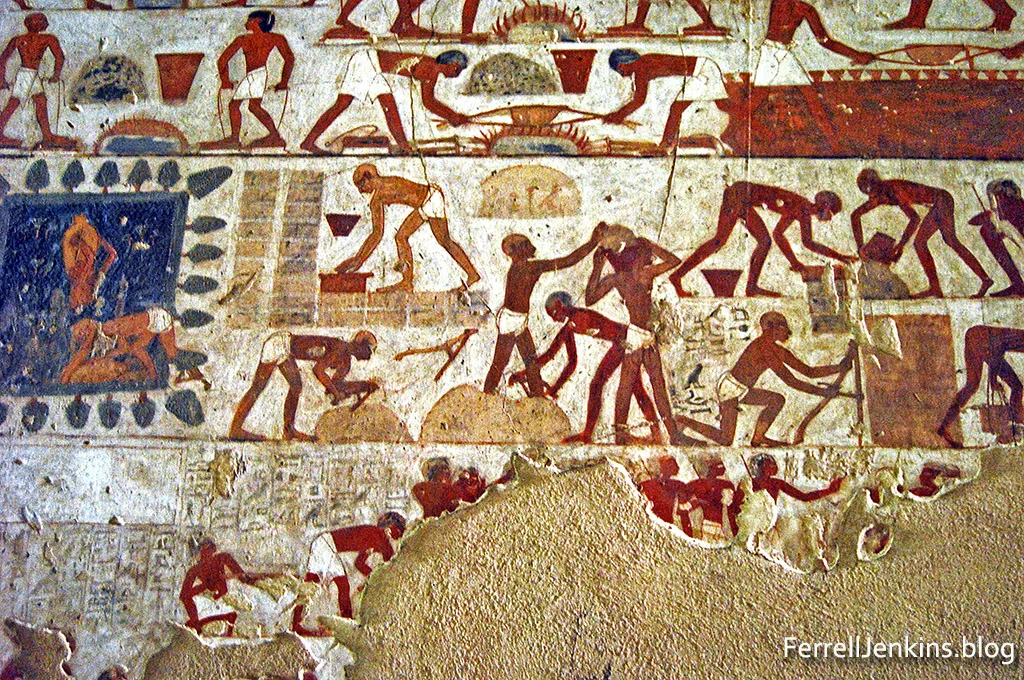
7. Egyptian Records of Slaves Making Bricks
One of the tasks the Israelite slaves were pressed into was making bricks (Ex 5:7-8). When Moses petitioned Pharaoh to let God’s people go, Pharaoh responded making their labor more difficult (Ex 5:6-18). The biblical description of slaves making bricks is affirmed by a painting in the tomb of Rehkmire (ca. 1470-1445 BC), the vizier of Egypt under Thutmose III and Amenhotep II. The painting depicts Nubian and Asiatic slaves (Egyptians called people from Canaan “Asiatics”) making bricks for the workshops of the Karnak Temple.21 Slaves are seen collecting and mixing mud and water, packing the mud in brick molds, and leaving them to dry in the sun. Nearby Egyptian officials, each with a rod, oversee the work.
In addition to the Rehkmire tomb painting, a leather scroll in the Louvre which dates to the time of Rameses II mentions forty stablemasters (junior officers) who each had a quota of 2000 bricks to be made by the men under them.22 Two further Egyptian papyri (Anastasi IV and V) record that “there are no men to make bricks and no straw in the district,”23 which highlights the importance of straw as a binder in brickmaking, and the dismay the Israelites felt when Pharaoh stopped supplying it, but still required the same number of bricks to be made (Ex 5:18-21). Egyptian records affirm the biblical description of the process of making bricks.
6. Discoveries at Avaris
According to the biblical text, the Israelites settled in “the land of Rameses” (Gn 47:11) sometime in the 19th century. While they were initially free, at some point they became slaves to the native Egyptians and pressed into building the city of Rameses (Ex 1:11). When they left Egypt in 1446 BC, some 430 years later, they left from Rameses (Ex 12:37).24 The use of the word “Rameses” is an update of the biblical text by later editors to replace an archaic place name with one that was more recognizable, as it is in Gn 47:11: “So Joseph settled his father and his brothers in Egypt and gave them property in the best part of the land, the district of Rameses, as Pharaoh directed.”
Thanks to five decades of excavations by the Austrian Archaeological Institute of Cairo at Tell el-Dab‘a in the eastern Nile Delta, we now know this was the site of the city Rameses, which was itself built over a previous city named Avaris. While the site is most famous as the Hyksos capital,25 it was originally settled in the 19th century (the time of Joseph) by a group of non-Egyptians from Canaan, as evidenced by the Canaanite pottery and weapons they used.26 There is even evidence of a four-roomed house in the village, the same layout as those typical of Israelite settlements in the later Iron Age, as well as a prominent tomb in which the remains of a statue of a Semitic man with a multi-coloured robe was found. The town grew and became more Egyptianized, with a mansion built atop the four-roomed house which some believe to be the residence of Ephraim and Manasseh, Joseph’s sons.27 A palace precinct was later built at Avaris during the Hyksos period, and then expanded during the 18th Dynasty, forming a new royal citadel.28 This later palatial complex dates to the time of Moses and is likely where he spent time when he was raised in Pharaoh’s courts. Interestingly, the excavators at Tell el-Dab’a note the site was suddenly and mysteriously abandoned after the reign of Amenhotep II, suggesting a plague may have been the reason.29 Bryant Wood summarizes the occupational history of the site: “The excavations at Tell el-Dab’a have revealed the presence of an “Asiatic” community who first settled as pastoralists, then grew in number as well-to-do entrepreneurs, became subservient to the Egyptians and finally left. This scenario exactly matches what we read in the Bible.”30
5. Evidence for Amenhotep II as the Pharaoh of the Exodus
Numerous scholars have identified Amenhotep II as the Pharaoh of the Exodus31; he was reigning in 1446 BC when the Israelites left Egypt. Amenhotep II is known to have spent considerable time in the delta region, likely in the 18th-Dynasty palace at Avaris where he would have met with Moses. According to Egyptologist, Charles Aling, “Amenhotep II was born and raised in this area [the Nile delta region], built there, had estates there, and in all probability resided there at times, at least in his early reginal years.”32 Interestingly, (and in keeping with the 10th plague – the death of the first-born), Amenhotep II was not the firstborn son of his predecessor, Thutmose III, nor was his successor, Thutmose IV his firstborn son, as implied by the Dream Stele on the Great Sphinx.33
Another piece of evidence for identifying Amenhotep II as the pharaoh of the Exodus is found by comparing the military campaigns of Amenhotep II and those of his father. While Thutmose III led 17 known military campaigns into the Levant, Amenhotep II led only two or three.34 Thutmose III boasted of having taken 5903 captives on his first campaign, while Amenhotep II claims to have taken 2214 captives on his first. However, Amenhotep II’s final campaign in the ninth year of his reign (ca. 1446 BC) appears to have been a hasty and limited excursion into Palestine to take 101,128 captives. One plausible explanation for this campaign and its dramatic number of captives is that he was seeking to replace a large portion of his slave labor base that had just left Egypt.35 Moreover, Amenhotep II never took another campaign into Canaan, and the 18th dynasty began to decline in power.
4. Seti War Relief
The famous relief of the campaigns of the pharaoh Seti I (ca. 1291-1279 BC) at the Karnak Temple depicts the eastern border of Egypt in pictorial form (like a map) and likely relates to the route Moses and the Israelites took during the Exodus. In Exodus 13:17 we read, “When Pharaoh let the people go, God did not lead them on the road through the Philistine country, though that was shorter. For God said, ‘If they face war, they might change their minds and return to Egypt.’” The Seti Relief depicts this road, known as the Horus Way, as well a number of fortresses, including “Tjaru,” the staging point for Egyptian campaigns into Canaan.36 A vertical waterway lined with reeds and labeled “the dividing waters,” is visible, as well as a larger body of water is at the bottom of the waterway (a feature that was seen by earlier explorers but is no longer visible).37 The Seti relief is evidence that there was, at one time in the distant past, a canal or waterway on the eastern border of Egypt, even though the area is a desert now.
This has been affirmed by geological studies, which have demonstrated there was indeed a man-made canal joining a string of lakes between the Gulf of Suez and the Mediterranean Sea. These canals and lakes – from the el-Ballah Lakes in the north to Lake Timsah to the Bitter Lakes in the south formed a defensive barrier on the Eastern frontier of Egypt. The Bible says Moses led the Israelites through the Red Sea (in Hebrew, the yam suf, literally, sea of reeds38), which may correspond to the wetlands and lake systems on Egypt’s eastern border.39 Egyptologist James Hoffmeier has matched Egyptian place names with the locations mentioned in the Exodus itinerary and suggests the yam suf the Israelites crossed was likely in the area of the el-Ballah Lakes.40
3. Soleb Inscription
At the end of the 15th century B.C., the Egyptian Pharaoh Amenhotep III built a temple to honor the god Amun-Ra at Soleb in Nubia (modern-day northern Sudan). He left a list of the territories he claims to have conquered on a series of columns in the temple. Each territory is depicted by a relief of a prisoner with their hands tied behind their backs over an oval “name ring” identifying the land of the conquered foe. One of the enemies is from the “the land of the Shasu (nomads) of Yahweh.” Given the other name rings nearby, the context would place this land in the Canaanite region. In addition, the prisoner is clearly portrayed as Semitic, rather than African-looking, as other prisoners in the list are portrayed.41 Two conclusions are almost universally accepted: first, this inscription clearly references Yahweh in Egyptian hieroglyphics (the oldest such reference outside of the Bible), and secondly, that around 1400 B.C. Amenhotep III knew about the god Yahweh. Moreover, it would indicate an area in Canaan in the 15th century BC inhabited by nomadic or semi-nomadic people who worship the god Yahweh. Egyptologist, Dr. Charles Aling and historian Dr. Clyde Billington summarize: “If the Pharaoh of the Exodus had never before heard of the God Yahweh, this strongly suggests that the Exodus should be dated no later than ca. 1400 BC because Pharaoh Amenhotep III had clearly heard about Yahweh in ca. 1400 BC.”42
2. Berlin Pedestal
The Berlin Pedestal is an Egyptian inscription housed in the Egyptian Museum in Berlin that almost certainly refers to Israel as a nation in Canaan. The inscription has three name rings, two of which clearly read “Ashkelon” and “Canaan,” and a third that has been reconstructed to read, “Ishrael.”43 In a recent re-examination of the inscription, Peter van der Veen, Christoffer Theis, and Manfred Gorg noted that names Ashkelon and Canaan largely were written consonantally and better reflecting examples from the reigns of Tuthmosis III and Amenhotep II (15th century BC), than those from the times of Rameses II and Merenptah (13th century BC).44 While the inscription reads “Ishrael” instead of “Israel,” there is no other candidate near Canaan and Ashkelon, other than biblical Israel. It may be that the “sh” spelling is an older way Egyptian spelled Israel, or perhaps borrowed from the cuneiform version.45 If this interpretation is correct, it would indicate that the Israelites had migrated to Canaan sometime in the middle of the second millennium BC,46 exactly at the time the Bible says they did.
1. The Merneptah Stele
The most famous, and arguably the most important discovery related to Moses and the Exodus is the Merneptah Stele. In ca. 1208 B.C. Pharaoh Merneptah erected a 10-foot tall victory monument (called a stele) in a temple at Thebes to boast of his claims of victory in both Libya and Canaan. It was discovered in 1896 by Sir Flinders Petrie. On it, Merneptah boasts, “Israel is wasted, its seed is not; And Hurru (Canaan) is become a widow because of Egypt.”47 The inscription likely refers to a small campaign into Canaan (only three cities are taken), and despite Merneptah’s boast, Israel was not destroyed.
Most scholars agree that this is the oldest definitive reference to Israel as a nation outside of the Bible, and certainly the clearest Egyptian reference to Israel. It is also important because it points towards an early date for the exodus (ca. 1446 B.C.) and not the late date that some scholars hold to (ca. 1270 B.C.). It is doubtful that there would be enough time from 1270 B.C. to 1208 B.C. to account for the exodus, the 40 years of wandering in the dessert, the seven-year conquest of Canaan, the settlement of the tribes in their territories, and the establishment of a national presence in the land, all before Merneptah claims to have conquered them. Merneptah’s Canaanite campaign instead likely dates to the time of the Judges, when the nation of Israel was already settled in Canaan. The Merneptah Stele is evidence that the Exodus from Egypt, led by Moses, took place in the 15th century BC, as the biblical data indicates.
Conclusion
Take together, these ten discoveries indicate the accounts of Moses and the Exodus are based in real history. While not the “proof beyond a shadow of a doubt” many seek, they provide circumstantial evidence that can lead one to reasonably conclude the people of Israel were slaves in Egypt at the time the Bible indicates. Further, the archaeological data suggests the Israelites left suddenly, and were settled in Canaan by the end of the 15th century BC, in line with the biblical data.
Endnotes:
1 Yair Hoffman, “A North Israelite Typographical Myth and a Judean Historical Tradition: The Exodus in Hosea and Amos,” VT 39/2 (1989): 170, quoted in Randall Price and H. Wayne House, Zondervan Handbook of Biblical Archaeology (Grand Rapids: Zondervan, 2017), 88.
2 James K. Hoffmeier, “Out of Egypt: The Archaeological Context of the Exodus.” In Ancient Israel in Egypt and the Exodus, ed. Margaret Warker. (Washington: Biblical Archaeology Society, 2012), 5.
3 Charles Aling, Egypt and Bible History. (Grand Rapids: Baker Book House, 1981), 96.
4 A good summary of the verses that point to an early date for the Exodus (and by implication the conquest 40 years later) in the 15th century B.C. can be found in the following episodes of ABR’s TV show, Digging for Truth: ;
5 Bryant G. Wood, “The Rise and Fall of the 13th Century Exodus-Conquest Theory.” Associates for Biblical Resaerch. April 17, 2008. ;(Accessed Sept. 16, 2021).
6 Editors of Encyclopaedia Britannica. “Sinaitic inscriptions.” Encyclopedia Britannica, August 24, 2012. . (Accessed Sept. 16, 2021).
7 Douglas Petrovich, “Hebrew As The Language of the World’s Oldest Alphabet.” Bible and Spade. Vol. 30. No. 2 (Spring 2017), 54.
8 Douglas Petrovich, “Hebrew As The Language of the World’s Oldest Alphabet.” American Society of Overseas Research. April 2017, Vol. V, No. 4. ;(Accessed Sept. 16, 2021).
9 Steve Law, “New Discoveries Indicate Hebrew Was World’s Oldest Alphabet – Part 3.” Patterns of Evidence. Jan. 19, 2017. ;(Accessed Sept. 21, 2021).
10 Alan Millard, “A Response to Douglas Petrovich’s “Hebrew as the Language behind the World’s First Alphabet?” American Society of Overseas Research. April 2017, Vol. V, No. 4. ;(Accessed Sept. 16, 2021).
11 Christopher Rollston, “The Proto-Sinaitic Inscriptions 2.0: Canaanite Language and Canaanite Script, Not Hebrew.” December 10, 2016. ;(Accessed Sept. 21, 2021).
12 See Douglas Petrovich’s responses to Alan Millard and Christopher Rollston at his academia.edu page:
13 James K. Hoffmeier, Israel in Egypt: The Evidence for the Authenticity of the Exodus Tradition. (Oxford: Oxford University Press. 1996), 138-139.
14 Ibid, 140.
15 Ze’ev Herzog, “Deconstructing the walls of Jericho.” Ha’aretz, October 29, 1999. ;(Accessed Sept. 18, 2021).
16 “Portion of a Historical Text.” Brooklyn Museum. ;(Accessed Sept. 18, 2021).
17 James K. Hoffmeier, Israel in Egypt: The Evidence for the Authenticity of the Exodus Tradition. (Oxford: Oxford University Press. 1996), 61.
18 Charles Aling, “Joseph In Egypt – Part II.” Associates for Biblical Research. (Accessed Sept. 18, 2021).
19 “Portion of a Historical Text.” Brooklyn Museum. ;(Accessed Sept. 18, 2021).
20 Titus Kennedy, “Hebrews in Egypt before the Exodus? Evidence from Papyrus Brooklyn.” APXAIOC. ;(Accessed Sept. 18, 2021).
21 Gary Byers, “The Bible According to Karnak.” Associates for Biblical Research. Aug. 13, 2009. ;(Accessed Sept. 20, 2021).
22 K. A. Kitchen, On The Reliability of the Old Testament. (Grand Rapids: Wm. B. Eerdmans Publishing Co., 2006), 247.
23 Ricardo A. Caminos, Late Egyptian Miscellanies (Oxford: Oxford Univ. Press, 1954), pp. 105–106, 188–189, 225, in Robert and Lorenzon Littman, Jay and Marta Silverstein, “With and Without Straw: How Israelite Slaves Made Bricks,” Biblical Archaeology Review, 40:2, (March/April 2014), 63.
24 Bryant Wood, “The Royal Precinct at Rameses.” Associates for Biblical Research. April 3, 2008. ;(Accessed Sept. 17, 2021).
25 Manfred Bietak, Avaris, The Capital of the Hyksos: Recent Excavations at Tell el-Dab’a. (London: British Museum Press, 1996), 7.
26 Bryant Wood, “New Evidence for Israel’s Sojourn in Egypt.” Bible and Spade. Vol. 33, No. 1 (Winter 2020), 11.
27 Ibid, 13.
28 Manfred Bietak, Avaris, The Capital of the Hyksos: Recent Excavations at Tell el-Dab’a. (London: British Museum Press, 1996), 67.
29 Manfred Bietak and Irene Forestner-Miller, from Agypten und Levant 15 (2005), 93, 95; translated by Walter Pasedag, quote in Bryant Wood, “New Evidence for Israel’s Sojourn in Egypt.” Bible and Spade. Vol. 33, No. 1 (Winter 2020), 14.
30 Bryant Wood, “New Evidence for Israel’s Sojourn in Egypt.” Bible and Spade. Vol. 33, No. 1 (Winter 2020), 11.
31 William Shea, “Amenhotep II as the Pharaoh of the Exodus.” ;; Douglas Petrovich, “Amenhotep II and the Historicity of the Exodus Pharaoh.” ;; Charles Aling in Egypt and Bible History.
32 Charles Aling, Egypt and Bible History. (Grand Rapids: Baker Book House, 1981),
33 Douglas Petrovich, “Amenhotep II and the Historicity of the Exodus Pharaoh.” Associates for Biblical Research. Feb. 4, 2010. ;(Accessed Sept. 21, 2021).
34 Ibid
35 Ibid
36 Gary Byers, “New Evidence from Egypt on the Location of the Exodus Sea Crossing: Part I.” Associates for Biblical Research. Aug. 19, 2008. ;(Accessed Sept. 22, 2021).
37 Ibid.
38 James K. Hoffmeier, “Out of Egypt: The Archaeological Context of the Exodus.” In Ancient Israel in Egypt and the Exodus, ed. Margaret Warker. (Washington: Biblical Archaeology Society, 2012), 17.
39 Ibid, 17.
40 Ibid, 17. See also James K. Hoffemeir, Israel in Egypt: Israel in Egypt: The Evidence for the Authenticity of the Exodus Tradition and Ancient Israel in Sinai: The Evidence for the Authenticity of the Wilderness Tradition
41 Joel Kramer, “The Oldest Yahweh Inscription.” Associates for Biblical Research. Jan. 20, 2017. ;(Accessed Sept. 22, 2021).
42 Charles Aling and Clyde Billington, “The Name Yahweh in Egyptian Hieroglyphic Texts.” Associates for Biblical Research. March 8, 2010. ;(Accessed Sept. 22, 2021).
43 Bryant G. Wood, “New Evidence Supporting the Early (Biblical) Date of the Exodus and Conquest.” Associates for Biblical Research. Nov. 11, 2011. ;(Accessed Sept. 22, 2021).
44 Peter van der Veen, Christoffer Theis, and Manfred Gorg, “Israel in Canaan (Long) Before Pharaoh Merenptah? A Fresh Look at Berlin Statue Pedestal Relief 21687.” Journal of Ancient Egyptian Interconnections, 2.4 (2010), 16.
45 Ibid, 19.
46 Ibid, 21.
47 Gary Byers, “Great Discoveries in Biblical Archaeology: The Merneptah Stele.” Associates for Biblical Research. March 15, 2006. (Accessed Sept. 22, 2021).
BRYAN WINDLE
Top Ten Discoveries in Biblical Archaeology in 2021
NOTE: Here is the video version of this blog, from Episode 156 of the TV show, Digging for Truth, by the Associates for Biblical Research (biblearchaeology.org).
I love being able to look back at all that has occurred in biblical archaeology in the past 12 months. Despite the ongoing effects of the pandemic which cancelled numerous digs, many important discoveries were made. These finds both affirm details in Scripture and help us understand the biblical text in greater detail. As I do each year, I choose the ten discoveries that I feel are the most significant.
If you’re new to my annual top ten list, here are my criteria:
- These discoveries must be directly related to people, places or events mentioned in Scripture, or to the composition of Scripture itself.
- They must be discoveries or new studies about discoveries, as opposed to announcements.
You can also read my past top ten lists here: 2020, 2019, 2018, 2017, and 2016, as well as the Top Ten Discoveries of the Decade (2010-2019), and Top Ten Discoveries of All-Time Relating to Both the Old and New Testaments.
With that said, here are the top ten discoveries in Biblical archaeology in 2021.
10. Evidence of Earthquake from the Time of King Uzziah Discovered in Jerusalem (Aug. 2021)
Archaeologists excavating in Jerusalem, near the Temple Mount and a First-Temple-era wall unearthed evidence of an 8th century BC earthquake. The earliest floor of the southernmost room of a building bore evidence of destruction, but not by fire, and was dated to a time period when no known conquest of Jerusalem occurred. Stones from an upper part of the northern walls had collapsed, shattering a row of vessels that had been along the wall beneath. The excavation directors from the Israel Antiquities Authority, Dr. Joe Uziel and Ortal Chalaf, believe this corresponds to the great earthquake which occurred in the days of King Uzziah, and is mentioned in Amos 1:1 and Zech. 14:5. Archaeological evidence for “Uzziah’s earthquake” has been found at other sites in Israel, including at Hazor and Tell es-Safi/Gath, but this is the first time archaeologists have identified evidence of this earthquake in Jerusalem. A similar 8th-century destruction layer was noted in a collapsed building 100 meters south of the current dig, which was excavated by Yigal Shiloh in the 1970’s, but it was not associated with Uzziah’s earthquake at that time.
NEWS LINK:
9. 2700-Year-Old Toilet Discovered in Jerusalem (Oct. 2021)
An ancient bathroom, complete with a toilet, was discovered in-situ near the Armon Hanatziv promenade in Jerusalem. The cubical is part of the 7th-century BC palatial structure in which several Judahite capitals were unearthed in 2020 (the number one discovery of 2020). The lavatory cubical is approximately 1.5m by 2m (5ft by 6.5ft), and includes a septic tank beneath the toilet hewn out of the limestone bedrock. A carved stone toilet seat with a hole in the center was found positioned over the septic tank. Dozens of bowls were also found in the room, leading scholars to speculate they may have been used for incense to make the room smell better. Private toilets like this were considered a luxury during the era of the kings of Judah, and this is more evidence of the important nature of the structure.
NEWS LINK:
8. Evidence of Roman Crucifixion Discovered in the UK (Dec. 2021)
The skeleton of a crucified man from Roman England was recently unearthed in the UK with a nail embedded in one his heel bones. The remains were found in a cemetery which held the graves of 48 people and dated to the third or fourth century AD. The victim was approximately 25-35 years old at the time of his death, and his skeleton displayed evidence of poor dental health and arthritis. He also had thinning leg bones, which archaeologists believe indicate he had been chained to a wall for a considerable period of time before he was executed. While Roman crucifixion is widely known from ancient writings, this is one of only a few archaeological discoveries that provide evidence of this type of punishment. The most famous find was unearthed in Jerusalem in 1968 when a first-century ossuary (bone box) containing the skeleton of a crucified victim were found in a tomb. The victim, named Jehohanen, also had a nail embedded in his heel bone, indicated he had been crucified. That artifact was named the number one discovery in biblical archaeology related to the New Testament. NOTE: Had this discovery dated to the first century, it would have been higher up this list; still, it is an important discovery.
NEWS LINK:
7. Davidic-Era “Royal Purple” Dye Found on Ancient Cloth (Jan. 2021)
Scholars have identified “argaman” royal purple dye on three pieces of ancient fabric discovered at Slaves Hill, an ancient copper smelting camp in the Timna Valley. The results of their study were published in a recent article in the journal PLOS One entitled, “Early evidence of royal purple dyed textile from Timna Valley (Israel).” The dry conditions at Timna preserved the cloth, which was dated using Carbon-14 to 1000 BC, roughly the time of King David. Researchers tested the textiles at the Bar Ilan University laboratory using High Pressure Liquid Chromatography (HPLC) analysis, which identified molecules of 6-monobromoindigotin and 6,6-dibromoindigotin, unique to murex sea snails. Dye from murex snails was used in ancient times to produce the rich color, also known as Tyrian purple, which was highly-prized among elite and royals. This purple dye, known in the Hebrew Bible as “argaman” is mentioned in numerous passages, and is associated with the Tabernacle (Ex 26:1; 27:16) and royalty (Sg 3:10; Est 1:6). The authors of the study suggest that this discovery will shed new light on the fashions of the elite and royalty in the early Edomite and Israelite kingdoms 3000-years ago.
NEWS LINK:
6. Inscriptions Discovered in “Church of the Apostles” at El-Araj/Bethsaida? (Oct. 2021)
Excavators at El-Araj, a candidate for the site of New Testament Bethsaida, unearthed two inscriptions which they believe demonstrates they have found the remains of the Byzantine “Church of the Apostles.” The Byzantine church is said to have been built over the house of Peter and Andrew in Bethsaida, and was described by Willibald, Bishop of Bavaria, in AD 725. The two inscriptions are incomplete, but enough is left to determine that one is a dedication to a bishop and describes renovations to the church during his time in office, and the other mentions the church deacon who built the compound. In addition, more flowing mosaics and walls were unearthed, which are oriented in an east-west direction, typical of many Byzantine churches. The excavators also discovered that the church was mysteriously buried after it was destroyed by an earthquake in AD 749. Walls were built on top of it along the exact outline of the original structure. In recent years, the excavators of both El-Araj and Et-Tell (located 3 km inland from the shore of the Sea of Galilee), have claimed to be the site of Bethsaida.
NEWS LINK:
5. Stela of Pharaoh Hophra Discovered in Farmer’s Field (June 2021)
A stela naming the Egyptian Pharaoh Wahibre (known as Hophra in Hebrew, Apries in Greek) was recently found by a farmer who was cultivating his field; he immediately turned it over to the Egyptian Ministry of Tourism and Antiquities. The stela is carved out of sandstone and has the winged sun-disk and the cartouche of Wahibre on the rounded lunette at the top. Wahibre (Hophra/Apries) was a pharaoh of the 26th dynasty who ruled from ca. 589–570 BC. Egyptian Antiquities authorities believe the stela was erected during one of his military campaigns towards the east. The Bible records that King Zedekiah rebelled against the Babylonian king, Nebuchadnezzar (Ez 17:15), who had placed him on the throne (2 Kgs 24:15-17), and turned to Egypt for help. Hophra’s army marched to Zedekiah’s aid, and Nebuchadnezzar’s army withdrew from attacking Jerusalem (Jer. 37:5-8). It will be interesting to see if the recently-discovered stele of Hophra is related to this campaign. Pharaoh Hophra is mentioned by name in Jeremiah 44:30, which reads, “This is what the LORD says: ‘I am going to hand Pharaoh Hophra king of Egypt over to his enemies who seek his life, just as I handed Zedekiah king of Judah over to Nebuchadnezzar king of Babylon, the enemy who was seeking his life.’” It should be noted that, the stela was discovered in Ismailia, Egypt, only 29 miles south of the ancient city of Taphanhes, where Jeremiah had been taken (Jer. 43:6-7) and from where he made the prophecy against Pharaoh Hophra (Jer. 44:1).
NEWS LINK:
4. New Fragments Discovered Near the Dead Sea (March 2021)
For the first time in over 60 years, fragments from a scroll have been found in a cave in the Dead Sea region. The scroll contains portions of the book of the 12 minor prophets, including text from Zechariah and Nahum written mainly in Greek, with the name of God is written in Hebrew. It may be a missing part of the Minor Prophets scroll which was discovered in 1952. The new fragments were discovered in the “Cave of Horror” in Nahal Hever, where over 24 human skeletons were previously discovered. In addition to the scroll fragments, the surveyors also found a cache of coins from time of the Bar Kochba revolt, the mummified remains of a child, and what may prove to be the world’s oldest basket. These discoveries were made as part of a national search to find ancient artifacts in the Dead Sea region before looters do. The discovery of the original Dead Sea Scrolls was named the number one find in biblical archaeology related to the Old Testament.
Dr. Randall Price, an expert on the Dead Sea Scrolls and one of the men behind the discovery of the new Dead Sea Scroll cave in 2017, provided the following helpful commentary on the recent announcement: “These texts, though called ‘Dead Sea Scrolls’ because of their being found in a cave in the Dead Sea region, are not to be confused with those scholars believe were collected, produced and preserved by the Jewish Community at Qumran…The scroll fragments found at Nahal Hever are from a later period and a different Jewish community….Aside from the historical and religious value such finds have for the academic community, this announcement comes as a continuing reminder of the treasures that remain in hiding in the many caves of the Dead Sea region and the urgent need for archaeologists to recover these materials before they are lost forever to local looters.”
NEWS LINKS:
3. Oldest Alphabetic Text in Israel Discovered at Lachish (April 2021)
In 2018, archaeologists excavating a Canaanite settlement at Lachish unearthed a 3500-year-old pottery sherd from a decorated Cypriot bowl which was inscribed with characters. In a recent article in the journal Antiquity, researcher Felexi Hoflmayer, has analyzed the text and suggests it is the oldest alphabetic yet discovered in Israel. According to the study, the Lachish ostracon dates to the mid-15th century BC, based on stratigraphy and was discovered in a large building that was once a part of the Late Bronze Age fortifications at Lachish. The words on the ostracon are difficult to decipher as the text is short, incomplete, and the direction in which it should be read is unclear. Still, researchers are hailing the find as an important step in filling in the gap in the history of alphabetic scripts between the earliest inscriptions in the Sinai and the later texts of Canaan. Some of the earliest alphabetic inscriptions come from Serabit el-Khadim, an ancient Egyptian turquoise mine in the southern Sinai, and were likely written by Semitic slaves from Egypt as early as the 19th century BC. Dr. Doug Petrovich, from The Bible Seminary, has studied the inscriptions from Serabit el-Khadim and believes that the language behind the world’s oldest alphabet is Hebrew. Future study of the Lachish ostracon will help us understand the development of the earliest alphabet script and may lead to an understanding of the language behind it.
NEWS LINK:
2. Second Ancient Synagogue Discovered at Magdala (Dec. 2021)
The expansion of a highway near the ancient Galilean town of Magdala (now known as Migdal) has led to the discovery of an ancient synagogue. This is the second synagogue dating to the Second-Temple period that has been discovered at Magdala. The first synagogue was discovered in 2009 and was larger and more ornate than the recently discovered structure. The newly-found synagogue has a main hall with two side rooms and is constructed out of volcanic basalt and limestone. Six pillars would have held up the roof; the bases of two of these were found. The walls were plastered and still bear evidence of paintings on them. A small room at the south end of the main hall had a shelf which may have been used to store the Torah scrolls. The structure was dated by the glassware, pottery and coins that were unearthed within. The two synagogues of Magdala were situated less than 700 feet (200 meters) apart: the first was in an industrial area, the second on a residential street. This is the first time two ancient synagogues from the Second-Temple period have been discovered in the same town. Dina Avshalom-Gorni, the co-director of the dig, is quoted as saying, “The more we study this time, the more we realize that synagogues were very common.” This discovery affirms the biblical description of Jesus’ ministry: “And Jesus went throughout all the cities and villages, teaching in their synagogues and proclaiming the gospel of the kingdom and healing every disease and every affliction.” (Mt 9:35).
NEWS LINK:
1. Biblical Name Jerubbaal Found on Pottery Sherd from the Time of the Judges (July 2021)
An ostracon (a pottery sherd with writing) bearing the name Jerubbaal, has been unearthed at Khirbat er-Ra‘I, located near the ancient city of Lachish. Jerubbaal (“Let Baal contend against him”) was the nickname that Gideon was given after he destroyed the altar of Baal (Judges 6:32). The ostracon dates to the 12th-11th century BC (ie. the time of the Judges) based on typology and radiocarbon dating from organic samples taken from the same archaeological layer in which it was found. The name Jerubbaal is only ever used for Gideon in the Bible, and this is the first discovery of it in an archaeological context. Due to the uniqueness and rarity of the name, some scholars believe this to be a reference to Gideon. Others have urged caution, noting that is impossible to know for certain if this inscription refers to the biblical judge without more information (ie. father’s name, title, or epithet). Regardless, this discovery is significant in that it affirms the name Jerubbaal was used during the time the Bible describes.
NEWS LINK:
Conclusion
Each year I sift through over 200 news reports related to biblical archaeology. I do this both for my own blog and for the Associates for Biblical Research with whom I am a Staff Researcher and Writer. Each week I write a Breaking News update for their website. You can stay up-to-date on the latest BREAKING NEWS in biblical archaeology each week here:
For over a century and a half, archaeologists have been unearthing the lands of the Bible, and discovery-after-discovery has affirmed hundreds of historical synchronisms (connections with the biblical text). My friend and colleague at the Associates for Biblical Research, Dr. Scott Stripling, has said, “After 150 years of archaeology in Israel, hundreds of synchronisms [connections] between the material culture and the biblical text have been established. At this point, it takes more faith to believe that the Bible is not true than to believe that it is true.”
BRYAN WINDLE
Top Three Reports in Biblical Archaeology – February 2022
Those who follow the Bible Archaeology Report know that we highlight both new discoveries and studies of old discoveries which relate to the biblical world. This past month three significant studies were published relating to ancient Egypt, Mitanni, Cyprus and Israel. They were the top three reports in biblical archaeology in February 2022.
3. New Study Analyzes Lead Ingots from Bronze Age Shipwreck Near Caesarea
According to a new study in the Journal of Archaeological Science: Reports, an isotope analysis of the ore in four lead ingots which were discovered in the 1980’s off the coast near Caesarea indicates they originated in southwestern Sardinia. The ingots, which date to the 12th or 13th century BC, also bear inscriptions in Cypro-Minoan script, suggesting they were processed and “rebranded” at Cyprus, before being sold and shipped to other regions around the Levant. The authors believe the Cypriots were actively involved in trade, procuring lead ore from Sardinia, more than 1550 miles (2500 km) away, in exchange for Cypriot copper, which has been discovered at multiple sites in Sardinia. They suggest this is evidence of the expanse of the trading networks at that point in history.
NEWS LINK:
2. New Study Suggests King Tut’s Dagger Came from Kingdom of Mitanni
A new study published in the journal Meteoritics & Planetary Science records the results of new tests conducted on Pharaoh Tutankhamen’s meteoritic iron dagger and proposes its method of manufacture and place of origin. The non-destructive chemical analysis of the dagger revealed a Widmanstätten pattern (bands with a cubic symmetry) in the metal and remnant troilite inclusions (dark, vesicular spots), which indicate it was manufactured by low-temperature (<950 °C) heat forging. The researchers also noted the presence of calcium lacking sulfur on the gold hilt, suggesting that lime plaster, rather than gypsum plaster was used as an adhesive material for the decorations of the hilt. The use of lime plaster was unknown in Egypt at the time of King Tut, but was prevalent in Mitanni and Hittite regions at that time. The authors also quote from one of the Amarna tablets (EA22), which records the gift of a “dagger, the blade of which is of iron, its guard, of gold, with designs” which was given to Amenhotep III, the grandfather of Tutankhamen, by Tusratta, the king of Mitanni. All of this leads the authors to propose that King Tut’s famous dagger may have originated in Mitanni.
NEWS LINK:
1. New Study Proposes Alternate Location for the Millo
A new study published in the Journal of Biblical Literature proposes that the Millo in Jerusalem should be identified with the fortifications that surround the Gihon Spring rather than the Stepped Stone Structure. The authors, Chris McKinny, Nahshon Szanton, Aharon Tavger, and Joe Uziel, point to recent archaeological excavations in the city of David and accompanying radiocarbon analysis which indicates the Spring Tower was either constructed in the 9th century BC or substantially renovated during the Late Bronze IIA period. They further argue that the verb ml’ is often used to describe filling with water, and better fits the location of a spring than the Stepped Stone Structure, which is filled with stones and dirt. The authors go on to suggest that the House of Millo (Beit Millo) was a familiar building near the Gihon Spring in which King Joash was assassinated (2 Kings 12:20). Some believe their theory helps explain the prominence of the Gihon Spring and Millo in the early history of the kingdom of Judah, including the location of Solomon’s inauguration (1 Kings 1:33-34) and its construction during Jeroboam’s rebellion (1 Kings 11:27). This theory is sure to generate academic debate as scholars seek to identify the enigmatic Millo in Jerusalem.
NEWS LINK:
Stay Up-To-Date
Get the latest BREAKING NEWS in biblical archaeology each week here:
BRYAN WINDLE
Hophra: An Archaeological Biography
“Thus says the LORD, Behold, I will give Pharaoh Hophra king of Egypt into the hand of his enemies and into the hand of those who seek his life, as I gave Zedekiah king of Judah into the hand of Nebuchadnezzar king of Babylon, who was his enemy and sought his life.” (Jer. 44:30)
Pharaoh Hophra (his Hebrew name), is better known as Apries (his Greek name) or Wahibre Haaibre (his Egyptian names). Both the Hebrew and Greek forms of his name are abbreviated by omitting the first syllable, Wa.1 Hophra was the fourth pharaoh of the 26th Dynasty, the son of Psammetichus II, and the grandson of Necho II. When his father died in 589 BC, Hophra ascended the throne and reigned until he was deposed, and ultimately killed, in military revolt in 570 BC.
Hophra’s Reign
Like the other pharaohs of the 26th Dynasty (also known as the Saite Period), he ruled from the capital city of Sais. While little remains at the site of ancient Sais, his other palace at Memphis was excavated, first by Sir Flinders Petrie in 1909-10, and most recently by a Portuguese team from the Universidade Nova de Lisboa beginning in 2000. Petrie discovered Hoprha’s palace was constructed of black mud brick that was about 14 feet wide, along with sone linings around the lower part of the halls, stone floors to the halls and stone doorways and stairways.2 In addition to this palace, he was known to have constructed additions to the temples at Athribis (Tell Atrib), Bahariya Oasis, Memphis, and Sais.3
Hophra’s reign was consumed with countering the growing Babylonian threat after Egypt’s former ally, Assyria, had seen her might all but fade away. He seems to have joined a coalition of nations that resisted Babylonian expansion, a group that included Judah (see below), and Phoenicia. For example, when Nebuchadnezzar swept down on the west to subdue and control these nations, he was unable to conquer the Phoenician city of Tyre because it was being supplied from the sea by Hophra’s fleet.4
Alan Lloyd comments, “The main foreign-policy issue during his time was the containment of Chaldean expansion from the Near East.”5 Hophra’s resistance to Babylonian rule likely drove most of his military campaigns. This is consistent with the geopolitical description of Babylon’s growing threat recorded in the Bible (2 Kings 24; Jer. 52).
Hophra’s Alliance with Judah
Hophra and Zedekiah, King of Judah were both contemporaries and allies. Zedekiah had been placed on the throne in 597 BC by King Nebuchadnezzar and had sworn fealty to his Babylonian overlord (2 Kgs 24:15-17). “However, in 590 BC, with the encouragement of Pharaoh Psammetichus II, Zedekiah violated his oath, revolted against Babylonian rule, and sought help from Egypt against the Babylonians (see Ezekiel 17:15).”6 Nebuchadnezzar responded by attacking Jerusalem in 589 BC, the year Psammetichus II died and Hophra ascended the throne.
Hophra’s army marched east to Zedekiah’s aid: Nebuchadnezzar temporarily withdrew from attacking Jerusalem to confront the Egyptian threat (Jer. 37:5-8). Donald Redman explains the outcome: “The Babylonian forces quickly withdrew from Jerusalem and sped westward into the coastal plain. Their march was apparently so swift and their front so intimidating that Apries [Hophra] with the limited number of troops he had brought saw neither the opportunity of marching up-country to Jerusalem nor any realistic chance of overcoming the enemy in an open battle. Ignominiously the Egyptians withdrew.”7 Nebuchadnezzar returned to Jerusalem, Zedekiah was captured trying to escape, he was blinded and taken to Babylon, where he was put in prison until he died (Jer. 52:8-11).
In 2021, a farmer who was cultivating his field unearthed a sandstone stele (monument) naming Pharaoh Hophra.8 Egyptian Antiquities authorities believe the stele was erected during one of his military campaigns towards the east, which has led some scholars to wonder if it commemorates Hophra’s brief attempt to help Zedekiah. One must wait until the translation of the stele in published to see which campaign it is commemorating.
Hophra’s Success
While Hophra failed in assisting King Zedekiah, he did lead successful campaigns against Tyre, Sidon, and Cyprus (ca. 754-571 BC). The ancient Greek historian, Diodoras records, “He made a campaign with strong land and sea forces against Cyprus and Phoenicia, took Sidon by storm, and so terrified the other cities of Phoenicia that he secured their submission; he also defeated the Phoenicians and Cyprians in a great sea-battle and returned to Egypt with much booty.”9 The motivation for these campaigns was likely to block Babylonian expansion and secure additional economic resources with which to fund the war.10
Hophra’s Failure
Despite these successful campaigns, Hophra is perhaps best remembered for his final, ill-fated campaign against Cyrene, a Greek city in eastern Libya on the coast of the Mediterranean. The Egyptians suffered a crushing defeat, for which the Egyptians blamed their king. They believed Hophra “had knowingly sent his men to their doom, so that after their perishing in this way he might be the more secure in his rule over the rest of the Egyptians.”11 In short, the Egyptians revolted.
Hophra sent his commander Amasis to quell the rebellion, but the Egyptian army crowned the general king; they then marched against Hophra. When he heard of this, he gathered the foreign mercenaries who were still loyal to him, and met Amasis and the Egyptian army in battle at Momemphis. Herodotus records that Hophra was defeated, taken captive, and “brought to Saïs, to the royal dwelling which belonged to him once but now belonged to Amasis” and that he was eventually killed by the Egyptians while in prison.12 Other sources, however, indicate he escaped and made his way to Babylon in search of Nebuchadnezzar’s support. In 567 BC Nebuchadnezzar invaded Egypt with Hophra at his side, likely intending to place him on the throne as a vassal king. The Babylonian force was defeated and Hophra was killed.13 Regardless, both sources agree that Hophra was buried in the royal cemetery at Sais.
Conclusion
Despite the fact that Hophra reigned for almost two decades, and experienced some success, he is remembered mainly for his failed attempt to come to King Zedekiah’s assistance and his disastrous final campaign against Cyrene, which ultimately resulted in his death. What is known from history about Hophra’s life is consistent with his brief appearance in the biblical text. In the end, the prophecy of Jeremiah was fulfilled that Hophra would be given “into the hand of his enemies and into the hand of those who seek his life” (Jer. 44:30).
Cover Photo: The head of a 26th Dynasty pharaoh, identified as Apries in the Civic Archaeological Museum of Bologna.
Endnotes:
1 K. A. Kitchen, On The Reliability of the Old Testament. (Grand Rapids: Wm. B. Eerdmans Publishing Co., 2006), 16.
2 W. M. Flinders Petrie, The Palace of Apries (Memphis II). (London: Hazell, Watson and Viney, 1909), 1.
3 Ian Shaw and Paul Nicholson, The British Museum Dictionary of Ancient Egypt. (Cairo: The American University in Cairo Press, 1995), 37.
4 Nicolas Grimal, A History of Ancient Egypt. Translated by Ian Shaw. (Cambridge: Blackwell, 1992), 362.
5 Alan B. Lloyd, “Apries.” In The Oxford Encyclopedia of Ancient Egypt – Vol. 1, ed. Donald B. Redford. (Oxford: Oxford University Press, 2001), 98.
6 “Biblical Pharaoh Hophra Named in Long-Lost Stele.” Artifax. Autumn 2021, 3.
7 Donald B. Redford, Egypt, Canaan, and Israel in Ancient Times. (Princeton: Princeton University Press, 1993), 466.
8 Bryan Windle, “Top Three Reports in Biblical Archaeology – June 2021.” Bible Archaeology Report. ;(Accessed Jan. 27, 2022).
9 Diodoras, Bibliotheca Historica, 1.68. Online: *.html (Accessed Jan. 27, 2022)
10 Alan B. Lloyd, “Apries.” In The Oxford Encyclopedia of Ancient Egypt – Vol. 1, ed. Donald B. Redford. (Oxford: Oxford University Press, 2001), 99.
11 Herodotus, Histories, 2.161. Online: ;(Accessed Jan. 27, 2022).
12 Herodotus, Histories, 2.169. Online: ;(Accessed Jan. 27, 2022).
13 Alan B. Lloyd, “Apries.” In The Oxford Encyclopedia of Ancient Egypt – Vol. 1, ed. Donald B. Redford. (Oxford: Oxford University Press, 2001), 99.
BRYAN WINDLE
Top Three Reports in Biblical Archaeology – January 2022
This month, the top news stories from the world of biblical archaeology focused discoveries related to the Late Bronze Age and the the Iron Age. They include discoveries related to two Egyptian pharaohs, Joshua’s altar on Mt. Ebal, and 7th-century BC “royal estate” in Jerusalem. Here were the top three (actually four!) reports in biblical archaeology in January 2022.
3a. Mummy of Pharaoh Amenhotep I Digitally Unwrapped
Researchers have used 3D CT scans to digitally unwrap Pharaoh Amenhotep I. His mummy had not been unwrapped in modern times due to the delicate mask covered with flower garlands. While Amenhotep’s mummy had been opened in the 11th century BC by priests who restored and reburied royal mummies after damage done by grave robbers, this is the first time in over 3000 years his remains have been seen. The study, which was published in the journal Frontiers in Medicine, revealed that Amenhotep I was the first pharaoh to be mummified with arms crossed and the last not to have had his brain removed from the skull. The researchers also discovered that Amenhotep I was approximately 35 years old at the time of his death, was about 5’6” (169 cm) tall, was circumcised, and had good teeth. He was also found to be wearing 30 amulets and a golden girdle with gold beads. Amenhotep I was the second pharaoh of the 18th dynasty, and ruled from ca 1525-1504 BC during the time the Israelites were slaves in Egypt.
NOTE: Sometimes news stories break so late in a month that I highlight the discovery in the following month. This story broke in late December, but trended in early January, which is why it is included in January’s Top Three list.
NEWS LINK:
3b. Two Colossal Sphynxes Depicting Amenhotep III Discovered in Egypt
Archaeologists in Egypt have unearthed the remains of two massive sphynx-like statues of Pharaoh Amenhotep III (ca. 1390-1353 BC). They were discovered in the mortuary temple of Amenhotep III, located near Thebes (modern-day Luxor), which was called the “Temple of a Million Years.” The statues were constructed of limestone and would have originally been 26-feet (8 meters) long. The sphynxes depict Amenhotep III wearing a mongoose-shaped headdress, a royal beard, and a broad necklace. An inscription across the chest reads, “the beloved of Amun-Re,” a reference to Amenhotep III. The team also found three statues of the goddess Sakhmet/Sekhmet, who is portrayed as having the head of a lion on the body of a woman. According to a straightforward, literal reading of biblical chronology, Amenhotep III was likely the pharaoh ruling when the children of Israel were establishing their presence in Canaan.
NEWS LINK:
2. Ancient Toilet Shows Jerusalem Residents Suffered from Parasites
Researchers have analyzed the sediment from the cesspit below the stone toilet that was recently discovered in the palatial complex/mansion on the Armon Hanatziv promenade in Jerusalem. The results of the study, which was published in the International Journal of Paleopathology, demonstrate that the residents of the 7th-century BC “royal estate” suffered from a variety of parasites. Microscopic eggs were detected, which belonged to various intestinal parasites, including tapeworm, roundworm, pinworm and whipworm. Since control samples of sediments taken near the installation didn’t produce evidence of parasites, the study confirms the structure was indeed a toilet. Moreover, the authors of the study suggest the research will lead to a greater understanding of the spread of diseases in ancient Jerusalem, as well as the living conditions and hygiene of people who lived in the years after the invasion of the Assyrian king, Sennacherib, described in 2 Kings 18-19, 2 Chr. 32, and Isaiah 37.
NEWS LINK:
1. Amulet with Possible Hebrew Inscription Discovered on Mt. Ebal
An amulet that was recently recovered from the site known as Joshua’s Altar on Mt. Ebal appears to contain the Hebrew letter aleph, along with a mark resembling a lotus flower. The amulet, was discovered during the Mt. Ebal Dump Salvage project, led by Dr. Scott Stripling in December 2019-January 2020, which wet-sifted the dump material from Adam Zertal’s excavations on Mt. Ebal in the 1980’s. Zertal excavated a rectangular altar, which dated to the 13th century BC, but discovered an earlier, round altar underneath it and at the exact geometric center, which may date to the time of Joshua. This would be consistent with the biblical record, which states, “At that time Joshua built an altar to the LORD, the God of Israel, on Mount Ebal” (Josh. 8:30). The lead amulet is roughly 2 cm by 2 cm in size and was folded in half, hiding the inscription. In order not to destroy it by trying to open it, the amulet was analyzed by a lab in Prague which performed sophisticated photography and constructed of a three-dimensional model of it. Their findings, which are yet to be published, revealed the possible Hebrew letter and the image of the lotus flower, an important symbol in the ancient Near East, particularly in Egypt.
NEWS LINK:
BONUS: Here is a presentation by Dr. Scott Stripling, Director of the Mt. Ebal Dump Salvage project, in which he discusses the altar on Mt. Ebal and the discovery of the lead amulet:
Stay Up-To-Date
Get the latest BREAKING NEWS in biblical archaeology each week here:
BRYAN WINDLE
Discussions with the Diggers: An Interview with Dr. Aren Maeir
The goal of Discussions with the Diggers, is to interview leading archaeologists and learn from them about different biblical sites and people. My next guest is one of the world’s leading authorities on the Philistines and the site of biblical Gath (Tell es-Safi).
Dr. Aren Maeir is a professor in the Martin (Szusz) Department of Land of Israel Studies and Archaeology at Bar-Ilan University. He holds a PhD in archaeology (Hebrew University, 1997), and Post-doctorate (MIT, 2003). Dr. Maeir has participated in excavations at numerous sites in Israel, including: Hazor, Jerusalem, Beth Shean, and Qasile, and has directed archaeological excavations and surveys in Jerusalem (The Western Wall Tunnels, Mamilla, Kikar Safra, Malha), Tell es-Safi/Gath, the Beth Shean Valley, and Tel Yavneh. He is, perhaps, best known for his work as the director of the Tell es-Safi/Gath Archaeological Project (), which has been excavating the site of Philistine city of Gath since 1997.
BIBLE ARCHAEOLOGY REPORT: How did you become involved in archaeology and what led you to Tell es-Safi/Gath
DR. AREN MAEIR: As a child and a teenager, I was interested in history and archaeology on the one hand, and hiking, birdwatching and other outdoor activities on the other. When I finished my army service I reached the decision that becoming an archaeologist would combine these interests and passions.
Towards the end of my PhD, I was looking to start a long-term archaeological project with some colleagues. After some deliberation, we decided on Tell es-Safi/Gath, as it was an important, multi-period site which had not been excavated for a century. Quite soon after the start, my colleagues who dealt with post-iron Age periods dropped out (as the main finds were Bronze and Iron Age), and I continued. At first I was sure I would work at the site for 10 years or so and move on, but as time went by, and finds became more and more exciting, and more questions and answers kept popping up, I stayed at the site for a quarter of a century!
BIBLE ARCHAEOLOGY REPORT: Who are the Philistines?
DR. AREN MAEIR: The Philistines are a goup(s) mentioned in the bible as adversaries of Israel/Judah during the biblical period (settlement through monarchical period).
The are identified with a cultural group(s) that is seen in the archaeological record of the Iron Age (ca. 1200-600 BCE) in the southern coastal plain region of Israel/Canaan/Palestine, particularly at the large sites of Ashdod, Ashkelon, Ekron and Gath.
Based on both the biblical and archaeological evidence, the Philistine culture appeared in the early Iron Age and major portions of their population were from non-local regions. This includes peoples who migrated from the area of the Aegean Sea, but other regions as well. Recent study shows that the Philistines were comprised of a mixed lot of people, of various origins, some foreign and some local. With time, the Philistines became more and more influenced by the local levantine cultures, but until the end of the Iron Age, when the final Philistine cities were destroyed (by the Babylonians), they retained a unique identity.
The Philistines had a rich material culture, that is currently well-known from many excavations in Philistia, such as at Ashdod, Ashkelon, Ekron, Gath, Qasile and other sites.
BIBLE ARCHAEOLOGY REPORT: Based on your excavations at Tell es-Safi/Gath, how would you describe biblical Gath?
DR. AREN MAEIR: It was a large (perhaps the largest) site in the Land of Israel in the Iron Age I and II (until the destruction by Hazael), with a large upper and lower city. It had temples, public buildings, domestic quarters and industrial zones, connections with faraway lands, and was well-fortified. It probably was the most important of the Philistine cities until its destruction.
BIBLE ARCHAEOLOGY REPORT: One of the exciting finds from Tell es-Safi was the Gath Ostracon. Can you tell us what that is and why it was significant?
DR. AREN MAEIR: This inscription is important as it mentions two names of non-Semitic, Indo-European origin, which show that the Philistines had non-Semitic names (similar to Goliath), but at the same time, commenced writing them using the local alphabetic script.
BIBLE ARCHAEOLOGY REPORT: The Bible describes Hazael, the king of Syria, defeating Gath (2 Kings 12:17a – At that time Hazael king of Syria went up and fought against Gath and took it.). What evidence have you found of this event?
DR. AREN MAEIR: We have evidence of the siege system that he built around the site (earliest known archaeological evidence of siege system in the world), and throughout the site, extensive evidence of the total destruction of the site. This massive destruction brought about about the end of Philistine Gath.
BIBLE ARCHAEOLOGY REPORT: I understand the Tell es-Safi/Gath Excavation Project is coming to an end. What’s next for you?
DR. AREN MAEIR: The large scale excavations are ending (that is a large group every summer). I plan to continue various focussed projects on the site in the next few years, and at the same time, continue with the final publication of the excavations (two volumes have appeared already, another one is about to appear, and several others are in various stages of preparation).
I want thank Dr. Maeir for graciously taking the time to answer my questions and to share with us about the archaeology of Tell es-Safi, the Philistine city of Gath.
Here are two articles written by Dr. Maeir about Tell es-Safi/Gath for those who wish to learn more about the Philistines, as well as a presentation he gave:
- Tell es-Safi/Gath I (2021) – Part 1
- Tell es-Safi/Gath II (2020) – Ch. 1 – Introduction and Overview
- VIDEO: New Light on the Biblical Philistines: Recent Study on the Frenemies of Ancient Israel
Dr. Maeir also teaches a free MOOC (Massive Online Open Course) called, “Biblical Archaeology: The archaeology of ancient Israel and Judah.” I’ve taken this 12-week course and found it both engaging and informative. It’s an excellent introduction to archaeological methods and various interpretations – some of which I agreed with, some of which I didn’t – related to ancient Israel and Judah. You can learn more about the MOOC by watching the trailer video below and/or clicking this link:
Disclaimer: As always, I allow each archaeologist to answer in his or her own words and may or may not agree with his or her interpretation of their work.
Photos: Unless otherwise stated, photos are courtesy of Dr. Aren Maeir and/or the Tell es-Safi/Gath Archaeological Project.
Sharing is caring
Share
+1
Tweet
Share
Share