

[2] Cf. M. Simonetti – E. Prinzivalli, Storia della letteratura cristiana antica, EDB, Bologna 2011, 36: «È opinione oggi corrente che l’opera, quale attualmente la leggiamo, sia il risultato della rielaborazione e fusione di scritti anteriori, peraltro da attribuire a un medesimo autore».
Pope Clement I (Latin: Clemens Romanus; Greek: Ancient Greek: Κλήμης Ῥώμης, romanized: Klēmēs Rōmēs) (c. 35 AD – 99 AD) was bishop of Rome in the late first century AD. He is listed by Irenaeus and Tertullian as the bishop of Rome, holding office from 88 AD to his death in 99 AD.[2] He is considered to be the first Apostolic Father of the Church, one of the three chief ones together with Polycarp and Ignatius of Antioch.[3]
- Cross, Frank Leslie; Livingstone, Elizabeth A. (2005). “Clement of Rome, St”. The Oxford Dictionary of the Christian Church. Oxford University Press. p. 363. ISBN 978-0-19-280290-3.
- ^ Jump up to:a b c d e f g Chapman, Henry Palmer (1908). “Pope St. Clement I” . In Herbermann, Charles (ed.). Catholic Encyclopedia. Vol. 4. New York: Robert Appleton Company.
El Pastor de Hermas es una obra cristiana del siglo ii que no forma parte del canon neotestamentario y que gozó de una gran autoridad durante los siglos ii y iii. Tertuliano e Ireneo de Lyon lo citan como «Escritura», el Codex Sinaiticus lo vincula al Nuevo Testamento y en el Codex Claromontanus figura entre los Hechos de los Apóstoles y las cartas de Pablo.
La utilización de un lenguaje alegórico se extiende por toda la obra, la cual transmite un mensaje optimista y lleno de esperanza. Sin embargo, se duda de la unidad del texto debido a que el Pastor no es mencionado en las primeras visiones y se presenta más bien como una especie de enlace entre la segunda y la tercera parte. Más aún, existen dos versiones (la copto-sahídica y la del papiro 129 que se encuentra en la Universidad de Míchigan) que no contienen las primeras cuatro visiones. Por tanto, al menos habría dos momentos de composición aun cuando ya desde muy pronto se le habrían unido las primeras cuatro visiones.
There is a II-III century MS of Irenaeus in P Oxy 405. Also there are papyri of Peri Pescha (Melito of Sardis), dating to III-IV century (P Bodmer XIII ) and V century (P Oxy 1600). There are even several III century fragments of Origen. Are you including the apostolic fathers? There are II-III century manuscripts of the Shepherd of Hermas (P Oxy 3528, 4705-4707, P Iandanae 1.3). See the full list here.
As is common with ancient texts, however, there are no surviving extant manuscripts of Josephus’ works that can be dated before the 11th century, and the oldest of these are all Greek minuscules, copied by Christian monks. https://en.m.wikipedia.org › wiki Slavonic Josephus – Wikipedia
Abgar V is said to be one of the first Christian kings in history, having been converted to the faith by Thaddeus of Edessa, one of the seventy disciples.[13][14]
The church historian Eusebius recorded that the Edessan archives contained a copy of a correspondence exchanged between Abgar of Edessa and Jesus.[15][16] The correspondence consisted of Abgar’s letter and the answer dictated by Jesus. On 15 August 944, the Church of St. Mary of Blachernae in Constantinople received the letter and the Mandylion. Both relics were then moved to the Church of the Virgin of the Pharos.[17]
- Chapman 1913.
- ^ Fortescue, Adrian (December 2001). Lesser Eastern Churches. ISBN 978-0-9715986-2-1.[permanent dead link]
- ^ Walsh, Michael J. (1986). The triumph of the meek: why early Christianity succeeded. Harper & Row. p. 125. ISBN 9780060692544.
The story about this kingdom which Eusebius relates is as follows. King Abgar (who ruled from AD 13 to 50) was dying. Hearing of Jesus’ miracles he sent for him. Jesus wrote back – this correspondence, Eusebius claims, can be found in the Edessan archives – to say that he could not come because he had been sent to the people of Israel, but he would send a disciple later. But Abgar was already blessed for having believed in him.
- ^ In his Church History, I, xiii, ca AD 325.
- ^ Janin, Raymond (1953). La Géographie ecclésiastique de l’Empire byzantin. 1. Part: Le Siège de Constantinople et le Patriarcat Oecuménique. 3rd Vol. : Les Églises et les Monastères (in French). Paris: Institut Français d’Etudes Byzantines. p. 172.
The text of the letter was:
Abgar, ruler of Edessa, to Jesus the good physician who has appeared in the country of Jerusalem, greeting. I have heard the reports of you and of your cures as performed by you without medicines or herbs. For it is said that you make the blind to see and the lame to walk, that you cleanse lepers and cast out impure spirits and demons, and that you heal those afflicted with lingering disease, and raise the dead. And having heard all these things concerning you, I have concluded that one of two things must be true: either you are God, and, having come down from heaven, you do these things, or else you, who do these things, are the son of God. I have therefore written to you to ask you if you would take the trouble to come to me and heal all the ill which I suffer. For I have heard that the Jews are murmuring against you and are plotting to injure you. But I have a very small yet noble city which is great enough for us both.[19]
Jesus gave the messenger the reply to return to Abgar:
Blessed are you who hast believed in me without having seen me. For it is written concerning me, that they who have seen me will not believe in me, and that they who have not seen me will believe and be saved. But in regard to what you have written me, that I should come to you, it is necessary for me to fulfill all things here for which I have been sent, and after I have fulfilled them, thus to be taken up again to him that sent me. But after I have been taken up, I will send to you one of my disciples, that he may heal your disease and give life to you and yours.[20]
- Leclercq, Henri (1913). “The Legend of Abgar” . In Herbermann, Charles (ed.). Catholic Encyclopedia. New York: Robert Appleton Company.
- ^ “CHURCH FATHERS: Church History, Book I (Eusebius)”.
Yes, most early Christian writings come to us via Bishop Eusebius of Caesarea. In the first decades of the 4th century, he and his scribes copied a huge number of Jewish and Christian texts, including the works of Josephus. Much of this material (Origen, Ireneaus, Papias) was incorporated into his monumental History of the Church and his other works.
“Fragments of Irenaeus in Eusebius” http://www.earlychristianwritings.com/text
Early Christian Manuscripts, Patristic Literature hr Around 4,000 Manuscripts of Patristic Literature https://mb-soft.com/believe/txv/earlychr.htm
The First Epistle of Clement (c. 96),[6] is the earliest extant epistle from a Church Father.[7] In the epistle, Clement calls on the Christians of Corinth to maintain harmony and order.[6]
Copied and widely read in the Early Church,[8] First Clement had been considered by some as part of the New Testament canon, e.g., listed as canonical in Canon 85 of the Canons of the Apostles,[9] among other early canons of the New Testament, showing that it had canonical rank in at least some regions of early Christendom. As late as the 14th century Ibn Khaldun mentions it as part of the New Testament.[10]
- Durant, Will (1972). Caesar and Christ. New York: Simon and Schuster.
- ^ Di Berardino, Angelo (2014). Encyclopedia of Ancient Christianity. IVP Academic. p. 1:549.
- ^ Elliott, John. 1 Peter. Doubleday, Toronto, 2000. Page 138.
- ^ “The Ecclesiastical Canons of the Same Holy Apostles”. Christian Classics Ethereal Library. Ante-Nicene Fathers. Grand Rapids, Michigan, U.S.A.: Eerdmans Pub Co. Retrieved 2020-10-09.
- ^ Ibn Khaldun (1958) [1377], “Chapter 3.31. Remarks on the words “Pope” and “Patriarch” in the Christian religion and on the word “Kohen” used by the Jews”, Muqaddimah, translated by Rosenthal, Franz
Philippe Henne relays the vital quote, which is preserved in Rufinus’ Latin translation of Origen’s First Homily on Psalm 37: “À
Césarée, il devint plus prudent. Il s’excuse presque de recourir au Pasteur. Il emploie
alors des formules comme celle-ci : «dans la mesure où ce livre semble devoir être reçu.»
La résistance au Pasteur était plus forte en Palestine qu’en Égypte.”
The article offers a discussion of the significance of the presence of the Apostolic Fathers in two of our earliest biblical manuscripts: the Epistle of Barnabas and the Shepherd of Hermas in Codex Sinaiticus, and 1 and 2 Clement in Codex Alexandrinus. It will be argued that the reception of these works does not provide support for the hypothesis that they were canonical for those who ordered the codices, and that it is more likely that they were included as recommended secondary books. https://www.jstor.org/stable/44785075
REVIEW New identifications among the sixth-century fragments of Augustine in Cambridge University library https://www.birmingham.ac.uk/news-archive/2020/sixth-century-manuscript-of-augustine-identified-by-the-catena-project
The Diatessaron (Syriac: ܐܘܢܓܠܝܘܢ ܕܡܚܠܛܐ, romanized: Ewangeliyôn Damhalltê; c. 160–175 AD) is the most prominent early gospel harmony, and was created in the Syriac language by Tatian, an Assyrian early Christian apologist and ascetic.[1] Tatian sought to combine all the textual material he found in the four gospels – Matthew, Mark, Luke, and John – into a single coherent narrative of Jesus’s life and death. However, and in contradistinction to most later gospel harmonists, Tatian appears not to have been motivated by any aspiration to validate the four separate canonical gospel accounts; or to demonstrate that, as they stood, they could each be shown as being without inconsistency or error.

Although widely used by early Syriac Christians, the original text has not survived. It was reconstructed in 1881 by Theodor Zahn from translations and commentaries.[2]
- Cross, F. L, ed. The Oxford Dictionary of the Christian Church. New York: Oxford University Press. 2005, article Tatian
- ^ Theodor Zahn: Forschungen zur Geschichte des neutestamentlichen Kanons und der altkirchlichen Literatur. Teil 1. Tatian’s Diatessaron. Deichert, Erlangen 1881.
El Antiguo Testamento del manuscrito contiene los libros deuterocanónicos, incluyendo III Macabeos, IV Macabeos, y el salmo 151 (una copia corta del Libro de los Salmos). Al mismo tiempo, algunos folios están perdidos. Como resultado, los libros de Génesis, I Reyes y Salmos tienen saltos. La “Epístola a Marcelino” atribuida a san Atanasio y el sumario de los Salmos de Eusebio de Cesarea están insertados antes del Libro de los Salmos.
Works of the Church Fathers
Search Our WebsiteSearch form submit button
| Article written by: | Chantry Westwell |
| Themes: | History and learning, Christian religion and belief |
The writings of the Church Fathers formed the central core of books copied and owned by medieval monasteries after the Bible. Chantry Westwell provides an introduction to these formative works of the early Christian Church and to the manuscript copies produced.
The writings of the early Fathers of the Western Church: Saints Ambrose (b. 340, d. 397), Jerome (b. 347, d. 420), Augustine (b. 354, d. 430) and Gregory (b. 540, d. 604) are known as patristic texts. These foundational texts were considered essential teaching guides and authoritative reference works on the Scriptures and the conduct of religious life. Over 150 manuscripts containing works of the Church Fathers have been digitised in The Polonsky Foundation England and France Project.
Under the monastic Rule of St Benedict (b. c. 673, d. 735), a set of practical and spiritual guidelines for Benedictine communities, study and reading should be as much part of daily practice as divine worship and manual labour. Early library catalogues of important institutions such as Rochester Cathedral Priory and the abbey of Bury St Edmunds in England list the works of the Church Fathers after copies of the Bible. This is also true of French monastic libraries, such as the Cistercian abbey of Clairvaux in Burgundy. In the Norman monasteries of Fécamp and Mont Saint-Michel, numerous copies were acquired under the influence of William of Volpiano (d. 1031), the Piedmontese monastic reformer and ecclesiastical architect to Richard II of Normandy (d. 1026).
In the 12th century a concerted programme of book production by monks and monastic communities in both England and France led to a significant increase in the number of books owned by monasteries and cathedrals. The reorganisation of monastic scriptoria and replenishment of libraries was part of a greater expansion and renewal of religious communities and religious life in Western Europe at this time, and the close links between monasteries in France and England meant that similar patterns of copying and collecting can be discerned.
What were these books like and who copied and used them? Surviving manuscripts from both sides of the Channel help to build up a picture of these phenomena.
Works of St Augustine of Hippo
The works of St Augustine tend to be the most numerous of the Church Fathers in the 12th-century libraries for which records survive, accounting for 18 out of 204 books in the inventory of Reading Abbey in c. 1192. In a list of books owned by the abbey of Jumièges in Normandy reconstructed from medieval catalogues and surviving manuscripts, 22 contain works by St Augustine, 12 by St Gregory, eight by St Jerome and seven by St Ambrose.
St Augustine is perhaps the most significant Christian thinker after St Paul, shaping the practice of biblical study and laying the foundation for much of medieval Christian thought. In a massive body of writing, of which the most influential works are his Confessiones (Confessions), De Trinitate (On the Trinity) and De civitate Dei (The City of God), he adapted classical methods to Christian teaching, creating a powerful theological system of lasting influence.
In his treatise, De Trinitate, he emphasised the resemblance between God and man and the ultimate role played by faith. In monastic communities such as Norwich and Fécamp there are records of it being read at mealtimes throughout the week following Trinity Sunday.
A small workaday book in a clear, even script from St Albans Abbey (now British Library, Egerton MS 3721) is a good example of a monastic copy of St Augustine’s writings. It contains additional material that makes it of particular interest.
English copy of St Augustine’s De Trinitate from St Alban’s Abbey

Calendar page for November with the feast day of St Katherine in red and green in a 12th-century manuscript from the Benedictine Abbey of St Albans (British Library, Egerton MS 3721, f. 7r)
Usage terms Public Domain in most countries other than the UK.
On the opening pages is a calendar that was copied separately and bound together with the main text at an early date. It includes saints and feast days specific to St Albans, with an entry that enables fairly precise dating. The feast day of St Katherine (25 November), also the day of ordination of Abbot Geoffrey de Goron of Le Mans (d. 1146), is marked in red and green only, whereas most of the entries are predominantly in brown ink. He reigned from 1119 to 1146, so the calendar was probably copied between these dates. This was a period of extensive book production at St Albans, when increased financial resources were devoted to the scriptorium. St Albans was one of the foremost Benedictine abbeys in England for most of the medieval period, with numerous dependent houses that it also supplied with books. It was a leading centre of learning, renowned for its book-production, and had one of the most extensive libraries in medieval England, of which 150 books survive today.
English copy of St Augustine’s De Trinitate from St Alban’s Abbey
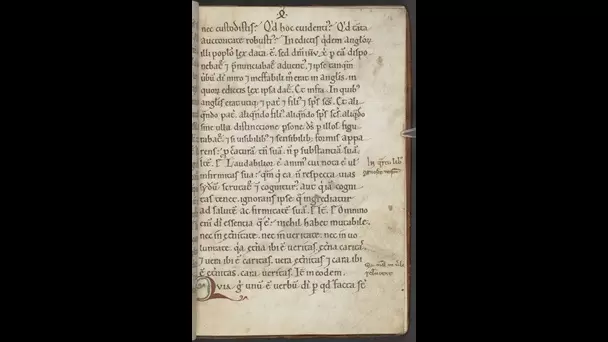
Text page from De Trinitiate (On the Trinity) (British Library, Egerton MS 3721, f. 16r)
Usage terms Public Domain in most countries other than the UK.
The De Trinitate text in this volume has paragraph numbers and notes in some parts, indicating regular use. It ends abruptly on the recto of the last folio, part way through book 15 (of 28 books in total), and an unusual poem on the colours of the 12 precious stones forming the Heavenly Jerusalem has been added. This suggests that the book could have been used at one time by an individual who added a favourite meditative text at the end, though there is no indication why the St Augustine text was not completed.
Centuries before the Norman era and the Benedictine reform, patristic texts were already key components of libraries on either side of the Channel, and books are known to have travelled between Britain and the Continent, where they were used as exemplars for copying in a leading religious institution like Cluny in central France. The foundations of what was to become one of the most important libraries in Europe were laid soon after it was established in 910. A catalogue of books circa 1100 lists 570 volumes, and a significant number of these contained patristic texts. In the latter part of the 10th century, Abbot Majolus of Cluny (r. 956–994) copied a collection of St Augustine’s works, now British Library, Add MS 11873. This manuscript was listed in a mid-12th century catalogue of Cluny manuscripts and probably remained there until the dispersal of the library in the 18th century, when it was acquired by an English collector.
Decorated volume of St Augustine’s writings

A large initial with knot-work decoration at the beginning of a 10th-century copy De Doctrina Cristiana (On Christian Doctrine), from Cluny (British Library, Add MS 11873, f. 59r)
Usage terms Public Domain in most countries other than the UK.
Works of St Ambrose
St Ambrose, a powerful political figure in imperial Milan, became bishop in 373. His deep spirituality and oratorical skill made him one of the greatest preachers of the early Church, and his Christian writings in the classical tradition were aimed at educated Roman citizens. He composed two of the first great theological works written in Latin, De Sacramentis (On the Sacraments) and De Spiritu Sancto (On the Holy Spirit), as well as numerous sermons and treatises on the spiritual life and the moral obligations of the clergy.
Seven of St Ambrose’s works have been compiled in a volume that was copied in the latter part of the 11th century in two Norman abbeys, both part of the province of Rouen but separated by more than two days’ walk.
Collection of works by St Ambrose
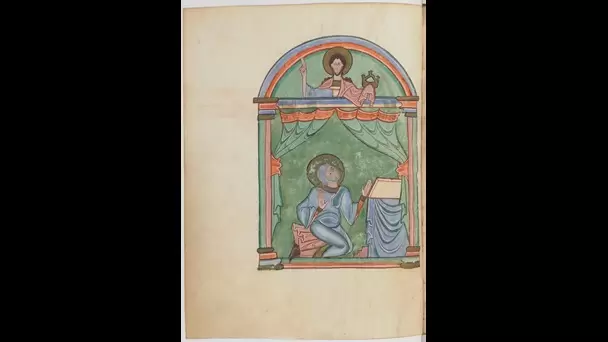
St Ambrose receiving Christ’s benediction at the beginning of De bono mortis (On a good death) (BnF Latin 2639, f. 31v)
Usage terms Public Domain
The first part, with the sermon De bono mortis (On a good death), was made and decorated in the Abbey of Mont-Saint-Michel (BnF Latin 2639, ff. 31-54). It has an image of St Ambrose kneeling before an altar, receiving Christ’s benediction and an initial with plant and animal motifs, by an artist of Mont-Saint-Michel.
Shortly afterwards, six additional texts, were added by Antonius, a monk of the Abbaye de la Trinité, Fécamp, who also made corrections to the earlier part. At the end of the 12th century the volume was listed in the Fécamp catalogue. The two houses had close links: William of Volpiano, who had established Fécamp Abbey, designed the Romanesque church of Mont-Saint-Michel in the 1060s.
Collection of works by St Ambrose
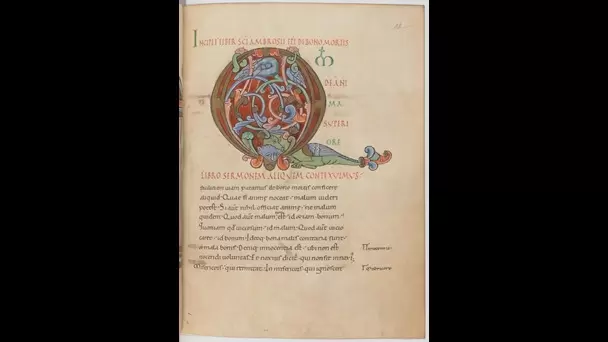
An initial with plant and animal motifs at the beginning of De bono mortis (On a good death) (BnF Latin 2639, f. 32r)
Usage terms Public Domain
Works of St Jerome
St Jerome’s greatest work, the Latin translation of the Vulgate Bible, became the fundamental Christian text throughout the medieval and early modern periods. St Jerome was also a prodigious translator of earlier authors such as Origen (b. c. 184, d. c. 253) and Eusebius (b. c. 263, d. c. 340) and produced a large body of homilies and commentaries as well as letters, many addressed to St Paula (b. 347, d. 404), with whom he founded a double monastery for monks and nuns in Bethlehem in the late fourth century.
The Abbey of St Peter, Corbie was founded by Bathilde (b. c. 626, d. 680), the widow of Clovis II (r. 639–657) in c. 660. It was an important centre of copying in the distinctive Corbie script in Charlemagne’s empire (r. 768–814). By the mid-12th century it had become less influential than the larger abbey of Cluny, but manuscripts were still being produced there, some by a scribe and illuminator known as Ingelrannus, who is known for his initials with elaborate decoration. This volume contains St Jerome’s commentary on Ecclesiastes, followed by his translations of works by Origen, and has a 12th-century ownership inscription of Corbie Abbey.
St Jerome, Commentary on Ecclesiastes and Translations of Origen

Ivo of Corbie at the feet of St Jerome, with St Paula and Eustochium (BnF, Latin 13350 f. Bv)
Usage terms Public Domain
In a full-page miniature preceding the text, Ivo, the presbiter or monastic priest, of Corbie and the commissioner of the book, is shown prostrated at the feet of St Jerome, who is seated at his desk with St Paula, and her daughter, Eustochium (b. c. 368, d. c. 419), on either side of him. This image is perhaps a homage to Bathilde, founder of Corbie, who was closely associated with Luxeuil and Chelles, two double houses (for men and women) in northern France.
Works of Gregory the Great
Pope Gregory I was a reformer of the early Church who sent missionaries to convert the pagans of Northern Europe, including the Anglo-Saxons. His writings offered practical wisdom for medieval Christians and were popular and influential, particularly his Curia pastoralis (Pastoral care), a guide for rulers, and his Moralia in Job (Commentary on Job), a work of moral theology. The evidence of Anglo-Saxon book collections, though sparse, points to Gregory, along with Isidore of Seville (b. 560, d. 636), as by far the most popular authors.
St Gregory’s works were still widely copied in the 12th century, including a two-volume set of the Moralia in Job from the library of St Andrew, Rochester, a Benedictine cathedral priory. The ‘Textus Roffensis’ from c. 1123, one of the earliest English library catalogues, contains 93 volumes, including this work, listed as no 45.
St Gregory the Great, Moralia in Job
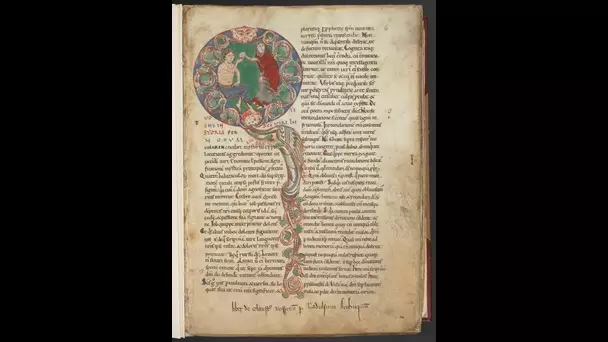
An initial with Job on the dunghill and ownership inscription at the beginning of the Moralia in Job (Commentary on Job) (British Library, Royal 6 C VI, f. 6r)
Usage terms Public Domain in most countries other than the UK.
The second in a two-volume set (British Library, Royal MS 6 C VI) contains the latter part of the Moralia, followed by the notes of Lanfranc who came from Bec in Normandy to be archbishop of Canterbury in 1070. An inscription provides important information as to how this work entered the Rochester library: it was donated by Ralph d’Escures, Bishop of Rochester from 1108 to 1114 and afterwards Archbishop of Canterbury. In the 14th century the Rochester ownership inscription Liber de Claustro Roffensis (‘Book of Rochester Priory’) was written on the first page of the Moralia beneath a large initial containing an image of Job on the dunghill, one of three decorated in a Rochester style, but with Norman influence.
As some of the most important works copied and owned by medieval monastic institutions, these books provide evidence of the shared leadership, liturgy, art and intellectual life of communities on both sides of the Channel.
Further Reading
The Cambridge History of Libraries in Britain and Ireland: Volume 1, to 1640, ed. by Elisabeth Leedham-Green and Teresa Webber (Cambridge: Cambridge University Press, 2006).
The Cambridge History of the Book in Britain, Volume I, c. 400-1100, ed. by Richard Gameson (Cambridge: Cambridge University Press, 2012).
Helmut Gneuss, Books and Libraries in Early England (Ashgate: Variorum, 1996).
English Benedictine libraries: the shorter catalogues, ed. by Richard Sharpe, 3 vols (London: British Library, 1996).
Rodney M. Thomson, Manuscripts from St Albans Abbey 1066-1235 (Woodbridge: Brewer, 1982).
Geneviève Nortier, Les bibliothèques médiévales des abbayes bénédictines de Normandie, Nouvelle édition (Paris : Éditions P. Lethielleux, 1971).
Written by Chantry Westwell
Chantry Westwell completed her undergraduate studies in modern languages at the University of Cape Town, followed by postgraduate studies in Linguistics at Ohio State University and in Medieval Studies, specialising in Old French and Old English, at University College London. She has a particular interest in Anglo-Norman and romance manuscripts and works as a volunteer cataloguer of medieval manuscripts at the British Library. She is originally from Zimbabwe. https://www.bl.uk/medieval-english-french-manuscripts/articles/works-of-the-church-fathers
Sixth-century manuscript of Augustine identified by the CATENA Project Fragments from a sixth-century manuscript of Augustine in Cambridge University Library have been identified for the first time by the ERC-funded CATENA project at the University of Birmingham https://www.birmingham.ac.uk/news-archive/2020/sixth-century-manuscript-of-augustine-identified-by-the-catena-project
Bard
Sure, here are some of the earliest manuscripts of other church fathers:
- Origen of Alexandria:
- A fragment of the Commentary on John from the 4th century AD, now held by the Chester Beatty Library in Dublin.
- A fragment of the Commentary on Matthew from the 5th century AD, now held by the Vatican Library in Rome.
- Jerome of Stridonium:
- A manuscript of the Vulgate Bible from the 5th century AD, now held by the Biblioteca Apostolica Vaticana in Rome.
- A manuscript of the Commentary on Isaiah from the 6th century AD, now held by the Bodleian Library in Oxford.
- John Chrysostom:
- A manuscript of the Homilies on Matthew from the 6th century AD, now held by the Morgan Library & Museum in New York City.
- A manuscript of the Homilies on the Pauline Epistles from the 7th century AD, now held by the Bibliothèque nationale de France in Paris.
- Cyril of Alexandria:
- A manuscript of the Commentary on the Gospel of John from the 6th century AD, now held by the Vatican Library in Rome.
- A manuscript of the Dialogue on the Trinity from the 7th century AD, now held by the University of Cambridge Library.
These are just a few examples of the earliest manuscripts of other church fathers. There are many other manuscripts that have been preserved, and scholars are constantly discovering new ones. These manuscripts are invaluable resources for the study of early Christianity, and they provide us with a glimpse into the thought and life of the early church.
Codex Ephraemi Rescriptus (5th century AD): A palimpsest, which means that it is a manuscript that has been reused by writing over the original text. The original text is a Greek manuscript of the Bible, and the overwritten text is a Syriac manuscript of the works of Ephrem the Syrian.
Codex Alexandrinus (5th century AD): A Greek manuscript of the Bible, it contains the works of the church fathers Origen, Eusebius of Caesarea, and Cyril of Jerusalem
Codex Bezae (6th century AD): A bilingual manuscript, which means that it contains the text of the Bible in both Greek and Latin. It contains the works of the church fathers Jerome and Augustine of Hippo
Codex Claromontanus (6th century AD): A Greek manuscript of the Pauline epistles, it contains the works of the church fathers Chrysostom and Theodoret of Cyrus
Codex Boernerianus (9th century AD): A Latin manuscript of the Bible, it contains the works of the church fathers Ambrose of Milan and Jerome.
Cgpt
Certainly, here is a list of some early Church Fathers along with their significant manuscripts:
- Ignatius of Antioch: His letters are found in the Ante-Nicene Fathers collection, and some of the earliest manuscripts include the Vossianus Latinus, Codex Mediceus, and Codex Colbertinus.
- Clement of Rome: His Epistle to the Corinthians is found in early manuscripts like Codex Alexandrinus and Codex Hierosolymitanus.
- Polycarp: His Letter to the Philippians survives in several manuscripts, with the earliest being the Codex Mediolanensis.
- Justin Martyr: His works are preserved in various manuscripts, such as the Parisinus Graecus, the Bodleianus Barocci, and the Codex Patmiacus.
- Irenaeus of Lyons: His “Against Heresies” is preserved in manuscripts like Codex Agobardinus and Codex Claromontanus.
- Tertullian: His writings are found in manuscripts like the Codex Agobardinus and the Codex Lugdunensis.
- Origen: Some of his works are available in manuscripts like the Codex Parisinus Graecus and the Codex Vaticanus Graecus.
- Cyprian of Carthage: His letters are preserved in various manuscripts, including the Codex Fuldensis and the Codex Palatinus.
- Augustine of Hippo: His numerous works are present in manuscripts like the Codex Augustinianus and the Codex Corbeiensis.
Please note that the availability of manuscripts might vary, and new discoveries could have emerged since my last knowledge update in September 2021. Always refer to the latest scholarly sources for the most accurate and up-to-date information.
Of course, here’s a longer list of early Church Fathers along with significant manuscripts associated with their works:
- Clement of Rome: Manuscripts include Codex Alexandrinus, Codex Hierosolymitanus, and Codex Claromontanus.
- Ignatius of Antioch: Notable manuscripts include Vossianus Latinus, Codex Mediceus, and Codex Colbertinus.
- Polycarp: Early manuscripts include Codex Mediolanensis, Codex Vaticanus Graecus, and Codex Nitriensis.
- Justin Martyr: Works preserved in Parisinus Graecus, Bodleianus Barocci, Codex Patmiacus, and Codex Bodmer.
- Irenaeus of Lyons: “Against Heresies” found in manuscripts like Codex Agobardinus, Codex Claromontanus, and Codex Sangermanensis.
- Tertullian: Manuscripts include Codex Agobardinus, Codex Lugdunensis, Codex Floriacensis, and Codex Sangallensis.
- Origen: Some works in Codex Parisinus Graecus, Codex Vaticanus Graecus, Codex Taurinensis, and Codex Sinaiticus.
- Cyprian of Carthage: Letters preserved in Codex Fuldensis, Codex Palatinus, Codex Toletanus, and Codex Oxoniensis.
- Clement of Alexandria: Notable manuscripts are Codex Alexandrinus, Codex Hierosolymitanus, and Codex Taurinensis.
- Hippolytus of Rome: Some works found in Bodleianus Barocci, Codex Patmiacus, and Codex Pseudo-Tertullian.
- Athanasius of Alexandria: Significant manuscripts include Codex Alexandrinus, Codex Sinaiticus, and Codex Vaticanus Graecus.
- Basil the Great: Works are preserved in Codex Parisinus Graecus, Codex Vaticanus Graecus, and Codex Monacensis.
- Gregory of Nazianzus: Manuscripts include Codex Parisinus Graecus, Codex Vaticanus Graecus, and Codex Monacensis.
- Gregory of Nyssa: Works found in Codex Parisinus Graecus, Codex Vaticanus Graecus, and Codex Monacensis.
- John Chrysostom: Notable manuscripts are Codex Parisinus Graecus, Codex Vaticanus Graecus, Codex Monacensis, and Codex Ravennas.
- Jerome: “Vulgate” translation preserved in Codex Amiatinus, Codex Fuldensis, and Codex Toletanus.
- Augustine of Hippo: Extensive works in Codex Augustinianus, Codex Corbeiensis, and Codex Sangallensis.
- John Cassian: Some manuscripts include Codex Regius, Codex Sangermanensis, and Codex Lugdunensis.
- Leo the Great: Works found in Codex Monacensis, Codex Vaticanus, and Codex Turonensis.
- Isidore of Seville: Manuscripts include Codex Sangallensis, Codex Toletanus, and Codex Isidorianus.
- Maximus the Confessor: Some works found in Codex Vaticanus Graecus, Codex Parisinus Graecus, and Codex Monacensis.
- Dionysius the Areopagite: Manuscripts include Codex Parisinus Graecus and Codex Vaticanus Graecus.
Please be aware that this list is extensive but not exhaustive, and manuscript availability may vary. To access the most accurate and up-to-date information, consult scholarly resources and collections of early Christian writings.
REVIEW https://www.churchfathers.org/
Sharing is caringFacebookX / TwitterLinkedInWhatsAppTelegramRedditEmail5492 words · 145 views