

What can we learn from this manuscript?
One thing we can learn from 2437 is that it is potentially very helpful to have digital reproductions of manuscripts. This manuscript is housed in Rio de Janeiro
, Brazil
, and there was recently a terrible fire at the National Museum in which over three-fourths of the 20 milllion items in the museum’s collections were lost. Fortunately 2437 was housed elsewhere in Rio de Janeiro
(at the National Library), but the tragic fire nearby serves as a reminder that digital reproductions can ensure that the manuscript-evidence is disaster-proof.

Another thing we can learn from 2437 is that many Byzantine manuscripts of the Gospels contain some liturgical expansions. Exhibit A in this regard is in Luke 14:24. The main text of the Robinson-Pierpont Byzantine Textform contains an extra phrase at the end of Luke 14:24: “for many are called, but few are chosen” – the same words found in Matthew 22:14. A hyphen in the margin of RP2005 conveys that this phrase is not in a significant portion of Byzantine manuscripts. The Textus Receptus does not have this phrase in Luke 14:24, and thus the KJV and NKJV do not have it either. The family-35 archetype reconstructed by Wilbur Pickering does not have it; neither does the Hodges-Farstad Majority Text (1982).
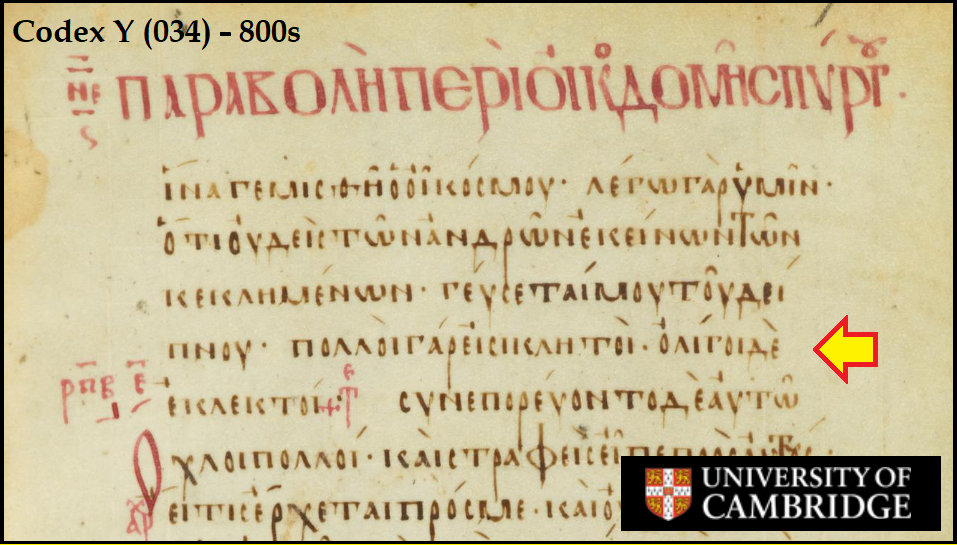
2437 provides evidence of how this phrase entered the text of Luke 14:24: it was used as a liturgical flourish at the end of a lection. The main text of Luke 14:24 in 2437 does not contain the phrase, but it is written in the margin – in red, as part of the lectionary apparatus, instructing the lector about how to finish the lection. A similar marginal note appears in Codex S, also in red: “for many are called.” This illustrates how this phrase entered the text – not just in relatively young manuscripts, but also in earlier manuscripts such as Codex Y (034), from the 800s.
A takeaway from this should be that when we find short phrases in some manuscripts that are absent from other manuscripts, we should ask if the phrase appears at the end of a lection, and if it could be used as a concluding flourish for a lection – and if the answers are“Yes,” then that is a strong indication of the origin of the phrase. It ought to be noted that this accretion is supported by family-13 manuscripts, indicating that the form of text in family-13 is essentially a text that was prepared as a sort of liturgical hybrid: a Gospels-text edited to facilitate the needs of lectors.
Similarly, 2437 shows how accretions occasionally slipped into the text at the beginnings of lections. In Luke 7:31, the Byzantine Text does not have the phrase “And the Lord said,” but the Textus Receptus does. These words originated not with Saint Luke but as an incipit, or introductory phrase for lection-reading, which can be seen in 2437, in red (as part of the lectionary apparatus) in an abbreviated form, between Luke 7:30 and 7:31.

A third lesson from 2437 is that even the most ordinary-seeming manuscript can have surprising and unusual readings. Taking in hand the UBS Greek New Testament, and turning to Matthew 22-27, there are hardly any contests in the textual apparatus in which 2437 does not agree with the Byzantine text. Exceptions, however, include a variant-unit in 24:31, where 2437 agrees with the unusual reading in Codex Bezae (and 1241 and the Vulgate and most Old Latin witnesses) – the equivalent of “with a trumpet and a loud voice” instead of “with a great voice of a trumpet.”
Even more remarkable is a variant in Matthew 27:49, where 2437 agrees (mostly) with the fourth-century Alexandrian codices Vaticanus and Sinaiticus (and Codex Regius) by including a statement at the end of the verse that someone came and took a spear and pierced His side, and water and blood came out. In Codex Vaticanus the reading is as follows: αλλος δε λαβων λογχην ενυξεν αυτου την πλευραν και εξηλθεν ϋδωρ και αιμα.
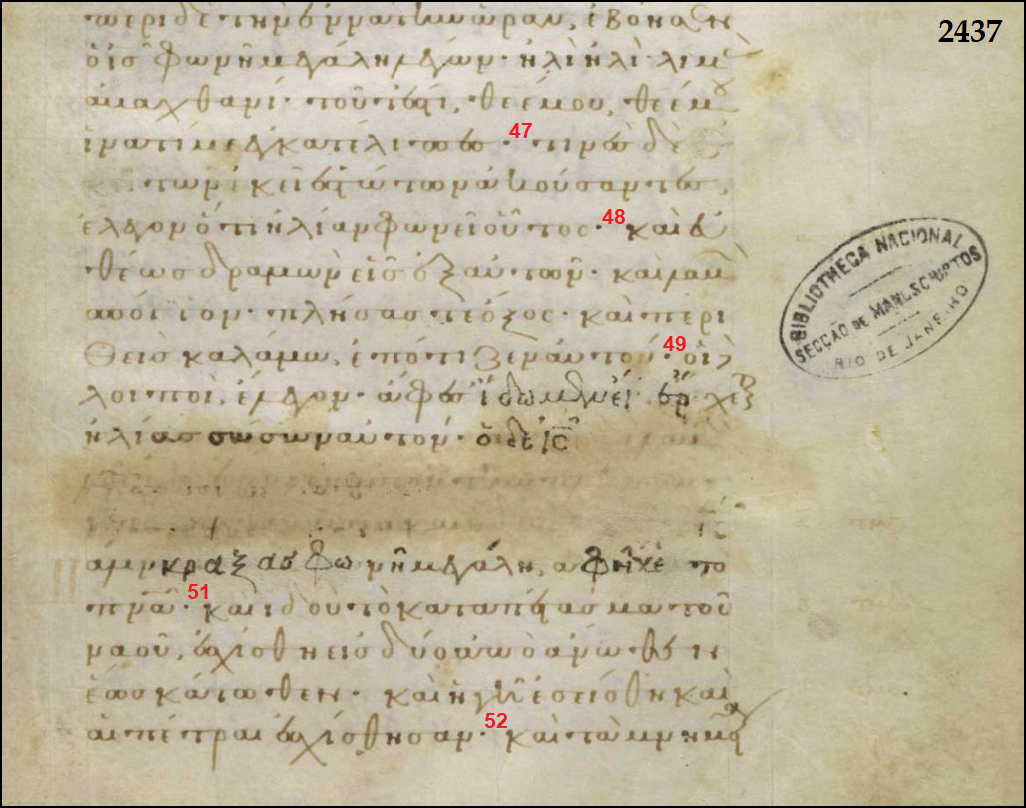
2437 is one of thirty-five Greek manuscripts which have (or had) this unusual reading in Matthew 27:49. (See Dirk Jongkind’s data for a complete list.) In addition to those witnesses, the testimony of Codex Y should not be overlooked; while it does not have this variant in its text, it has a red wavy obelus (~ with a dot above and below the ~ ) between the end of Matthew 27:49 and the beginning of 27:50; the same symbol appears in the inner margin.
This reading is remarkable for several reasons. Perhaps the paramount reason is that although it is supported by two manuscripts (Vaticanus and Sinaiticus) that are often referred to as our “most reliable” manuscripts, if it were to be included in the text, it would form a contradiction with the parallel-passage in John 19 by stating that Jesus was pierced before He died; John’s account specifies that Jesus’ body was pierced, and that blood and water flowed from the wound, after He was dead.
It is no surprise that there is no footnote about this reading in the Christian Standard Bible and the English Standard Bible, for their publishers probably did not want to bear the burden of telling their evangelical customers that if their two “oldest and most reliable” manuscripts were consistently followed – the two manuscripts which steered the compilation of their base-text to a large extent – their text would not be inerrant.
Another reason why this reading is interesting is that Severus of Antioch, a patristic writer in the first half of the 500s, commented about it in his Epistle 107, written to Thomas, another bishop. In his younger days, Severus had studied in Alexandria, Egypt, and this may explain why he was aware of this reading, about which he wrote along these lines:
“The holy evangelist John, and no one else, recorded that our Lord Jesus Christ was pierced in the side with a lance by a soldier, after He gave up the ghost, and blood and water came forth from it in a miraculous manner. But certain persons have clearly falsified the Gospel of Matthew and inserted this very passage, when the contrary is the fact, in order to show that it was while He was alive that the soldier pierced His side with the spear, and afterwards He gave up the ghost.”
Severus continues on this subject for several paragraphs, mentioning at one point that the question about whether this passage belongs in Matthew or not was resolved via a consultation of a copy of the Gospel of Matthew – perhaps the autograph is intended to be meant – which was (according to Severus) found in the tomb of Saint Barnabas; this volume, stored in the royal palace in Constantinople, was examined and found to not contain the passage in Matthew.
Severus proceeds to raise a question about John Chrysostom’s treatment of Matthew 27:49-50 in Chrysostom’s Homily 88 on Matthew, a text which is still extant. Chrysostom (c. 400) cited Matthew 27:49 and included the reading about another coming to Jesus and piercing His side with a spear – but then Chrysostom affirmed that Jesus was dead when he was struck. No wonder Severus was puzzled.
More of Severus’ comments, and some additional information about this variant, can be found in Wieland Willker’s Textual Commentary on the Greek Gospels. One point worth special notice is that Eusebius of Caesarea included John 19:34 in the tenth list of passages in his Canon Tables, and the tenth list was reserved for material found in only one Gospel – which clearly implies that Eusebius did not find the passage about Jesus being struck with a spear anywhere but in the Gospel of John. (This reduces the plausibility of the theory that Eusebius was directly involved with the production of Vaticanus and/or Sinaiticus.)
In 2437, the text of the Alexandrian reading occupied three lines when the manuscript was produced, but the text there has been erased. Enough traces of the writing have survived, however, not only to confirm that it is the same variant, but that in 2437, the phrase ended with “blood and water” (as in John 19:34) rather than “water and blood.”
Hort, one of the scholars who prepared the 1881 revised text, studied this reading, and called it a corruption, but he favored agreements of Vaticanus and Sinaiticus so much that he kept it in the main text, within double-brackets. Hort categorized this reading – or rather, the non-inclusion of this reading – as a “Western Non-interpolation” – that is, as an interpolation found in all early forms of text except the Western Text. Thanks largely to the discovery of Papyrus 75, the collection of verses and phrases in Luke 24 which Hort considered spurious – favoring the shorter Western variants at those points (some of which were also missing in the Revised Standard Version) have been restored to the text. This reading in Matthew, however, has not been adopted, and it is rare to find a modern version that even mentions it in a footnote (the NRSV and the NET being two exceptions.) The recently published Tyndale House edition of the Greek New Testament does not acknowledge its existence at all.
| An annotation in the margin of minuscule 72, alongside Matthew 27:48-50. |

John Burgon also gave this reading some attention, and the results of his research can be found in Appendix H of his 1871 book The Last Twelve Verses of Mark. He concluded that the variant is probably an extract from Tatian’s Diatessaron (a continuous combination of the four Gospels, produced in the 170s). Evidence for this position may be found in a margin-note in manuscript 72 which states that “In the Gospel account, according to a report of Diodorus and Tatian and assorted other holy fathers, this is also there: “Another came with a spear and pierced His side, and there came forth water and blood.” This is also said by Chrysostom.”
Another possibility exists. Just as some marginal notes in 2437 related to liturgical Scripture-reading are formatted as part of the text in other manuscripts, the phrase “And another came with a spear and pierced His side, and there came forth water and blood” may have stood as a marginal note in an early lector’s copy – not with the intention that the phrase should be added after Matthew 27:49, but as a signal to the lector that in the annual Scripture-readings on Good Friday, the lector was to turn to the excerpt in John in which this occurred – that is, the lector was to stop reading from Matthew 27 at this point, and continue the narrative by turning to John 19:31-35 (or 19:31-37).
In other words, this variant originated as the equivalent of an early chapter-title in the margin, rather than as something intended to be inserted in the text. The surprising thing is not that it entered the Alexandrian Text (in much the same way that the accretions in Luke 14:24 and 14:31 entered many Byzantine copies), but that it was replicated in some Old Latin copies (echoed by extant Latin copies such as the Garland of Howth, the Book of Mulling, the Book of Armagh, and the Book of Kells (all with the word-order “water and blood” at the end), in the Middle Egyptian version, and in over two dozen Byzantine manuscripts such as 2437.
In closing, I wish to briefly delve into what may seem to be a tangential subject: lection-divisions in the closing chapters of the Gospel of John. If this allows readers to decipher the marginalia which appears in 2437 in those chapters, in addition to illustrating a theory about the possible origin of the variant in Matthew 27:49, this scenic detour will be time well spent.
The Byzantine chapters in John are much fewer than in the other three Gospels, being only 18 in number (or 19, with the story of the adulteress listed as a chapter). The last chapter begins at John 19:38, and the next-to-last chapter begins at 15:26. But one also finds marks and marginal notes designating smaller segments of the text: lections which were read especially at Eastertime. In 2437, in addition to faint marks identifying John 15:26 as the beginning of chapter 17, and John 19:38 as the beginning of chapter 18, there are designations for the beginnings of lections (or portions of lections) at the following points:
● in John 16:2, where the mark ⁜ appears (= lection for the Tuesday of the seventh week after Easter),
● before John 16:15 (= lection for the Wednesday of the seventh week after Easter),
● in John 16:23 (= lection for the Thursday of the seventh week after Easter),
● in 17:1 (= lection for the seventh Sunday after Easter),
● at the beginning of 18:28 (= first segment of the Gospels-lection for the ninth hour of Good Friday),
● at 19:20 (= lection for the second hour of Good Friday),
● 19:25 – archou (“Resume”) (= first segment of the lection for the ninth hour of Good Friday),
● 19:31 – archou (“Resume”). (= second segment of the lection for the ninth hour of Good Friday),
● 19:38 (= the beginning of chapter 18, and the fourth in a series of lections (Matthew 27:1-38 + Luke 23:39-43 + Matthew 27:39-54 + John 19:31-37 + Matthew 27:55-61 + First Corinthians 1:18-2:1) in the liturgy for Good Friday).
The arrangement of the series of lections in the liturgy for Good Friday – in which John 19:31-37 is flanked by passages from Matthew 27 – probably resembles, approximately, the kind of liturgical arrangement which was expressed in the marginal note that found its way into an ancestor of 2437. (It could feasibly have been modeled on Tatian’s Diatessaron, which would explain, at least in part, the annotation in 72.) Such a note could not possibly reach Vaticanus, Sinaiticus, the Middle Egyptian version (as represented by Codex Schøyen 2650, from the 300s), the copies mentioned by Severus, several important Latin Gospels-manuscripts, and the ancestor of over two dozen Byzantine manuscripts (such as 2437) unless somewhere in their ancestry their texts were all influenced by the early introduction of the same (or very similar) notations which expressed the arrangement of text-segments to be read on Good Friday. This implies that at some point in the 100s, or the early 200s at the latest, a reading-cycle for major Christian feast-days existed; its influence was widespread, and, where it was not understood by copyists, it was capable of impacting the Gospels-text.
Readers are encouraged to explore the embedded links for additional resources.

“A Syriac inscription is found on the tomb of Queen Helena of Adiabene, who was buried in Jerusalem.”
Helena de Adiabene fue reina de Adiabene y esposa de Monobaz I. Con él tuvo a Izates II y Monobaz II. Murió alrededor del 56 d. C. El hecho de que fuera hermana de su marido[1] indica que era de origen helénico. Helena se convirtió al judaísmo hacia el año 30 d. C.
Josephus, “Ant.” xx. 2, § 1.
REVIEW https://www.torahapologetics.com/language–word-studies/aramaic-primacy-of-the-new-testament
Shepherd teacher John 20:16 syriac
Saying because Yeshua spoke Aramaic that it must have been written in Aramaic would be like saying because Abraham grew up in Ur of the Chaldeans, everything about him must have been written in Chaldean (Aramaic). But that is not the case. Moses wrote Genesis in Hebrew.
That is nonsense. No body is saying that.
Jerusalem Talmud, Sotah 7.2, which says, “Let not the Aramaic be esteemed by you lightly my son; as the Holy One, blessed be He, has seen fit to give it voice in the Torah and the Prophets and the Writings.”
Syriac and Galilean Aramaic
Standard Hebrew Ashuri script
Matthew 19:24 – “Again I say to you, it is easier for a camel to go through the eye of a needle, than for a rich man to enter the Kingdom of Elohim.”
[Some] state that the word in Aramaic for “camel” is גמלא (gamala), which is spelled the same way in Aramaic as the word gamla, which means “thick rope.” Thus, the translation should not be “camel” but rather “thick rope.” This would imply that only after a careful process of “unraveling” all the threads that keep a rich man tied down can the strands fit through the eye of the needle. Therefore, they say, the idiom makes sense.
Well, as mentioned, in Syriac it could simply say “thick rope” rather than “camel” as the word גמלא could mean either, depending on the vowels. APs say that since the vowels were added later, many years after the texts were first penned, it originally read “thick rope” but then was later altered by scribal error. Then, when the Greek was translated from Syriac, it contained the same error.
Well it should be pointed out that yes, this is surely a possibility. The two words gamla and gamala are spelled the same way in Syriac. However, what is the issue with it being a camel?
The Talmud contains the following statement, in an attempt to explain that dreams reveal the thoughts of a man’s heart: “They do not show a man a palm tree of gold, nor an elephant going through the eye of a needle.”
This statement is found in the Babylonian Talmud (Berakhot 55b). This, too, seems odd, yet the analogy should be very clear: a giant animal cannot fit through the eye of a needle. It is just that simple. Yeshua was not giving them some impossible parable; He was drawing on something they obviously understood culturally. What is more, is that if the statement was meant to be understood as a thick rope, then we have another issue in reconciling the next 2 verses. The disciples wonder, “who then can be saved?” and Yeshua says, “with men, this is impossible.”
The understanding of this verse is not, “unravel each strand of rope, symbolizing that you can untangle yourself from the worries and riches of the world, and then you can do it.” The understanding is, “YOU can’t do it. At all. Period.” That’s the point. Only God can do it. The reason a camel is used is because it was the largest domestic animal in Judea at that time. In the Babylonian Talmud, for the Jews that lived in Babylonia (Persia), the elephant was the largest domestic animal, and thus the elephant served as a better representation of a large creature.
The Babylonian Talmud applies the aphorism to unthinkable thoughts. To explain that dreams reveal the thoughts of a man’s heart and are the product of reason rather than the absence of it, some rabbis say:
They do not show a man a palm tree of gold, nor an elephant going through the eye of a needle.[2]
A midrash on the Song of Songs uses the phrase to speak of God’s willingness and ability beyond comparison to accomplish the salvation of a sinner:
The Holy One said, open for me a door as big as a needle’s eye and I will open for you a door through which may enter tents and camels.[3]
- B.T. Berakhot 55b
- ^ Jump up to:a b “‘The camel and the eye of the needle’, Matthew 19:24, Mark 10:25, Luke 18:25”. Hebrew New Testament Studies. Retrieved 21 June 2011.
REVIEW Remember that one thing textual critics have found is that scribes always tried to harmonize the gospel accounts. That is why in so many manuscripts we have phrases from John that appear in Matthew, and phrases from Matthew that appear in Luke, and so on. Scribes felt the need, in many cases, to harmonize the gospels by adding and removing words and even whole sections. A great example of this IN SYRIAC was the Diatessaron by Tatian, which included the four gospels all harmonized together.
Next let’s look at a number of phrases found in the Greek text, that are themselves Aramaic in origin. Then we’ll go back and dive deeper into our examples from Matthew.
It should also be noted that when quoting from the “Aramaic NT” it will taken as quotes from the Syriac Aramaic Peshitta, as it is the only dialect of Aramaic that contains the entire NT.
Wrong. There is a nonsyriac aramaic peshitta
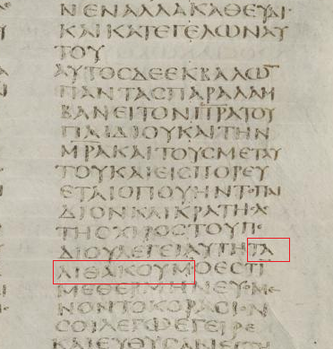
Talitha kum. Mark 5:41 And taking the hand of the child, He said to her, “Talitha kum”, which translates as, “Little girl, I say to you, get up.” [The image above is a photo of the Greek Codex Sinaiticus. The highlighted sections in red read, ΤΑΛΙΘΑΚΟΥΜ, or, “talitha koum.”
Ephphatha. Mark 7:34 And looking up to heaven, He sighed and said to him, “Ephphatha,” which is ‘be opened.’
Raca. Matthew 5:22 But I say unto you, That whosoever is angry with his brother shall be in danger of the judgment: and whosoever shall say to his brother, Raca, shall be in danger of the council.
Boanerges. Mark 3:17 and James, the son of Zebedee, and John the brother of James (to them He gave the name Boanerges, which means, “Sons of Thunder”);
These phrases are written even in the Greek text. Surely this proves that there is significant Aramaic influence in the Greek. The Greek equivalents of these words are completely different, so if the NT was originally Greek, we should expect some original Greek phrases, right?
Matthew 1: Peshitta Primacists will tell you that Matthew 1:16 does not state that Joseph was the husband of Mary, but rather that Joseph was Mary’s father. This would mean that Joseph was the name of her husband, as well as the name of her father. This, then, clears up the issue with needed 14 generations, as Joseph would be 12th, Mary 13th, and Yeshua 14th. So why does it read, “husband” then? Well in Greek, the word used is ανερ (aner) which literally just means “man; male.” When used in the possessive form (that is, “my man” or “Mary’s man”) it means “husband.” In Hebrew, Aramaic, Greek, and numerous other ancient languages, there is no separate word for “husband” and “wife” than from “man” and “woman.” In Hebrew, the word איש (ish) means “man” but אישי (Ishi) means “my man.” Thus it is taken to mean “husband.” The same goes for Greek.
But in the Peshitta, it does not use the standard word for “husband” or “my man.” Rather, it uses גברה (gowrah) which is usually defined as “man; male.” This is sometimes used as “husband” and sometimes as “father” (as it appears in Matt. 7:9). So the Aramaic Primacist (AP) states that this, then, solves the problem. While Greek is very ambiguous and, indeed, contradictory, Aramaic clears it up. Joseph was the name of Mary’s father, as well as her husband. This gives us 14 generations, and it means that Luke gives Joseph’s genealogy, whereas Matthew gives Mary’s. But there’s a problem with that.
For starters, if it meant to say Joseph was Mary’s father, why does it not say that Joseph was the אב (av) of Mary? Why not say that Joseph “begat” (Syr.: ילד) Mary, as it does in the rest of the chapter? Why interrupt the entire flow of the verse (and the preceding 15 verses) to completely change gears mid-sentence? If it were meant to be understood as “father” we would expect the sentence structure to remain the same, but it does not.
There is an explanation for it
Scribes had a tendency to add more than they did to remove (see Bruce Metzger’s book The Text of the New Testament: Its Transmission, Corruption, And Restoration.) This most often happened in an attempt at harmonization, but also in an attempt to give explanation.
REVIEW David Stern’s Jewish New Testament Commentary, he notes that at one time the scroll of the prophets began with Jeremiah. Thus when saying “Jeremiah,” Yeshua may have actually been referencing the entire scroll, which included multiple of the writings of the prophets.
REVIEW נמוסא
12-14-2007, 10:09 PM http://peshitta.org/for/showthread.php?tid=1342&pid=5893&highlight=nomos#pid5893
Hi Albion,
“Namusa” is an Aramaic word of Greek origin, long before Christianity arrived. The Greek word “Nomos” made it into several languages , like Arabic and even Mongolian … when Alexander conquered the east, lots of different languages absorbed many different loan-words from Greek.
The presence of loan-words in a document is a very weak evidence of what language it was composed in. Think of “Paradise” in the NT – Luke 23:43, for example. The word “Paradise” is a Persian loan-word in Aramaic (and, Greek for that matter)
Does that mean that Luke wrote in Persian?
The Greek NT is loaded, absolutely loaded, with Aramaic loan-words.
In and of itself the presence of loan-words means nothing when determining the original language.
BTW – the Mandeans of Iraq (pre-Christian Gnostics) also speak Aramaic to this day, and they use the word “Namusa.”
–
There are other Greek, and even Latin words, also used in the Peshitta. This does not, in and of itself, prove one is more original than the other. The Hebrew of the Tanakh actually uses some words that are neither Hebrew nor Aramaic, such as Akkadian and Egyptian (for example the word for “concubine” if one looks it up, will find that its origin is not Hebrew; the same for anokhi (“I”) that Adonai Himself uses many times). But that doesn’t mean the Torah was written in anything other than Hebrew.
Mark seems to have been written in greek
Now the APs have an answer for this, so to be fair I’ll give it here. You will find that in most other cases, such as “Talitha kum” and “ephphathah” it does not say “which means” or “which is translated as” or anything. However, we still have to wonder why it DOES give an explanation in Mark 15. So the APs say that it was going from one dialect, the spoken, to another dialect, the written, and thus the need for explanation. Because Eloi (or Eli) is Hebrew for “My God” whereas in Syriac the word is אלהי (Alahi). Note, too, that the people standing by thought He was calling for Eliyahu [Elijah]. This would be because, whatever He was speaking, it sounded similar to “Eliyah.” Well clearly, Eli sounds similar, though Alahi maybe not so much.
So even if we accept the answer that Mark was explaining what it meant in a different dialect, we have further evidence that what was spoken in Judea was not Syriac.
What? He was writing what Jesus said
ܟܐܦܐ • (transliteration needed) f (plural ܟܐܦܐ)
- rock, stone
- (figurative) anything made of stone; stone vessel, column, idol, precious stone
- hailstone
https://en.m.wiktionary.org/wiki/%DC%9F%DC%90%DC%A6%DC%90
Shlama akhi,
pointless assertion here. the reason being that the Aramaic is seamless in maintaining Keepha (Cephas) throughout the text, while the GNT manuscripts are all over the place. check it out:
in Galatians:
1:18 — KEEPHAN / PETRON
2:9 — KEEPHAS / PETROS
2:11 — KEEPHAS / PETROS
2:14 — KEEPHAS / PETRO
different Greek manuscripts contain the two conflicting names. why would anyone assert one over the other when the readings could be arbitrary? it makes no sense unless the Greek was merely a translation from the Aramaic, which is consistent throughout Galatians as to the identity being Keepha.
if you’d like the specific manuscripts i can give you the lists. kinda lengthy, but it may be needed to shut the mouth of someone promoting that silly idea.
Chayim b’Moshiach,
Jeremy
http://peshitta.org/for/showthread.php?tid=2817&pid=16507&highlight=Keepha#pid16507
Writings of the Church Fathers and the Original Language
I mentioned earlier that many people claim the early church fathers stated that Matthew was written in Aramaic. Let’s examine that claim now. Below are quotes used by APs.
“Matthew collected the oracles in the Aramaic language.” – Papias (150 CE – 170 CE)
“Matthew also issued a written Gospel among the Hebrews in their own language.” – Ireneus (170 CE)
“The first [Gospel] is written according to Matthew, the same that was once a tax collector, but afterwards an apostle of Jesus Christ, who having it published for the Jewish believers, wrote it in Aramaic.” – Origen (c. 220 CE)
“Matthew also, having first proclaimed the Gospel in Aramaic, when on the point of going also to the other nations, committed it to writing in his native tongue, and thus supplied the want of his presence to them by his writings.” – Eusebius (c. 315 CE)
“Pantaenus…penetrated as far as India, where it is reported that he found the Gospel according to Matthew, which had been delivered before his arrival to some who had the knowledge of Christ, to whom Bartholomew, one of the apostles, as it is said, had proclaimed, and left them the writing of Matthew in Aramaic letters.” – Eusebius (c. 315 CE)
“They [the Nazarenes] have the Gospel according to Matthew quite complete in Aramaic, for this Gospel is certainly still preserved among them as it was first written, in Aramaic letters.” – Epiphanius (370 CE)
“Matthew, who is also Levi, and from a tax collector came to be an apostle first of all evangelists composed a Gospel of Christ in Judea in the Aramaic language and letters, for the benefit of those of the circumcision who had believed; who translated it into Greek is not sufficiently ascertained. Furthermore, the Aramaic itself is preserved to this day in the library at Caesarea, which the martyr Pamphilus so diligently collected. I also was allowed by the Nazarenes who use this volume in the Syrian city of Berea to copy it. In which is to be remarked that, wherever the evangelist… makes use of the testimonies of the Old Testament, he does not follow the authority of the seventy translators [the Greek Septuagint], but that of the Aramaic.” – Jerome (382 CE)
Greek vs mt vs old testament peshita
Hebrews 10:5 is our first example. Now take a normal Bible (other than the ISR, HRV, or HRB) and look up Psalm 40:6. Now go to Hebrews 10:5. Notice the difference? Here they are from the NASB:
Psa. 40:6 (NASB95) – Sacrifice and meal offering You have not desired; My ears You have opened; Burnt offering and sin offering You have not required.
Heb. 10:5 (NASB95) – Therefore, when Christ came into the world, he said: “Sacrifice and offering you did not desire, but a body you prepared for me…”
Well that’s quite a difference, isn’t it? But here’s the verse from the LXX:
Psa. 40:6 (LXX in American English) – Sacrifice and offering you would not; but a body have you prepared me: whole burnt offering and sacrifice for sin you did not require.
So we can see that the NT book of Hebrews was not quoting the Hebrew Masoretic text, but what happened? Given that the author of Hebrews quoted the reading as it is found in the LXX, most likely the original Hebrew text read, “a body you have prepared for me” instead of “my ears you have opened.”
Now here’s the verse in the Peshitta OT:
Psa. 40:6 (Aramaic Bible in Plain English) – With sacrifices and with offerings you have not been pleased, but you have pierced the ears for me; burnt peace offerings for sin you have not requested.
And here it is from Hebrews.
Heb. 10:5 (Aramaic Bible in Plain English) – Because of this, when he entered the universe, he said, “Sacrifices and offerings you did not want, but you have clothed me with a body…”
So why does the Syriac Aramaic Peshitta NT quote the Greek Old Testament (LXX) and not the Peshitta Old Testament? Or even the Hebrew OT? You might say, “Well it is simply quoting the Hebrew original.” And you may be right, but let’s put that to the test by going further.
Acts 7:43 (NASB95) – You also took along the tabernacle of Moloch and the star of the god Rephan, the images which you made to worship. I also will remove you beyond Babylon.
This is a quote from Amos 5:26.
Amos 5:26 (NASB95) – You also carried along Sikkuth your king and Kiyyun, your images, the star of your gods which you made for yourselves.
Notice how different they are? The confusion here was caused by Moloch (in Hebrew, מלך mem-lamed-khaf), and the word for king (in Hebrew, מלך mem-lamed-kha), which is pronounced “Melekh.” The word Sikkuth is from sukkah, the root of Sukkot, meaning “booth” or “tent” or in some cases, “tabernacle.” Lastly, Kiyyun (or Chiun in the KJV) was regarded as a god comparable to Saturn. Here’s the verse from the LXX:
Amos 5:26 (LXX in American English) – Yes, you took up the tabernacle of Moloch, and the star of your god Raephan, the images of them which you made for yourselves.
When they translated “melekh” into Greek, it eventually came to be viewed as Moloch. Raephan is a Coptic (Egyptian) designation for the god Saturn, and thus it made sense to identify the god Saturn with an equivalent name.
So how does the Peshitta OT translate this?
Amos 5:26 (translation mine) – But you carried along the tent of Milkom, and Kewan, your images, the star of your gods which you made.
Here, the Peshitta translates ‘melekh’ as Milkom (another name for Moloch), transliterates the Hebrew Kiyyun as Kewan, and has nothing at all to do with the name Raephan as the LXX does. So what about the Peshitta NT?
Acts 7:43 – ‘But you carry the tabernacle of Malcom and the star of the god Rephan, images which you have made to worship. I shall remove you farther than Babel.’
See what it looks like here? Please note no Dead Sea Scroll has been discovered that contains these verses in Amos (parts of each chapter have been found, but none containing the verse in question), so verification there is not currently possible. Otherwise, with the evidence given, it again appears that the Peshitta NT is quoting the Greek. Let’s look at another.
9
Matthew 15:8-9 (NASB5) – This people honors Me with their lips, but their heart is far away from Me. But in vain do they worship Me, teaching as doctrines the precepts of men.
This is a quote from Isaiah.
Isaiah 29:13 (NASB) – Because this people draw near with their words, And honor Me with their lip service, But they remove their hearts far from Me, And their reverence for Me consists of tradition learned by rote.”
Here it is from the LXX:
Isa. 29:13 (LXX in AE) – This people draw near to me with their mouth, and they honor me with their lips, but their heart is far from me: but in vain do they worship me, teaching the commandments and doctrines of men.
Here it is from the Peshitta Tanakh:
Isa. 29:13 (translation mine) – This people draw near to Me with their mouth, and honor Me with their lips, but their heart is distant from Me; their fear of Me is a teaching taught by men.
And here it is from the Peshitta NT:
Mat. 15:8-9 (Aramaic Bible in Plain English) – This people is honouring me with their lips but their heart is very far from me. And they revere me in vain while they teach the doctrines of the commandments of man
REVIEW Could the current syriac nt be a transliteration?
Sharing is caringFacebookX / TwitterLinkedInWhatsAppTelegramRedditEmail6367 words · 156 views