

Tatian’s most influential work is the Diatessaron, a Biblical paraphrase, or “harmony”, of the four gospels that became the standard text of the four gospels in the Syriac-speaking churches until the 5th-century, after which it gave way to the four separate gospels in the Peshitta version.[9]
- Walters, James E. “Tatian of Adiabene – Syriaca”. Syriac Biographical Dictionary. Vanderbilt University, Princeton University. Retrieved 30 August 2016.
- ^ “Church Fathers: The Other Greek Apologists”.
- ^ “Canon and Text of the New Testament”. New York, C. Scribner’s sons. 1907.
- ^ “History of the Christian Religion to the Year 200”.
- ^ Ryland, J. E. “Introductory Note To Tatian the Assyrian”. earlychristianwritings.com.
- ^ “Tatian, Address, 42”, Ante-Nicene Fathers, 2: 81–82
- ^ “ANF02. Fathers of the Second Century: Hermas, Tatian, Athenagoras, Theophilus, and Clement of Alexandria (Entire)”. Christian Classics Ethereal Library.
- ^ The Origins and Emergence of the Church in Edessa during the First Two Centuries A.D. Author(s): L. W. Barnard Source: Vigiliae Christianae, Vol. 22, No. 3 (Sep., 1968), pp. 161-175.
- ^ Cross, F. L., ed. The Oxford Dictionary of the Christian Church. New York: Oxford University Press. 2005, articles ‘Diatessaron’ and ‘Peshitta.’
His Oratio ad Graecos (Address to the Greeks) condemns paganism as worthless, and praises the reasonableness and high antiquity of Christianity. As early as Eusebius, Tatian was praised for his discussions of the antiquity of Moses and of Jewish legislation, and it was because of this chronological section that his Oratio was not generally condemned.
His other major work was the Diatessaron, a “harmony” or synthesis of the four New Testament Gospels into a combined narrative of the life of Jesus. Ephrem the Syrian referred to it as the Evangelion da Mehallete (“The Gospel of the Mixed”), and it was practically the only gospel text used in Assyria during the 3rd and 4th centuries.
In the mid 5th century the Diatessaron was replaced in those Assyrian churches that used it by the four original Gospels. Rabbula, Bishop of Edessa, ordered the priests and deacons to see that every church should have a copy of the separate Gospels (Evangelion da Mepharreshe), and Theodoret, Bishop of Cyrus, removed more than two hundred copies of the Diatessaron from the churches in his diocese. The Syriac Sinaitic manuscript of gospels was produced in between AD 411 and 435 as a result of his edict.[12]
Lewis, Agnes Smith (1894). A Translation of the Four Gospels from the Syriac of the Sinaitic Palimpsest. pp. xvii. ISBN 9780790530086.
REVIEW
There are six versions of the New Testament in Aramaic languages:
- the Vetus Syra (Old Syriac), a translation from Greek into early Classical Syriac, containing most—but not all—of the text of the 4 Gospels, and represented in the Curetonian Gospels and the Sinaitic Palimpsest
- the Christian Palestinian Aramaic Lectionary fragments represented in such manuscripts as Codex Climaci Rescriptus, Codex Sinaiticus Rescriptus, and later lectionary codices (Vatican sir. 19 [A]; St Catherine’s Monastery B, C, D)
- the Classical Syriac Peshitta, a rendering in Aramaic[citation needed] of the Hebrew (and some Aramaic, e.g. in Daniel and Ezra) Old Testament, plus the New Testament purportedly in its original Aramaic, and still the standard in most Syriac churches
- the Harklean, a strictly literal translation by Thomas of Harqel into Classical Syriac from Greek
- the Assyrian Modern Version, a new translation into Assyrian Neo-Aramaic from the Greek published in 1997 and mainly in use among Protestants
- and a number of other scattered versions in various dialects
READ https://www.bible-researcher.com/noninterp.html
Σημείωση Las escrituras fueron recibidas de los evangelistas y apóstoles por los escritores. Los anteriores de quienes habían conservado las escrituras de los profetas. Estos textos recibidos y traducidos por erasmus. En la actualidad se aplica crítica textual, algo muy bueno pero cuando no se aplica de manera Profesional sirve para intentar construir el texto en base a manuscritos poco responsables. Luego de haber quitado libros y parte de libros para seguir quitando porciones del texto. Además de querer interpretar y traducir el texto en base a ideologías sin tener en cuenta que para el nuevo testamento la base griega sería una traducción del arameo.
REVIEW
Textus Receptus is the Greek text that stands behind the King James Bible. Contrary to what its name suggests, it is not the text received by all. Even Erasmus wasn’t pleased with the production. He never liked it. He admitted it was rushed, that it was precipitated rather than produced. He put in eight years of work. By the end, he was tired.
In the late 1800s, Frederick Scrivener said there was no book he had ever seen with as many errors as the first edition of Erasmus’s Greek New Testament.
REVIEW https://zondervanacademic.com/blog/the-story-of-codex-alexandrinus
According to Overbeck[6] he himself produced a version (or revision) of the New Testament in Syriac, known as the Peshitta. Rabbula’s involvement may have been,[7] a first step in the direction of the Philoxenian version. FC Burkitt went further and advanced the hypothesis that Rabbula, at least as regards the Gospels, actively helped in the translation of the current Peshitta text, using the Greek text as read in Antioch about 400. However, since then Arthur Vööbus has furnished evidence that the Peshitta predated Rabbula.[8]
Recent research has revealed that the text of the “Evangelion Da-Mepharreshe”, the Gospel text prepared by Rabulla, is indeed the text of the Old Syriac Curetonian Palimpset rather than the Peshitta.[9] Burkitt and Lewis suggested as much by calling the Curetonian Version the “Evangelion Da-Mepharreshe”. As the Peshitta predated Rabbula, this suggests Rabbula had no knowledge of the Gospel text of the Peshitta and prepared his own translation into Syriac from the Greek.
- Overbeck, p. 172
- ^ as Wright suggests (Syr. Lit. p. II)
- ^ Vöörbus (1947). Investigations into the Text of the New Testament used by Rabbula of Edessa.
- ^ http://aramaicnt.com/files/Does%20the%20Peshitta%20stem%20from%20the%20Old%20Syriac.pdf[bare URL PDF]
Syriac historian, Dr. Arthur Voobus on Burkitt’s claims:
«This kind of reconstruction of textual history is pure fiction without a shred of evidence to support it»
Early Versions of the New Testament, Estonian Theological Society, 1954, pp. 90-97
Famous textual critic, Dr. Bruce Metzger adds:
«The question who it was that produced the Peshitta version of the New Testament will perhaps never be answered. That it was not Rubbula has been proved by Voobus’s researches. . .In any case, however, in view of the adoption of the same version of the Scriptures by both the Eastern (Nestorian) and Western (Jacobite) branches of Syrian Christendom, we must conclude that it had attained a considerable degree of status before the division of the Syrian Church in AD 431.»
Early Versions of the New Testament, New York: Claredon, 1977, p. 36 [59-60]
http://www.superbook.org/LAMSA/FAQ/peshitta_old_syriac.htm
Early versions of the New Testament : manuscript studies by Vööbus, Arthur Publication date 1954 https://archive.org/details/earlyversionsofn0000vbus/page/n10/mode/1up
Does the Peshitta stem from the Old Syriac?
The original Peshitta is the most authoritative of the Aramaic versions. The Church of the East (COE) maintains it’s tradition that they were given the original books by the Apostles themselves. Internal and external evidence has not been able to contradict this; rather, it supports the COE stance that the Peshitta books are the originals. There is another major Aramaic versions, but it is a fraud.
The “Old Syriac”
The very name of this version is a slap in the face to Peshitta primacists. It is modeled after the name of the Old Latin, the alleged precursor to the Latin Vulgate. It is generally accepted by most Bible scholars that this version precedes the Peshitta and the Peshitto. As you will soon discover, this notion is completely false and illogical.
The Old Syriac contains the four Gospels only. It consists of two main documents, the Old Syriac Sinaiticus, and the Old Syriac Curetonianus. These two manuscripts disagree with each other to such an extent, that it is highly questionable why they are considered to be “one version”. Furthermore, the Old Syriac agrees very closely with the Greek Codex Bezae, considered by many Greek scholars to be the “original Greek”. This is one of the main reasons why Greek primacists rate the Old Syriac as the “best Aramaic”.
To add insult to injury, scholarly consensus holds that the Peshitta (and the Peshitto along with it – it seems that most Greek primacists are unaware that there are differences between the Peshitta and the Peshitto, however slight) was translated from the Greek by Rabulla, the bishop of Edessa from 412-435 AD. One of the main proponents of this belief has been noted textual critic, F.C. Burkitt. Scholarly consensus says that it was the “Byzantine Greek”. The irony of this belief is that from the many split words discussed earlier in this series, sometimes the Peshitta agrees with the Byzantine Greek, and sometimes with the Alexandrian Greek, heavily implying that both Greek traditions actually stem from the Peshitta.
That Rabulla created the Peshitta is a completely irrational belief, to those who are familiar with the history of the two big Aramaic-speaking Churches. The problem with this belief is that the Peshitta/Peshitto (keep in mind that these versions are almost identical) was used by both the COE and the SOC, even long after Rabulla’s death. When the big Church split into the COE and SOC in 431 AD, Rabulla sided with the SOC and heavily persecuted the COE, which led to them naming him, “the tyrant of Edessa”. It is not reasonable to assume that the COE would use a version of the Bible created by their biggest enemy, while they believed that they already possessed the original Aramaic Bible. It is even more incredible that this “Rabulla-Peshitta” theory remains so strong, despite not a single shred of evidence to support it. It seems that the Greek primacy movement will do anything to suppress the Aramaic.
Syriac historian, Dr. Arthur Voobus on Burkitt’s claims:
«This kind of reconstruction of textual history is pure fiction without a shred of evidence to support it»
Early Versions of the New Testament, Estonian Theological Society, 1954, pp. 90-97
Famous textual critic, Dr. Bruce Metzger adds:
«The question who it was that produced the Peshitta version of the New Testament will perhaps never be answered. That it was not Rubbula has been proved by Voobus’s researches. . .In any case, however, in view of the adoption of the same version of the Scriptures by both the Eastern (Nestorian) and Western (Jacobite) branches of Syrian Christendom, we must conclude that it had attained a considerable degree of status before the division of the Syrian Church in AD 431.»
Early Versions of the New Testament, New York: Claredon, 1977, p. 36
Burkitt’s theory is all the more illogical when you consider that the COE and SOC were practically mortal enemies, yet were using the same Aramaic tradition. Clearly, the Peshitta must have gained much respect and reverence by the COE and SOC, long before they split.
Now that we have cast aside the notion that Rabulla created the Peshitta from the Greek translation, we yet do not cast aside the idea that Rabulla did in fact make an Aramaic version form the Greek. A colleague of his wrote the following after Rabulla’s death:«By the wisdom of God that was in him he translated the New Testament from Greek into Syriac because of its variations, exactly as it was.&eaquo;
Rabul episcopi Edesseni, Baleei, aliorumque opera selecta, Oxford 1865, ed. J.J. Overbeck
Rabulla himself stated:
«The presbyters and deacons shall see to it that in all the churches a copy of the Evangelion de Mepharreshe shall be available and read.»
Zahn, Forschungen zur Geschichte des neutestamentlichen Kanons, i. (1881), p. 105
Clearly, Rabulla did make an Aramaic version using the Greek. And we have its name: Evangelion de Mepharreshe.
Could this be the Old Syriac? We shall let the Old Syriac itself answer that one!
The header to OS Matthew reads: “Evangelion de Mepharreshe”.

“Here ends the Evangelion de Mepharreshe”
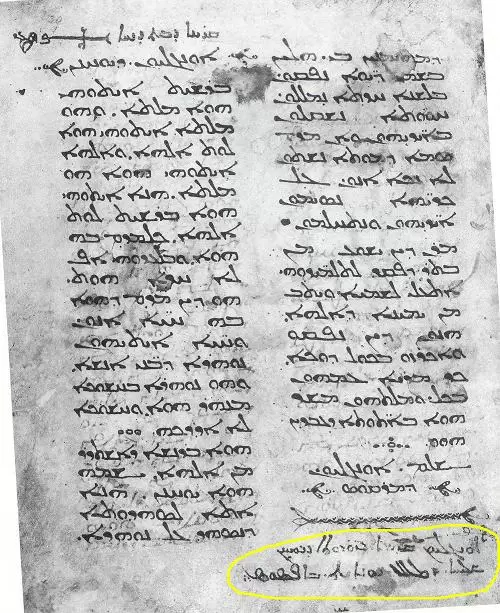
Infamous Assyrian apologist, Tatian, created a harmony of the four Peshitta Gospels, in order to have a continuous narrative of the life of Jesus. This Aramaic version is known as the “Diatessaron” (meaning “Gospel harmony”) aka “Evangelion da Mehallete”. Sound familiar? It should. It basically means, “Mixed Gospels”. It is generally accepted by most scholars as being published around 175 AD or earlier. Only fragments remain of the original Aramaic version, but further translations into Arabic, Latin and Armenian still exist.
The Diatessaron became a very popular version in Syria, during the 4th and 5th centuries. Even in Edessa, the diocese of Rabulla. When he saw that nearly every Church was using the Diatessaron, Rabulla ordered the priests and deacons to ensure that every church should have a copy of the his “Evangelion da Mepharreshe”.
He wanted to replace the “Evangelion da Mehallete” (“Mixed Gospels”) with his “Evangelion da Mepharreshe” (“Separate Gospels”).
The true story now becomes very clear. Rabulla created the Old Syriac, not the Peshitta! This makes complete sense, after seeing Rabulla’s emphasis on the Gospels (to rival the Diatessaron, the harmonised Gospel) and the fact that the Old Syriac consists of the four Gospels only.
Happily enough, internal evidence from the Arabic translation of the Assyrian Diatessaron (the only surviving version translated into a sister Semitic tongue) heavily indicates that the Diatessaron stems from the Peshitta. This would date the Peshitta to around 175 AD at the absolute latest. That’s pretty impressive, considering that the New Testament is believed to have been completed around 100 AD.
But why in countering the Diatessaron, did Rabulla create the Old Syriac (from the Greek translation), instead of using the original Peshitta Gospels? The author does not understand, especially since his ally, the SOC, revered the Peshitta tradition. Perhaps he wanted to make a name for himself. Or perhaps he conspired to suppress the Peshitta tradition. Indeed, the SOC did make use of his Old Syriac for a while, before reverting back to their more trustworthy Peshitto.
In any case, this investigation yields some vital facts:• Rabulla did not create the Peshitta, he created the Old Syriac.
• The Peshitta does not stem from the Old Syriac, the Old Syriac stems from the Peshitta, via the Greek.
• The Peshitta dates back to 175 AD at the very latest.
It all makes sense now. One would expect the COE to reject the version created by Rabulla, their great persecutor. Yet they didn’t reject the Peshitta. They rejected the Old Syriac. That the Old Syriac was a poor version (unavoidable seeing as it was an Aramaic translation from a Greek translation of the original Aramaic*), is evident not only by the COE’s rejection, but also the eventual rejection by the SOC, Rabulla’s ally. Both Churches decided to stay with the Peshitta tradition. Yet scholars still are adamant that the Old Syriac is somehow older and superior to the Peshitta and Peshitto.
* – The Old Syriac shares many similarities with the Western Greek text (aka Codex Bezae, aka Manuscript D) as textual critic Dr. James Trimm demonstrates. And the Western Greek text seems to be an early Greek translation of the Peshitta as indicated by its “Semiticness” (the NT author’s were all Semites after all) and its variants with other Greek manuscripts, which stem from mistranslations/misunderstandings of the original Peshitta passages (split words).
After learning the true history of the “Old Syriac”, you may loathe to call it by that name. A popular alternative among Peshitta enthusiasts is “Old Scratch”, as manuscripts were found where the Old Syriac was scratched off to make way for a priest’s biography. No Semite would dare do this to the Peshitta!
Note: More articles regarding the history of the Peshitta and OS comparisons can be found in my book.
http://www.superbook.org/LAMSA/FAQ/peshitta_old_syriac.htm
Arthur Vööbus (28 April [O.S. 15 April] 1909 – 25 September 1988) was an Estoniantheologian, orientalist, scholar, author, professor, and church historian.[1][2]
Arthur Vööbus was born in Matjama village, Tartu County, Livonia, Russian Empire as the son of a teacher. In 1928, he completed his schooling at the Hugo Treffner Gymnasium in Tartu, then in 1932 his studies at the Theological Faculty of the University of Tartu. That same year he was ordained a priest. From 1933 to 1940 he was a pastor in the Estonian Evangelical Lutheran Church in Tartu. Arthur Vööbus graduated as master of theology in 1934 with a thesis on “The true Christian, true Christian life and the true Christian church by Soren Kirkegaard.” In parallel, Arthur Vööbus worked in libraries and manuscript collections in Rome, Paris, London, Berlin and Leipzig on theological texts in Syriac. His language skills were acquired at the university under Uku Masing.
In 1936 he married Ilse Luksep, a daughter of a wealthy merchant family, which, along with his job in a large parish, provided the material basis for his research. Towards the end of the 1930s, Vööbus worked on the publication of Syriac texts. In 1940, he fled the Soviet occupation of Estonia to Germany. His dissident attitude led to observation by the Gestapo. After the occupation of Estonia by German troops Vööbus returned to Estonia. His doctoral thesis in 1943 at the University of Tartu was concerned with monasticism in Syria, Mesopotamia and Persia before the 10th Century.
In 1944, Vööbus and his family fled a second time before the Soviet reoccupation of Estonia. He spent part of the war interned in concentration camps.[3][4][5] From 1944 to 1948 he worked as a pastor in refugee camps, and from 1946 to 1948 he was a professor of church history at the Baltic University at Pinneberg, near Hamburg. When this university was closed, he worked in London at the British Museum.
In 1948, Vööbus immigrated to the United States and became chair of the New Testament and ancient church history at the Lutheran School of Theology at Chicago (LSTC), where he taught from 1951 until his retirement in 1977.[6] Arthur Vööbus was a member of several scientific academies, including the Royal Academy of Science, Letters and Fine Arts of Belgium. Vööbus died on 25 September 1988 in Oak, Park, Illinois, United States.
During his career, Vööbus made more than 40 separate trips to the Middle East, creating a collection of manuscript photographs on film that is larger than any other collection of Syriac manuscript images before the advent of digital imaging.[7] This collection of manuscript images is now known as the Vööbus Syriac Manuscript Collection. In 1979, the collection moved from Vööbus’ home in Chicago to the newly-founded Institute of Syriac Manuscript Studies (ISMS), located in the JKM Library at LSTC. The collection (then called the Professor Arthur Vööbus Collection of Syrian Manuscripts) was maintained at ISMS until 2016. In 2016, due to financial constraints, the ISMS entered into an agreement with the Hill Museum & Manuscript Library (HMML) and the entire collection was transferred and stored in HMML’s microfilm vault.[7] HMML now undertakes responsibility for the continued digitization of the films and the hosting of the images.[6]
Works
- Communism’s Challenge to Christianity (1950)[8]
- Studies in the History of the Gospel Text in Syriac (Louvain: 1951)
- Early Versions of the New Testament Manuscript Studies: Oriental Texts and Facsimile Plates of Syriac, Armenian, Georgian, Coptic, Ethiopic and Arabic Manuscripts (Stockholm: 1954)
- “Liber Graduum: Some Aspects of its Significance for the History of Early Syriac Asceticism,” Charisteria Johanni Kopp Octogenario Oblata (Papers of the Estonian Theological Society in Exile, 7), pages 108–128 (Stockholm: 1954)
- The Communist Menace, the Present Chaos and Our Christian Responsibility (New York: 1957)
- History of Asceticism in the Syrian Orient: A Contribution to the History of Culture in the Near East, volumes 1–3 (Louvain: 1958, 1960, 1988)
- The Department of Theology at the University of Tartu: Its Life and Work, Martyrdom and Annihilation (Stockholm: 1963)
- Discoveries of Great Import on the Commentary on Luke by Cyril of Alexandria: The Emergence of New Manuscript Sources for the Syriac Version (1973)
- Important New Manuscript Sources for the Islamic Law in Syriac: Contributions to the History of Jurisprudence in the Syrian Orient. (1975)
- West Syrian Synodicon, CSCO 367–368/161–162; 375–376/163–164. (Louvain: 1975, 1976)
- “In Pursuit of Syriac Manuscripts,” Journal of Near Eastern Studies 37.2, Colloquium on Aramaic Studies (April 1978), pages 187–193.
- “On the Pathways of the Syrian Orient in the Pursuit of Manuscript Treasures,” The Professor Arthur Vööbus Collection of Syriac Manuscripts on Film and the Institute of Syriac Manuscript Studies, pages 2–20 (Chicago: 1982).
- The Martyrs of Estonia: The Suffering, Ordeal and Annihilation of the Churches under the Russian Occupation (Stockholm: ETSE, 1984)
- Studies in the History of the Estonian People, volumes 1–14
- Tragedy of the Estonian People, volumes 1–2
- Reference Library of European America 1998 “Arthur Voobus (1909-1990) obtained his doctorate in Estonia in 1943 and came to the United States after the war.”
- ^ Chicago Tribune obituary
- ^ “Refugee Talks at Meeting of Brotherhood”. The Daily Chronicle. De Kalb, IL. April 1, 1952. p. 2. Retrieved April 28, 2023 – via Newspapers.com.
- ^ “Teen-Age Group at Convention for Lutherans”. Vero Beach Press Journal. Vero Beach, FL. June 13, 1963. p. 23. Retrieved April 28, 2023 – via Newspapers.com.
- ^ “Church Council Feels Scholar’s Wrath”. The Province. Vancouver, BC. January 21, 1978. p. 8. Retrieved April 28, 2023 – via Newspapers.com.
- ^ Jump up to:a b Kitchen, Robert (2023). “Arthur Vööbus Collection at Hill Museum & Manuscript Library”. Syriac Annals of the Romanian Academy (3): 133–136.
- ^ Jump up to:a b “Vööbus Syriac Manuscript Collection”.
- ^ “All Christian Churches Urged to Unite Against Common Enemy”. Our Sunday Visitor. Omaha, NE. January 20, 1952. p. 11. Retrieved April 27, 2023 – via Newspapers.com.
Sharing is caringFacebookX / TwitterLinkedInWhatsAppTelegramRedditEmail3793 words · 141 views