

ABRAHAM
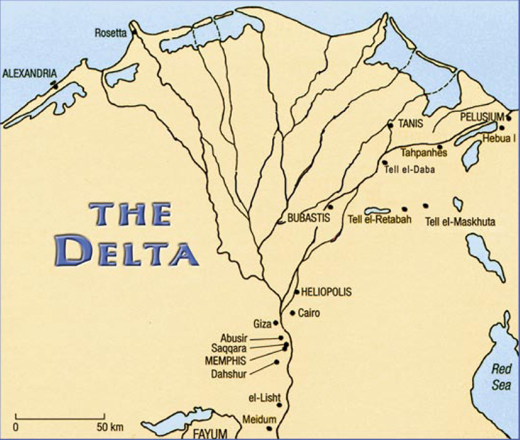
Abraham came to Egypt during the 21st century BC, at the end of the First Intermediate Period (Gn 12:10; 13:1). The 11th Dynasty based in Thebes was just gaining power in the south and would ultimately control all of Egypt. So the Pharaoh that Abraham met (Gn 12:15–20) may have been a northern leader who took the title, or an early king from the Theban dynasty. Presumably, their encounter took place in the delta area.
While in this region, Abraham probably saw the Giza pyramids on the Nile’s west bank. Giza is the northern-most and most famous of the Old Kingdom royal cemeteries in the delta region, including Meidum, Dahshur, Saqqara and Abusir. They were located near Memphis, the national capital at that time. While the most famous and largest pyramids are at Giza (Fourth Dynasty; 27th-26th century BC), the first was a four-sided stepped stone construction built by Pharaoh Djoser (Third Dynasty; 27th century BC) at Saqqara. Pharaoh Sneferu (Fourth Dynasty; 25th century BC) constructed the earliest smooth-sided pyramid in the form we know today at Dahshur.
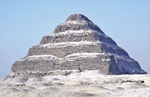
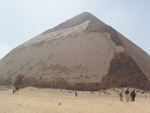
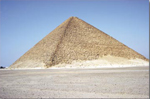
Pyramid development. They started from a flattop rectangular mud-brick tomb, called a mastaba (Arabic for “bench”). The first pyramid (left) was a series of six increasingly smaller mastabas, one on top of the other. The famous builder Imhotep constructed the four-sided stone structure for Pharaoh Djoser (Third Dynasty; 27th century BC) at Saqqara. This stepped pyramid is the oldest freestanding stone structure in the world. From Djoser’s stepped pyramid came the first real pyramid with four smoothed flat sides, constructed by Pharaoh Sneferu (Fourth Dynasty; 27th century BC) at Dahshur (center). Unfortunately, his builders were forced to correct the slope half way up, and it is known today as the Bent Pyramid. A later Sneferu pyramid at Dahshur, known today as the Red Pyramid because of the reddish color of the local limestone that was used in its construction, was perfectly constructed and is generally recognized as the first true pyramid (right). Contrary to popular opinion, none of Egypt’s royal pyramids were constructed by Israelite slaves. Instead, known archaeological evidence suggests they were constructed by professional builders who lived in nearby villages and spent their lives working on the project.
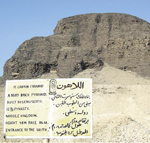
Pyramid of 12th Dynasty Pharaoh Sesostris II at El-Lahun in Lower Egypt. This was possibly the Pharaoh under whom Joseph rose to the position of vizier in Egypt. Although a Middle Kingdom Pharaonic tomb, it was much smaller than the Old Kingdom pyramids at Giza. Sesostris II’s pyramid was constructed of a mud-brick core with a limestone casing. All that remains today is the mud-brick core, as the casing was stripped away long ago by locals for building material.
JOSEPH
The Midianites would have brought Joseph to Egypt by way of the Horus Road (Gn 37:28; 39:1). Once in Egypt, he was sold to Potiphar, a high Egyptian official, and apparently worked as a slave on Potiphar’s estate in the delta (Gn 39:1, 2). Interestingly, Egyptian history indicates that slavery first appeared at this very time period (Aling 2002: 35–37).
Egypt’s 12th Dynasty (ca. 1991–1786 BC) built a new capital city in Upper Egypt’s northern extremity, close to the delta. From here they could more effectively administrate and access their eastern frontier (Leprohon 1992: 345–46). Called itj-tawy, it was probably located near the capital’s royal necropolis at el-Lahun, at the entrance to the Faiyum, a large fertile area west of the Nile. The actual site is unknown today (Ray 2004: 40). Here was constructed the pyramid of 12th Dynasty Pharaoh Sesostris II (ca. 1897–1877 BC). Biblical dating suggests this was the Pharaoh under whom Joseph rose to the position of vizier in Egypt (Gn 45:8). As the most powerful man in the kingdom, Joseph would have visited and even had authority over construction of this pyramid. In fact, Joseph may have supervised Pharaoh’s burial here.
Joseph most likely served under Sesostris II’s son, Sesostris III (ca.1878–1843 BC), during the years of famine. Sesostris III’s own pyramid tomb at Dahshur (northern Upper Egypt) also would have been a major responsibility for Joseph. Since documents mention later viziers during Sesostris III’s reign, Joseph probably went into honorable retirement in the delta’s Goshen region shortly after the years of famine.

Uraeus worn by Sesostris II. Discovered in Sesostris II’s pyramid by W.M. Flinders Petrie in 1920, it had been left behind by tomb robbers. The term uraeus is derived from the Greek transcription of Egyptian iaret, the cobra with its hood dilated ready to strike. An emblem of royalty, the reptile was applied to crowns to protect the king from evil with its poison. Sesostris II’s uraeus is made of solid gold, with a head of lapis lazuli, and its body contains lapis lazuli, feldspar and carnelian. It is on display at the Egyptian Museum in Cairo.
Recent excavations in the eastern Nile delta may have actually identified the location of Joseph’s residence in retirement, and even his tomb. At a site known as Tell el-Daba today, the Rameses of the Old Testament, extensive excavations have been carried out under the direction of Manfred Bietak of the Austrian Archaeological Institute, Cairo, since 1966. This site was strategically located at the eastern starting point to the Horus Road to Canaan and along the Nile’s easternmost branch, the Pelusiac. That may explain its name, Rowaty (“the door of the two roads”) in the days of Joseph and Jacob. The site has evidence for Asiatics as early as the mid-12th Dynasty (mid-19th century BC), the general period when Jacob entered Egypt. It was an unfortified rural settlement, although numerous enclosure walls probably kept animals. Living quarters consisted of rectangular huts built of sand bricks (Wood 1997: 55).
Not all residents of Tell el-Daba’s first Asiatic settlement lived in huts. One, evidently an important official, lived in a small villa. While the Bible tells us that Joseph was given the title “Ruler of all Egypt” (Hebrew) or vizier, it does not mention where he lived while serving in the Egyptian bureaucracy. It seems logical that after he discharged his duties associated with the famine, he would have moved to Rowaty to be near his father and brothers. It is possible the villa in Rowaty and the surrounding semi-circle of poorer two-room houses are the homes of Joseph and his brothers (Wood 1997: 56).

The earliest remains of Asiatics at Tell el-Daba included houses and tombs (12th Dynasty, mid-19th century BC). Called Rowaty (“the door of the two roads”) at that time, this Asiatic settlement was probably Rameses (Gn 47:11, 27; a later name for the same site) where Jacob and his family settled in Goshen. One particular house and tomb excavated there may actually be Joseph’s. Directly above that was found a later and larger early Hyksos palace (13th Dynasty). It was probably the first Hyksos Pharaoh, “who did not know about Joseph” (Ex 1:8), that pressed the Israelites into slavery and had them build the store city of Rameses (Ex 1:11; a later name for this Hyksos city). (Based on Fig. 7 in Avaris: The Capital of the Hyksos, by Manfred Bietak [London: British Museum, 1996].)
A cemetery with artifacts that connected it to the houses was also excavated in the open space to the southwest. One of the tombs was monumental in construction and totally unique in finds. Inside were found stone fragments of a colossal statue of a man who was clearly Asiatic, based on the yellow painted skin, the red-painted mushroom-shaped hairstyle and a throwstick on his right shoulder (the hieroglyph for foreigner). The statue had been intentionally broken in antiquity.
While the other tombs nearby had intact skeletons, the only finds in the monumental tomb were fragments of an inscribed limestone sarcophagus and a few bone fragments. The body was gone! While it was common to plunder tombs in ancient Egypt, the bodies were usually not taken. Could this be the tomb of Joseph, from which he commanded his bones to be carried back to Canaan (Gn 50:25; Ex 13:19)? Without an inscription, it cannot be proven; but this site suggests the first material evidence of Israelites in Egypt. It is the right culture in the right place at the right time (see Wood 1997: 56-58).
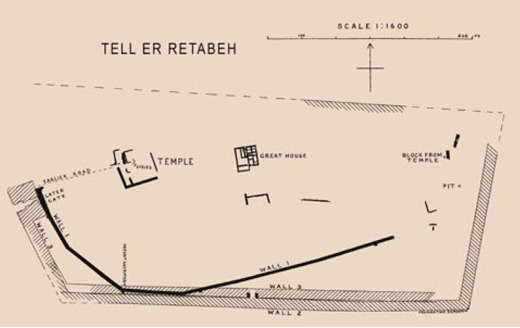
The other store city of Pharaoh built by the Israelites was Pithom (Ex 1:11). Scholars differ on the modern location of this ancient site, but the two leading candidates are Tell el-Maskhuta and Tell el-Retabah, about 9 mi apart in the Wadi Tumilat at the southern edge of Goshen. While the question is not settled yet, the best choice appears to be Retabah; Maskhuta may well have been Succoth (Ex 12:37; 13:20). ( W.M Flinders Petrie, Hyksos and Israelite Cities [London: British School of Archaeology in Egypt, 1906], PL. 35.)
HYKSOS
The town known as Rowaty, where Joseph and his family probably lived, had its name changed to Avaris toward the end of the 18th century BC. This was during Egypt’s 14th Dynasty and the new name meant “the (royal) foundation of the district.” Same site, different era, different name—Avaris would continue to be the site’s name even through the period of the Hyksos (Wood 2004: 45).
The Hyksos, whose hieroglyphic name meant “foreign rulers,” came into the Nile delta from southern Canaan and established a center of power at Avaris. Their leaders took the title of Pharaoh and ruled northern Egypt for 108 years (ca.1664–1555 BC). They have come to be known as Egypt’s 15th Dynasty. Avaris was their capital and it became an important commercial center. The “Pharaoh that knew not Joseph” (Ex 1:8) was probably the first Hyksos Pharaoh, and it was probably Hyksos Pharaohs who forced the Israelites to build the store cities of Pithom and Rameses (Ex 1:8–12).
When the Egyptians, under the leadership of the 18th Dynasty’s founder Amosis, drove out the Hyksos in the mid-16th century BC, they most likely changed the name of the city of Avaris. The new name was probably Peru-nefer, which meant “happy journey” (Wood 2004: 45). That would have been the name of the city during Moses’ time.
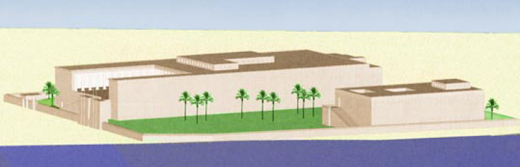
A royal palace complex from Moses’ time (18th Dynasty; 15th century BC) was excavated at Izbet Helmi, a few hundred yards west of where the early Asiatic settlement had been found (mid-19th century BC). It was built in close proximity to the Nile River (the Pelusiac Branch), as the Bible indicates. Possibly called Peru-nefer during that period, it fits the time and place for the palace where Moses grew up and where he also later confronted Pharaoh to let his people go. (Reprinted by permission of the Österreichische Akademie der Wissenschaften, from Manfred Bietak and Irene Forstner-Müeller, Ausgrabungen im Palastbezirk von Avaris: Vorbericht Tell el-Dab’a/’Ezbet Helmi Spring 2003, Egypt and the Levant 13 [2003], P.39.)
MOSES
The Bible records the events of Moses’ birth in Exodus 2, with the Israelites apparently still living in the delta’s Goshen area. When Pharaoh’s daughter went down to the Nile to bathe, she found baby Moses (Ex 2:5). This daughter of Pharaoh may well have been Hatshepsut, who later became a Pharaoh herself (Hansen 2003). So, the Bible suggests that the royal family had a residence in Goshen where the Israelites lived (Ex 2:2–10). While the national capital for the 18th Dynasty Pharaohs was in Memphis 13 mi south of Cairo, after the Hyksos experience a royal presence would always have been seen as necessary for national security in the Nile’s eastern delta.
Bietak’s excavation at Tell el-Daba uncovered a ten-acre royal citadel from the time of Moses at the village of Ezbet Helmi, just a few hundred yards west of the earlier Asiatic settlement. It was part of a new royal center established at the former Hyksos capital of Avaris. Located just south of where the Pelusiac branch of the Nile once flowed (the courses of the Nile branches, and the delta itself, have changed dramatically over the millennia), Bietak found two palaces that were in use during the time of Moses (early 18th Dynasty).
The palace closest to the river (Palace F) was the smaller and probably doubled as a watchtower of the river and citadel. Just 100 ft (30m) from the river, it was constructed on a platform with a ramp leading to the entrance. Nearby were a middle class settlement, workshops, storage rooms and possibly a ritual complex (Wood 2004: 47).
The main palace (Palace G), occupying over 3 acres, also had a ramp to the entrance, a bathing room at the entrance, a large open courtyard, a reception hall and private apartments for the royal family.
The site is in the right area and at the right time to be the royal palace where Moses was raised (Ex 2:10; Acts 7:20–21) and where he confronted Pharaoh 11 times during the time of the Ten Plagues (Ex 4–12). If this is correct, then the site of Jacob’s sojourn in Egypt (modern Tell el-Daba), the home and tomb of Joseph (modern Tell el-Daba) and the palace where Moses was raised and confronted Pharaoh before the Exodus (modern Ezbet Helmi) have all been excavated and are located within the same ancient complex.
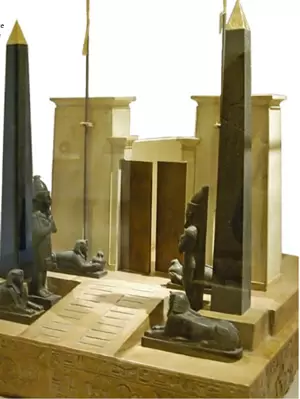
Reconstruction of the sun temple at Heliopolis. The base of a model of the temple at Heliopolis from the reign of Seti I (ca. 1291–1279 BC) was found in Egypt and is now in the Brooklyn Museum of Art. From the model, the staff at the Brooklyn Museum of Art was able to reconstruct the Heliopolis sun temple as seen in the photo. All that remains of the temple today is one lone obelisk, dedicated to the 12th Dynasty Pharaoh Sesostris I (ca. 1971–1928 BC); thus it would have been standing in Joseph’s day. Other obelisks from Heliopolis have been sent to various cities as gifts, including New York, London and Rome. New York’s obelisk was erected behind the Metropolitan Museum of Art. It was originally commissioned by Tuthmosis III (ca. 1504–1450 BC), so was not at Heliopolis during Joseph’s time.
RAMESES
The Bible mentions that Jacob and his family settled in “the land of Rameses” where they became property owners (Gn 47:11, 27). The Bible also mentions that the Israelites were used as slave labor to build the city of Rameses (Ex 1:11) and when they left Egypt after 430 years (Ex 12:40) they departed from Rameses (Ex 12:37). Apparently, most of the Israelites spent the years of the Egyptian Sojourn in and around Rameses.
While the location of ancient Rameses had been in dispute for years, excavations at Tell el-Daba and surrounding villages in the Nile’s eastern delta have demonstrated that the ancient city was located here. It sat on the Pelusiac branch of the Nile, giving access to the Mediterranean, and was the starting point of the Horus Road to the east. While its name changed throughout the centuries, the location along the Pelusiac and the Horus Road kept it a strategic site on Egypt’s eastern border.
The name Ramesses actually comes from a later period than the Israelite Sojourn. It was the name given by 19th Dynasty Pharaoh Rameses II (Rameses the Great, ca 1279–1212 BC) to the city he built a short distance northeast of ancient Rowaty/Avaris/Peru-nefer in the eastern Nile delta. Known as Pi-Rameses (“city of Rameses”) to the Egyptians, it is located at the modern village of Qantir. Much of the ancient capital has been located by means of a magnetometer survey. The 13th century BC city covered more than 4 square mi (10 square km). Excavations have uncovered a palace-like structure with pillared halls and associated stables from the time of Ramesses II. Not excavated yet, but identified on the magnetometer survey, are an additional palace area, significant public buildings, and a vast residential quarter with avenues, channels, streets, villas, courtyards and gardens (Pusch 2001).
Thus, the city called Rameses was not built until after the Exodus. But it was built at the same site where Jacob, Joseph and Moses lived. While the Bible calls it Rameses when Jacob moved there (Gn 47:11) and when the Israelites built a new city at the site (Ex 1:11) under the “Pharaoh that knew not Joseph” (Ex 1:8), that name did not actually apply to the site until the 13th century BC. Later scribes updated the Biblical text with the name Rameses when the earlier names of the site went out of use.
Egypt During the Period of the Kingdom of Judah
During the period of the Babylonian empire, there are frequent mentions of Lower Egyptian sites by the prophets Jeremiah and Ezekiel. Numerous Jews fled to Egypt when Israel and Judah were invaded, first by the Assyrians and later by the Babylonians, and these two prophets addressed them and their cities of refuge. While Memphis was most famous as one of early Egypt’s first national capitals from the 3rd millennium BC, it was only mentioned in the Bible late. Called Noph (Jer 44:1) and Moph (Hebrew; Hos 9:6), both shortened forms of Memphis (hieroglyphic mn-nfr), it was mentioned for judgment by the prophets.
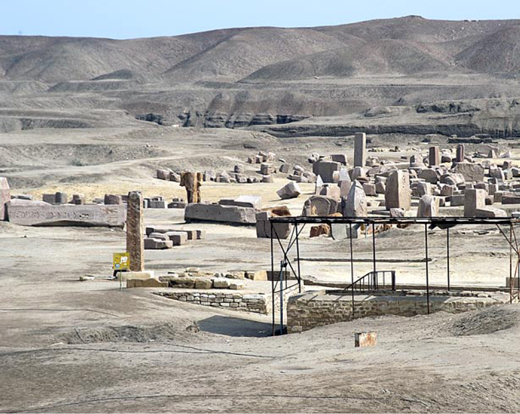
Temple of Amun at Zoan. Built in the 21st Dynasty by Psusennes I (ca. 1055–1004 BC) at the time of Saul, the temple occupies an area of 240 x 80 yd (220 x 72 m). In the foreground is Tomb 5 of Sheshonk III (ca. 819–767 BC). It contained a canopic jar (used to store the organs of the deceased) and a heart scarab of Biblical Shishak (Sheshonk I, ca. 931–910 BC), so he may have been buried here as well.
HELIOPOLIS
Another important Old Kingdom city was Heliopolis (Greek for “sun city”). Called On (Hebrew from the hieroglyphic Iwnw “pillar town;” Gn 41:45, 50; 46:20), it was the home of Potiphera the priest and father of Asenath, Joseph’s wife. The city of Aven (Ez 30:17), a slightly different spelling of the same name, is also said to be under God’s judgment. Jeremiah’s reference to Beth Shemesh (Hebrew “city of the sun;” Jer 43:13) also refers to On as being under judgment. The ancient city is identified with modern Tell Hisn, north of Cairo. Mentioned as early as the Old Kingdom period, it was prominent during Egypt’s Saite period (664–525 BC), the days of Jeremiah and Ezekiel (Redford 1992a: 122–23).
BUBASTIS
Bubastis (Hebrew Pibeseth, Ez 30:17; from the hieroglyphic name meaning “house of Bastet”—the cat goddess) was also located in the delta and was mentioned under God’s judgment. The ancient city is identified with modern Tell Basta in Zagazig, with remains dating as far back as the Old Kingdom. Bubastis became politically important as a capital city during the 22nd and 23rd Dynasties (10th-9th centuries BC).
ZOAN
Zoan was the Hebrew name for a site better known to us as Tanis (Greek). Called San el Hagar today, it was first mentioned during the reign of Rameses XI (20th Dynasty; 12th century BC). Zoan became the official residence of the 21st Dynasty (ca. 1081–931 BC), replacing Rameses (Peru-nefer/Avaris/Rowaty). This was possibly due to the shifting of the Pelusiac branch of the Nile and loss of Rameses’ harbor. Interestingly, structures, statues and stele from Rameses were shipped down the Nile to Zoan. The residence of Shishak I (ca. 931–910 BC; 1 Kgs 14:25), Zoan was the site of the lost ark in Indiana Jones’ Raiders of the Lost Ark. Zoan was Egypt’s capital during part of the Judean monarchy (Is 19:11, 13: 30:4: Ez 30:14; see Redford 1992b: 1106).
TAPHANHES
Tahpanhes (Hebrew; Jer 2:16; 43:7–9; 44:1; 46:14; Ez 30:18) comes from the Egyptian name meaning “Fortress of Penhase.” Penhase (like Hebrew Phinehas) means “Nubian” and was the name of a powerful 11th century BC Theban general who suppressed a rebellion in the delta. This site, identified today with Tell ed-Defenna in the eastern delta, was probably settled during the time of the Judean Monarchy and became important into the Persian period. Tahpanhes became a safe haven for Jews, including Jeremiah, fleeing the Babylonian invasion of Judah. Here the prophet pronounced judgment on Egypt and Jews taking refuge from Nebuchadnezzar. Jeremiah’s prophesy included mention of Pharaoh Hophra being handed over “to his enemies who seek his life” (43:7–44:30).
PELUSIUM
Sin (Hebrew, from the hieroglyphic sin “mud;” Ez 30:15–16) was an important fortress on Egypt’s extreme northeastern border. Also called Pelusium (Greek) in antiquity, it is known as Tell el Farama today.
MIGDOL
Migdol (Hebrew meaning “tower” and a loan word into Egyptian, suggesting a northern location) was mentioned in the Exodus (Ex 14:2), and as a place where Jews resided in Egypt during the Babylonian period (Jer 44:1; 46:14) and a site of God’s judgment on Egypt (“tower” in Ez 29:10; 30:6). While a popular place name throughout the ancient near east, presumably all references relate to the same site in Egypt’s eastern delta. This city is identified with the modern Hebua I fortress, probably the famous Tjaru, a fortress on Egypt’s eastern border.
CONCLUSION
The key to understanding the history of Egypt, especially the delta region, is the Hyksos invasion from southern Canaan. Known in Egyptian history as the Second Intermediate Period, it led to permanent changes in Egyptian political thinking. From that period on, the delta was especially protected from the east. From the delta regular military campaigns were waged into Canaan. A Pharaonic presence in the eastern delta became a constant.
The Hyksos invasion of Egypt was also a seminal event in the history of Israel in Egypt. Arriving en masse with Jacob, most Israelites lived in the delta region. Under Joseph they lived reasonably well (Ex 1:7), but with the coming of the Hyksos and a new Pharaoh “who did not know about Joseph” (Ex 1:8) the fortunes of Israel changed. It was evidently the first Hyksos Pharaoh who began oppressing the Israelites and it was under the Hyksos that the Israelites built the store cities of Pithom and Rameses (Ex 1:11). After the Theban 18th Dynasty expelled the Hyksos and established Egypt’s New Kingdom, they too made the Israelites serve with hard labor. It was during this period that Moses was born and grew up in the royal house in the delta. From this very location, 80 years later, the Exodus would begin.
Late in the Old Testament story, Jeremiah and Ezekiel again mention numerous Egyptian sites, both north and south. It becomes clear from their message to their fellow countrymen living in Egypt that you can run, but you cannot hide from God. He knew where they were and He would bring judgment on them and their Egyptian hideouts.
The story of Israel in Egypt is bound up in the Egyptian history of the Nile delta.
PHARAOHS WHO RULED WHEN BIBLICAL PERSONAGES WERE IN EGYPT
ABRAHAM *
- First Intermediate Period (ca. 2190–2061 BC) ca. 2090 BC
- Abraham entered Egypt to escape famine in Canaan and encounters a Pharaoh. This was during the First Intermediate Period, a time when rulers and their dates are not well known.
JOSEPH AND JACOB
- 12th Dynasty
- AMENEMHET II, ca. 1929–1895 BC
- ca. 1898 BC Joseph enters Egypt at age 17 and is sold to Potipher
- SESOSTRIS II. ca. 1897–1877 BC
- ca. 1885 BC Pharaoh makes Joseph Administrator of the Royal Estates
- ca. 1876 BC Jacob and his family enter Egypt and Jacob appears before Pharaoh
- SESOSTRIS III. ca. 1878–1843 BC
- ca. 1859 BC Jacob dies and Joseph obtains permission from Pharaoh to take Jacob’s body to Canaan for burial in the family sepulcher at Hebron
- AMENEMHET III. ca. 1843–1797 BC
- ca. 1805 BC Joseph dies and is “placed in a coffin in Egypt”
MOSES
- 18th Dynasty
- AMENHOTEP I. ca. 1551–1524 BC
- ca. 1530 BC edict made by Pharaoh to kill all male Hebrew babies
- ca. 1526 BC Moses born
- TUTHMOSIS I. ca. 1524–1518 BC; Tuthmosis II. 1518–1504 BC;
- HATSHEPSUT, ca. 1503–1483 BC: Tuthmosis III, ca. 1504–1450 BC
- ca. 1526–1486 BC Moses educated and lived in the royal court as the adopted son of Pharaoh’s daughter
- ca. 1486–1446 BC Moses flees to Midian to escape Pharaoh’s punishment for killing an Egyptian taskmaster
- ca. 1483 BC Hatshepsut, or ca. 1450 BC Tuthmosis III, the Pharaoh who died while Moses was in Median
- AMENHOTEP IIA. ca. 1450–1446 BC**
- ca. 1446 BC Pharaoh of the Exodus who died in the Yam Suph
JEROBOAM
- 22nd Dynasty
- SHESHONQ I. ca. 931–910 BC, Biblical Shishak
- ca. 931 BC Jeroboam flees to Egypt to escape Solomon
JEREMIAH
- 26th Dynasty
- HOPHRA (Greek Apries), ca. 589–570 BC
- ca. 586 BC Jeremiah flees to Egypt in the aftermath of the fall of Jerusalem to the Babylonians
JESUS
- Roman Era
- AUGUSTUS, 30 BC-AD 41
- ca. 6–4 BC Joseph and Mary flee to Egypt with the infant Jesus to escape Herod’s Bethlehem death decree
* Dates for Abraham through Moses are based on an Exodus date of 1446 BC
** For the possibility of both an Amenhotep IIA and an Amenhotep IIB, see William H. Shea, Amenhotep II as the Pharaoh of the Exodus, Bible and Spade 16 (2003): 41-51.
_________________________________________________________
BIBLIOGRAPHY
Aling, Charles
2002 Joseph in Egypt, Second of Six Parts. Bible and Spade 15: 35–38.
Hansen, David G.
2003 Moses and Hatshepsut. Bible and Spade 16: 14–20.
Leprohon, Ronald J.
1992 Egypt, History of: Middle Kingdom-2D Intermediate Period (DYN 11–17). Pp. 345–48 in The Anchor Bible Dictionary 2, ed. David N. Freedman. New York: Doubleday
Pusch, Edgar B.
2001 Piramesse. Pp. 48–50 in The Oxford Encyclopedia of Ancient Egypt 3, ed. Donald B. Redford. Oxford, England: Oxford University Press.
Ray, Paul J., Jr.
2004 The Duration of the Israelite Sojourn in Egypt. Bible and Spade 17: 33–44.
Redford, Donald B.
1992a Heliopolis. Pp. 122–23 in The Anchor Bible Dictionary 3, ed. David N Freedman. New York: Doubleday
1992b Zoan. Pp. 1106–1107 in The Anchor Bible Dictionary 6, ed. David N Freedman. New York: Doubleday.
Wood, Bryant G.
1997 The Sons of Jacob: New Evidence for the Presence of the Israelites in Egypt. Bible and Spade 10: 53–65.
2004 The Royal Precinct at Rameses. Bible and Spade 17: 45–51.
Exodus early dates
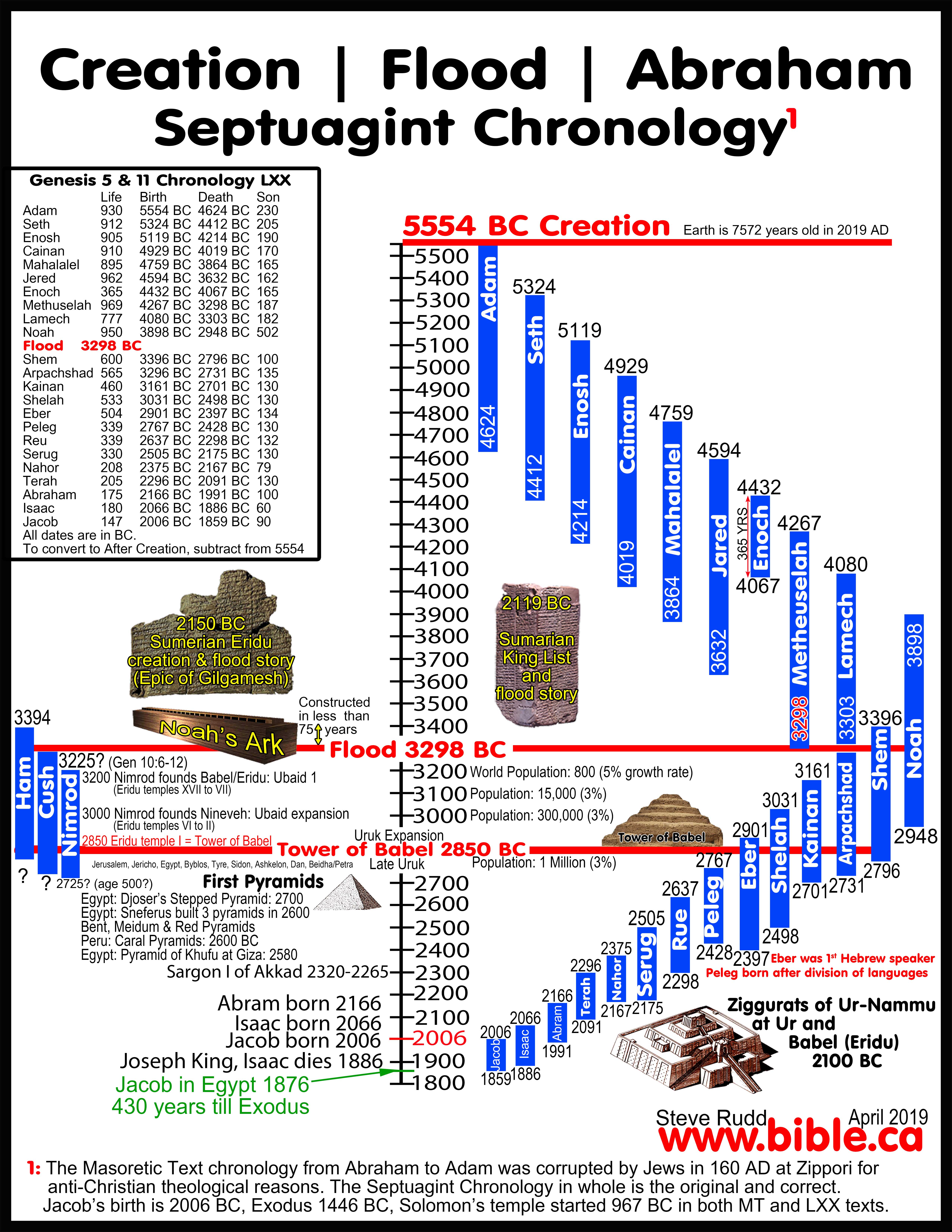
Is exodus equal to hyksos expulsion? Who were the hyksos? These and more questions must be made to set a proper early date for exodus. Before this article, almost in every one, at least in 8 BAR category articles, a 1446bc date is directly mentioned as the earliest possible date for exodus.
Some of them think that early christian era writers didn’t mean exodus happened when hyksos expulsion occurred (more info in expulsion of the Hyksos in approximately the 15th year of Ahmose), others think they made some dates mistakes that are going to be addressed in next articles in which Acts 13:20 and other verses relationship are mentioned too israel and egypt dates discrepancies.
It is important to say that a later exodus, an after 1500bc date is impossible.
Ahmose’s reign is can be fairly accurately dated using the Heliacal rise of Sirius in his successor’s reign, but because of disputes over from where the observation was made, he has been assigned a reign from 1570–1546 BC, 1560–1537 BC, 1551–1527 BC and 1539–1514 BC by various sources.[36][37][38]
But is heliacal rise of sirus, sothis trust worthy? Read about it at ancient history.
According to Josephus in Contra Apionem and Theophilus of Antioch in his Apologia ad Autolycum, Manetho’s Aegyptiaca stated that the pharaoh who expulsed the Hyksos from Egypt was named “Tethmôsis” and reigned for 25 years and 4 months.[39][36] At the opposite, according to the Byzantine scholar George Syncellus, Sextus Julius Africanus wrote that the Aegyptiaca reported the king to be named “Amôs”. Syncellus also notes that Eusebius in his Chronicon told that an “Amôsis” or “Amoses”—depending on the version of Eusebius—is mentioned in the Aegyptiaca as reigning 25 years and founding the eighteenth dynasty from Thebes.[40] The 25 years figure is seemingly supported by a ‘Year 22’ inscription from his reign at the stone quarries of Tura.[41] A medical examination of his mummy indicates that he died when he was about thirty-five, supporting a 25-year reign if he came to the throne at the age of 10.[36] The radiocarbon date range for the start of his reign is 1570–1544 BC, the mean point of which is 1557 BC.[20][note 2]
Ramsey et al. 2010, p. 1556.
- Grimal 1992, p. 193.
- ^ Helk, Wolfgang. Schwachstellen der Chronologie-Diskussion pp. 47–49. Göttinger Miszellen, Göttingen, 1983.
- ^ Encyclopaedia Britannica Ahmose I | Accomplishments & Facts | Britannica.com Archived July 7, 2015, at the Wayback Machine
- ^ Waddell 1971, pp. 101 & 109.
- ^ Waddell 1971, p. 115.
- ^ Breasted, James Henry. Ancient Records of Egypt, Vol. II p. 12. University of Chicago Press, Chicago, 1906.
REVIEW Biblical Archaeology:
The Date of the Exodus According to Ancient Writers: From Manetho, Josephus calculates the exodus as three hundred and ninety three years before Danaus arrived in Argos (about 1290 BC), which would place the exodus at 1683 BC, and a thousand years before the Trojan war (1186 BC; 1926, 205, 257; Against Apion I.103-5). The thousand years seems to be a round exaggerated number that is unreliable, or a mistake of the Trojan war for the first Olympiad (776 BC). For in Eusebius it is only 400+ years from the Trojan war and 1020 years from the first Olympiad (1981, 524, 533). From Phoenician history Josephus proves that the temple of Solomon was built a hundred and forty-three years and eight months earlier than the foundation of Carthage by the Tyrians (814 BC; 1926, 205-7; Against Apion I.106-11; Rowton 1950, 20). This would put the building of the temple at 957 BC https://www.bibleandscience.com/archaeology/exodusdate.htm
When Was the Exodus? The temple argument One argument for dating the Exodus is based on 1 Kings 6:1, which says:
In the four hundred and eightieth year after the people of Israel came out of the land of Egypt, in the fourth year of Solomon’s reign over Israel, in the month of Ziv, which is the second month, he began to build the house of the Lord.
Solomon began reigning around 972 B.C., so his fourth year would be 968. If this was the 480th year since the Exodus, we should back up 479 years, putting us in 1446 B.C.
This would have been during the reign of Pharaoh Thutmose III, making him the pharaoh of the Exodus. https://www.catholic.com/magazine/print-edition/when-was-the-exodus
It must be said that to some the writer of kings excluded 111 years of slavery.
DEBUNKING ‘THE EXODUS DECODED’. A BAR 1446bc exodus article we should have in mind before we go further.
Author: Bryant G. Wood PhD Category: Contemporary Issues Created: 20 September 2006
The Exodus Decoded made its US debut August 20 on the History Channel. Produced and narrated by Simcha Jacobovici, the film purportedly provides new evidence to demonstrate the Exodus really happened. Some of Jacobovici’s points are old hat…
The $3.5 million documentary The Exodus Decoded made its US debut August 20 on the History Channel. Previously it had been broadcast on the Discovery Channel in Canada in April and was shown at the Jerusalem Film Festival in July. Produced and narrated by Simcha Jacobovici, the film purportedly provides new evidence to demonstrate the Exodus really happened. Some of Jacobovici’s points are old hat, having been proposed before, while others are indeed new. But, alas, the presentation suffers from the same fate as other similar “documentaries”—dates are revised willy-nilly to make everything neatly come together to explain the events of the Exodus. In the end, Jacobovici does more harm than good since he mishandles the archaeological evidence, hence providing fuel to skeptics who wish to undermine the Exodus.
The information is conveniently organized by “Exhibits.” Let us examine the Exhibits one-by-one to check their credibility.
Bust of Pharaoh Ahmose,
Brooklyn Museum of Art.
(ABR photo by Michael Luddeni)

Exhibit A: The Ahmose Stela. It was under the leadership of Ahmose that the Egyptians drove out the hated foreign Hyksos who had infiltrated Egypt’s eastern Nile delta. The Hyksos, meaning “foreign rulers” in Egyptian, were Canaanite traders who had emigrated from southern Canaan. Ahmose went on to establish the powerful Egyptian 18th Dynasty. The stela tells of a great storm during Ahmose’s rule, ca. 1569–1545 BC. Jacobovici claims that the darkness and storm described in the stela are related to the Biblical plagues. His major premise in the documentary is that the Biblical Exodus is the same event as the expulsion of the Hyksos in Egyptian records. This raises three insurmountable problems. First, the expulsion is dated to the 15th year of Ahmose, ca. 1555 BC (Bietak 1991:48).[1] According to Biblical chronology, on the other hand, the Exodus occurred in 1446 BC (Young 2003), over a century after the expulsion of the Hyksos. Jacobovici overcomes this difficulty by arbitrarily splitting the difference between the two events; he raises the date of the Exodus to 1500 BC and lowers the date of the expulsion to 1500 BC. Voilà, discrepancy resolved! Even with this nifty slight-of-hand, there is not a good correlation between the stela and the Biblical plagues. The stela tells of darkness and a fierce rain storm that caused devastating flooding (Redford 1997: 16). There was no rain or flooding associated with the ninth plague of “darkness that can be felt” (Ex 10:21). The second major problem with the hypothesis is that the Hyksos were not slaves, but wealthy merchants and rulers of Egypt. The Hyksos, in fact, ruled Egypt for 108 years. They built palaces and temples at their capital city of Avaris, and had far-flung commercial operations.
Exhibit B: Pharaoh Ahmose. By associating the Exodus event with the expulsion of the Hyksos, Jacobovici maintains that, for the first time, we know who the Pharaoh of the Exodus was—Ahmose. But Jacobovici is not the first to make a connection between the expulsion of the Hyksos and the Israelite Exodus. Associations can be seen as far back as the third-century BC Egyptian priest Manetho (Redford 1992: 412–19). As we have seen, however, more than 100 years separate Ahmose and the Pharaoh of the Exodus, so the identification is invalid. In addition, the third problem with Jacobovici’s thesis is that Ahmose drove the Hyksos out of their capital Avaris by force of arms, whereas the Israelites left peacefully when Pharaoh ordered them out to avoid further calamities.
Wooden sarcophagus of Ahmose, Egyptian Museum, Cairo. (ABR photo by Michael Luddeni)
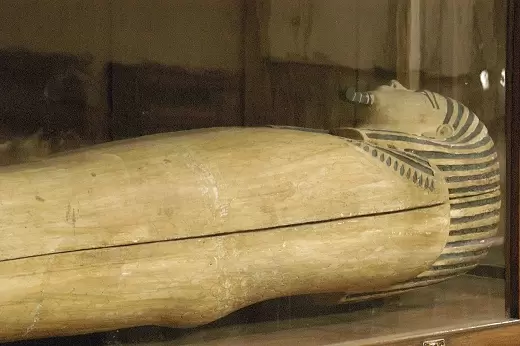
Exhibit C: Tomb at Beni Hasan. Jacobovici wishes to connect a Semite caravan depicted in a Middle Kingdom tomb at Beni Hasan in Middle Egypt with the migration of Jacob and his family to Egypt. At this point in the narration, he states “we know from the Bible that the Israelites arrived in Egypt some 200 years before their Exodus.” This is incorrect. The length of the Sojourn as recorded in the Bible was 430 years (Ex 12:40). He then goes on to say that the Beni Hasan tomb painting dates to 1700 BC. Wrong again! The painting is clearly dated by an inscription to the sixth year of Sesostris II, ca. 1890 BC (Wilson 1969: 229), 190 years before Jacobovici’s entry date of 1700 BC. Setting the chronological faux pas aside, the association is not a good one. The inscription says there were 37 individuals in the caravan compared with 66 in Jacob’s entourage (Gn 46:26). Jacobovici claims that the Beni Hasan group came from the area of modern Israel, whereas the inscription says they came from Shut, not Retenu or Hurru, the Egyptian names for the area of modern Israel.

Scene from the tomb of Khnumhotep in Beni Hasan, Middle Egypt, of a group of Semite (Asiatic) traders entering Egypt to sell eye paint, ca. 1890 BC. (ABR photo by Michael Luddeni)
Exhibit D: The “Yakov” (Jacob) Royal Ring. Jacobovici contends that Joseph’s royal seal was discovered at Tell el-Daba, the site of the ancient Hyksos capital Avaris. This is also the location of Rameses, the place where the Israelites settled (Gn 47:11) and where they departed from (Ex 12:37). In the 13th century BC, long after the Israelites had left, Rameses II rebuilt the city and named it after himself. It is this later, better-known, name that is used in the Bible since the earlier names of the site (there were several) went out of use. The Austrian team excavating the site found nine scarabs (beetle-shaped amulets) bearing the name of a Hyksos called Jacob-Her dating to ca. 1700 BC. Jacobovici, of course, surmises that this is Joseph’s father Jacob. He further contends that these are “seals worn by Joseph’s court officials.” If the scarabs are connected to the high official Joseph, then why is Jacob’s name on them? Jacobovici does not explain. In reality, Jacob was a common Semitic name and in this case probably belonged to a prominent Hyksos leader or businessman. In addition to the nine examples at Tell el-Daba, three Jacob-Her scarabs were found in Israel: two at Kabri, near Nahariya, and one at Shiqmona, near Haifa (Bietak 1997: 115).
Exhibit E: Serabit Slavery Inscriptions. Serabit el-Khadem is an area of turquoise mines in the northwestern part of the southern Sinai Peninsula. Inscriptions in both Egyptian hieroglyphs and early Semitic (Canaanite) alphabetic script written with pictographic signs have been found there. The Semitic inscriptions are assumed to have been written by Asiatic slaves who worked in the mines. Whether or not these inscriptions can be related to the period of Israelite slavery in Egypt is an open question. Specialists are divided as to whether they should be dated to the Middle Kingdom (ca. 2061–1665 BC) or New Kingdom (ca. 1569–1081 BC) (Beit-Arieh 1993).
Exhibit F: Santorini Pumice in Egypt. The second major premise of The Exodus Decoded is that tectonic activity caused the eruption of the Santorini volcano and triggered earthquakes, bringing about the plagues in Egypt. Jacobovici says the eruption took place in 1500 BC at the time of the Exodus. The date of the eruption is a hotly debated topic. Carbon-14 samples suggest a date of ca. 1625 BC, whereas conventional historical dating places the event at ca. 1525 BC.[2] Pumice from the Santorini eruption was found at Tell el-Daba. Here, we run into another major chronological difficulty. The pumice was found in an archaeological stratum later than the reign of Ahmose (Bietak 1997: 124–25). Thus, there is a chronological disconnect between Jacobovici’s Pharaoh of the Exodus and the eruption of Santorini.
Exhibit G: Ipuwer Plagues Papyrus. Jacobovici now calls on the Ipuwer Papyrus, which he believes provides evidence for a plague of “ice and fire mingled together.” The seventh plague of hail, he says, is volcanic hail induced by Santorini as described in the Ipuwer Papyrus. Again, we have a chronological problem. Although Jacobovici states that many scholars date the Ipuwer Papyrus to the Hyksos period, the fact of the matter is that most Egyptologists date it to the First Intermediate Period (ca. 2100 BC) or the late Middle Kingdom (ca. 1700 BC) (Shupak 1997: 93), well before Jacobovici’s Exodus date of 1500 BC.

Ipuwer Papyrus, National Archaeological Museum, Leiden, Netherlands. It tells of ordeals and calamities blamed on an unnamed king, perhaps Pepy II (ca. 2300–2206 BC) of the Sixth Dynasty, and predicts better times under a coming, ideal monarch. (ABR file photo)
Exhibit H: Santorini Ash in the Nile Delta. Jacobovici claims that an ash cloud from Santorini caused the darkness of the ninth plague. There is no question but what Santorini ash arrived on the shores of Egypt. But the pumice evidence indicates that this was after the Hyksos period.
Exhibit I: Male Plague Victims. Jacobovici asserts that mass burials of males in pit graves at Tell el-Daba are evidence for plague 10, the death of the firstborn. However, he presents only part of the evidence. As usual, there is a chronological problem. The burials are from the early 18th Dynasty, after the expulsion of the Hyksos. In addition, the individuals have a very narrow age range: between 18 and 25. We would expect victims of plague 10 to be younger than 18 and older than 25. Anthropological examination has shown that some of the individuals were Nubians, commonly employed in the Egyptian army in this time period. Since the burials were in the area of a military camp and arrowheads were found in the graves, the most logical explanation is that the burials were soldiers from the Egyptian army. The excavator concludes, “They were probably soldiers who died in the camps from diseases over a period of time” (Bietak 2005: 13).
Exhibit J: Ahmose’s Son Prince Sapair. Ahmose’s son died at age 12 and therefore died in the 10th plague according to Jacobovici. The presumed cause of the disaster, touted as “the first scientific explanation of the tenth plague,” was earthquake-dislodged carbon dioxide rising to the surface of the Nile River. Such an event occurred in 1986 at Lake Neos, Cameroon, when carbon dioxide gas was released from the mineral-saturated waters trapped in the lake’s depths. A similar event could not happen in a river, however, because moving water prevents minerals from accumulating at the bottom as in a stationary lake.
Exhibit K: el Arish Inscription. The el-Arish Inscription is a text from the Ptolemaic period (305–31 BC) written on a shrine found at el-Arish on the Mediterranean coast in northern Sinai. It is a legendary text concerning the gods Shu, god of air and sunlight, and his son Geb, god of the earth, and has nothing to do with the Exodus. Immanuel Velikovsky related the inscription to the crossing of the sea in his books Worlds in Collision and Ages in Chaos. Jacobovici follows Velikovsky’s interpretations, claiming the text “tells the entire story of the Exodus from Pharaoh’s point of view,” even giving the precise location of the crossing. Velikovsky’s understanding of this text has been thoroughly refuted. Mewhinney writes, “His interpretations of the el-Arish inscription are so obviously, blatantly wrong in so many particulars that it is hard to see why there should have been any controversy over the facts of the case, excepting only minor details. We find names altered and combined, words mistranslated, characters confused with one another or split in two, and events set in the wrong time and place. To permit Velikovsky to make the associations he does, one would have to take a sledgehammer to the shrine, smash it to bits, and reassemble the pieces in a different order. The method—a sort of ‘free association’ in which a whole complex of ideas is summoned up by an isolated word or phrase—must be rejected as well” (2006).
Exhibit L: Yam Suph (Reed Sea). Based on the el-Arish inscription J. identifies the sea crossing as the Ballah Lake on the northeast Egyptian frontier. On this point, we can agree with Jacobovici. It is not the el-Arish inscription that leads to this identification, however, it is modern archaeological research (Byers 2006a; 2006b).

View of the Suez Canal looking north from the Qantara Bridge in the northeast Nile delta. This was the area of the northern end of the Ballah Lake prior to the cutting of the canal in 1859–1860. This is possibly the area where the Israelites crossed the Reed Sea. (ABR photo by Michael Luddeni).
Exhibit M: Santorini Wall Paintings. Jacobovici claims that the Miniature Frieze found in the West House in the excavations at Akrotiri on the island of Santorini (ancient Thera) depicts a Minoan voyage to Avaris, Egypt. Although this interpretation is undoubtedly wrong,[3] there is ample evidence to indicate that there was contact between the Minoans and Egypt. From this interchange, he contends that some of the followers of Moses in Egypt were Aegeans from Greece and that they returned to Greece shortly after the Exodus. It is necessary to make this connection in order bring in artifacts from Greece that supposedly relate to the Exodus (Exhibit N and Final Exhibit below). Needless to say, there is no evidence to suggest that there were Aegeans enslaved in Egypt when the Israelites were there. Egyptian texts only speak of Asiatic slaves at that time (David 1986: 188–92; Redford 1992: 78–79, 208–209, 221–27).
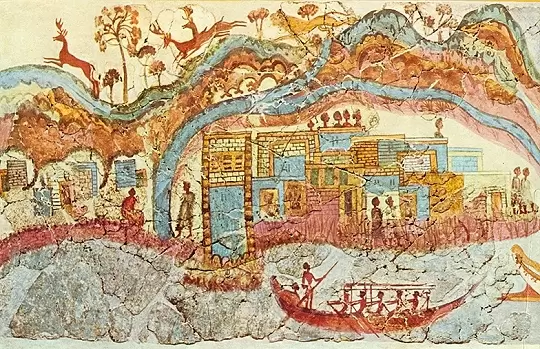
Minoan wall painting of a naval procession, West House, Akrotiri, Santorini. Rather than depicting a voyage to Avaris in Egypt as claimed in The Exodus Decoded, it is more likely a cultic procession taking place somewhere in the Aegean. (ABR file photo)
Exhibit N: Grave Stelae of Mycenae. Since there is no evidence that there were Greeks among the Israelite tribes that left Egypt, there is no basis for interpreting the images on grave stelae at Mycenae as scenes of the sea crossing as claimed by Jacobovici.

Ayun Musa (Spring of Moses) at the northeast shore of the Gulf of Suez, possibly Elim of Exodus 15:27. (ABR photo by Michael Luddeni)
Exhibit O: Mt. Sinai (Hashem el-Tarif). Jacobovici’s methodology in attempting to locate Mt. Sinai is admirable in that he utilizes Biblical data. Unfortunately, some of his information is incorrect. He bases the location on the distances the Israelites could travel within the Biblical timeframe. He begins by saying it took the Israelites 14 days to travel from Elim to Mt. Sinai. Elim, he suggests, is located at Ayun Musa on the northeast shore of the Gulf of Suez, which is no doubt correct, but his timeline is off. According to Exodus 16:1, after the Israelites left Elim, they “came to the Desert of Sin, which is between Elim and Sinai, on the 15th day of the second month after they had come out of Egypt.” They then arrived at the Desert of Sinai a month later (Ex 19:1; Nu 33:3). So, the travel time from Elim to the Desert of Sinai was more than 30 days, not 14 days. The daily rate of travel Jacobovici assumes, 15 km (9 mi) is also incorrect. Pastoralists traveling with their flocks can go no more than 10 km (6 mi) per day (Wood 2000). In addition, one cannot simply multiply a rate of travel times the number of days traveled and draw a straight line on a map to locate Mt. Sinai. The ancient routes and the zigs and zags and ups and downs of traveling by foot in a rugged terrain must be taken into account. Although Hashem el-Tarif may be a valid candidate for Mt. Sinai, one cannot arrive at that identification using Jacobovici’s calculations.

Grave stela from Shaft Grave V in Grave Circle A at Mycenae, ca. 1550–1500 BC, National Archaeological Museum of Athens. Jacobovici interprets the scene as “an Egyptian charioteer chasing Moses across the parted sea” just before the waters returned. The spirals, which Jacobovici says are waves, are a common Mycenaean motif. (Credit: University of Oklahoma)
Final Exhibit: The Ark of the Covenant. The final exhibit of the presentation is a small gold object from the Bronze Age cemetery at Mycenae. J. claims it represents a composite view of the Ark of the Covenant, ramp of the Tabernacle and altar as seen from the Holy of Holies. Why would the Ark be depicted on an object found in Greece? Jacobovici conjectures that Greeks referred to as Danoi by Homer are Danites who migrated to Greece after the Exodus. Since the Tribe of Dan helped make the Ark it was the Biblical Danites who fashioned the gold object.
There are a number of difficulties with this scenario. First, the Tribe of Dan did not help make the Ark. According to Exodus, Bezalel, a Judahite, was the chief craftsman for the Tabernacle appointed “to make artistic designs for work in gold, silver and bronze, to cut and set stones, to work in wood and to engage in all kinds of artistic craftsmanship” (Ex 31:4). It was he who made the Ark (Ex 37:1). A Danite named Oholiab was appointed to help Bezalel (Ex 31:6), but his specialty was embroidery (Ex 38:23) and he was involved in “constructing the sanctuary” (Ex 36:1). Moreover, the Danoi were native Greeks, not immigrants. According to Greek tradition, a legendary figure named Danaus immigrated to Greece from Egypt. He became a ruler and required the native Greeks to be called Danoi (Stabo, Geography 8.6.9). In addition, the two figures depicted on the so-called “ark” are ordinary birds, not cherubim[4] as on the Biblical Ark (Ex 37:6–9).
Conclusion
The Exodus Decoded is similar to The Da Vinci Code in that disparate pieces of information from the past are brought together in a story line. There is a big difference between the two, however. The Exodus Decoded is presented as factual history, whereas The Da Vinci Code is advertised as a novel. The exhibits of The Exodus Decoded do not stand up to scrutiny in the court of objective scholarship. Archaeological data are wrenched from their chronological contexts and forced into a different time frame to fit the filmmaker’s reconstruction. What is more, the film is replete with factual errors. Although the production is offered as a serious and accurate documentary, it is not accurate and it cannot be taken seriously. There is little of substance in The Exodus Decoded for those seeking valid historical and archaeological information on the Exodus.
Footnotes
[1] Egyptian dates in this article are from the Egyptian King List in Redford 2001.
[2] For a summary of the issue, see Balter 2006.
[3] The Miniature Frieze probably depicts a cultic procession taking place in the Aegean. See Wachsmann 1998: 105–22.
[4] Although it is not known exactly what cherubim looked like, it was a composite beast, no doubt similar to composite beasts depicted in Ancient Near Eastern art (Harrison 1979)
Bibliography
Beit-Arieh, Itzhaq
1993 Serabit el-Khadem. Pp. 1335–38 in The New Encyclopedia of Archaeological Excavations in the Holy Land 3, ed. Ephraim Stern. Jerusalem: The Israel Exploration Society & Carta.
Bietak, Manfred
1991 Egypt and Canaan During the Middle Bronze Age. Bulletin of the American Schools of Oriental Research 281: 27–72.
1997 The Center of Hyksos Rule: Avaris (Tell el-Dab‘a). Pp. 87–139 in The Hyksos: New Historical and Archaeological Perspectives, ed. Eliezer D. Oren. Philadelphia: The University Museum, University of Pennsylvania.
2005 The Tuthmoside Stronghold of Perunefer. Egyptian Archaeology 26: 13–17.
Balter, Michael
2006 New Carbon Dates Support Revised History of Ancient Mediterranean. Science 312 (April 28): 508–509.
Byers, Gary A.
2006a New Evidence from Egypt on the Location of the Exodus Crossing, Part 1. Bible and Spade 19: 14–22.
2006b New Evidence from Egypt on the Location of the Exodus Crossing, Part 2. Bible and Spade 19: 34–40.
David, A. Rosalie
1986 The Pyramid Builders of Ancient Egypt: A Modern Investigation of Pharaoh’s Workforce. London: Routledge & Kegan Paul.
Harrison, Roland K.
1979 Cherubim. Pp. 642–43 in The International Standard Bible Encyclopedia 1, ed. Geoffrey W. Bromiley. Grand Rapids MI: Eerdmans.
Mewhinney, Sean
2006 El-Arish Revisited, http://www.pibburns.com/smelairis.htm, accessed August 30. Originally published in Kronos 11.2 (1986).
Redford, Donald B.
1992 Egypt, Canaan, and Israel in Ancient Times. Princeton NJ: Princeton University.
1997 Textual Sources for the Hyksos Period. Pp. 1–44 in The Hyksos: New Historical and Archaeological Perspectives, ed. Eliezer D. Oren. Philadelphia: The University Museum, University of Pennsylvania.
2001 The Oxford Encyclopedia of Ancient Egypt (ed.). Oxford, England: Oxford University.
Shupak, Nili
1997 The Admonitions of an Egyptian Sage: The Admonitions of Ipuwer. Pp. 93–98 in The Context of Scripture 1: Canonical Compositions from the Biblical World, ed. William W. Hallo. Leiden, The Netherlands: Brill.
Wachsmann, Shelley
1998 Seagoing Ships & Seamanship in the Bronze Age Levant. London: Chatham.
Wilson, John A.
1969 Egyptian Historical Texts. Pp. 228–64 in Ancient Near Eastern Texts Relating to the Old Testament, 3rd ed. with supplement, ed. James B. Pritchard. Princeton NJ: Princeton University.
Wood, Bryant G.
2000 An Editorial Comment. Bible and Spade 13: 98–99.
Young, Rodger C.
2003 When Did Solomon Die? Journal of the Evangelical Theological Society 46: 589–603.
Sharing is caringFacebookX / TwitterLinkedInWhatsAppTelegramRedditEmail8575 words · 272 views