

● Ten Reasons Why Sinaiticus Was Not Made by Simonides – in which I summarize 10 observations which weight in against Simonides’ claim to have written the text in Codex Sinaiticus – including the observations that different copyists (with different handwriting and different standards of spelling) produced the manuscript, and that the manuscript includes in its margin an Arabic note that alludes to an Arab invasion.
● Ten More Reasons Why Sinaiticus Was Not Made by Simonides – in which I summarize 10 more reasons why Simonides’ claim should be rejected – including some details of Simonides’ earlier attempt to use a forgery to defraud the Academy of Berlin. Constantine Tischendorf played a key role in exposing Simonides’ forgery, after which Simonides was arrested.
● What Darkened Sinaiticus? – in which an explanation is provided, with input from Jacob Peterson, of the differing tints of different sets of photographs of pages of Codex Sinaiticus.
Chris Pinto’s movie Tares Among the Wheat (the second in the trilogy) strangely avoids sharing the details about how Constantine Simonides tried to defraud the Academy
of Berlin
, and does not go into detail about his other attempts to sell forgeries to various individuals and institutions in Europe
. The movie avoids giving a detailed account of Tischendorf’s role in the events in 1856 that led to the arrest of Simonides, and thus viewers are not shown that Simonides had a strong motive to attempt to cause trouble for Tischendorf.
Tares Among the Wheat also does viewers a disservice via its minimal description of items in the collection of Joseph Mayer, who was an antiquities-collector in Liverpool, England
. Mayer had obtained a variety of ancient materials from Egypt
, including some papyrus scrolls which were so tightly rolled up that he was reluctant to open them himself, and so he had Simonides inspect them. Along with examining some of Mayer’s genuinely ancient materials (which included a very ancient Egyptian papyrus), and claiming to have discovered a fragment of Hegesippus’ Ecclesiastical History, Simonides spent some time studying the papyrus scrolls, and when he was done preparing them, he declared that they contained ancient New Testament texts, including

(1) Five fragments with text from the Gospel of Matthew, including one which included, after the end of chapter 28, a note stating that it had been written by the hand of Nicolaus the Deacon, at the dictation of Matthew, the apostle of Jesus Christ, in the fifteenth year after the ascension of our Lord, and distributed to the believing Jews and Greeks in Palestine,” and
(2) two fragments of the Epistle of James, and
(3) a fragment of the Epistle of Jude.
Furthermore, Simonides claimed that the text in all three fragments deviated from the normal text. For instance, he claimed that in the newly discovered text of Matthew 27:19, Pilate’s wife’s message is much longer; in the newly discovered text of Matthew 27:20, the word αυτων is present (so as to convey “their multitudes”); in the newly discovered text of Matthew 28:6, the angel describes Jesus as the Lord of death; in James 1:2, the twelve tribes are called the twelve tribes of Israel; in verse 19 of Jude in the newly discovered text, the word “actually” (ολως) is present (so as to convey that the false teachers “do not actually have the Spirit”), and verse 22 is phrased so as to say, “On some have compassion in the fear of the Lord.”
If anyone involved in the production of Tares Among the Wheat thinks that Constantine Simonides was not a swindler and a con artist who wrote forged texts on the blank reverse-pages of ancient papyri, then they should be clamoring for the items described by Simonides in Mayer’s personal museum (now part of the World Museum in Liverpool) to be brought to public attention and scrutinized. But if, instead, they think (as members of the Royal Society of Literature concluded in 1863) that Simonides was an educated huckster who tried to defraud German academics by doctoring ancient manuscripts, so as to make them appear to be palimpsests that contained yet more ancient writing, then they should realize that Simonides had a strong motive to try to impugn Tischendorf’s reputation – for it was Tischendorf who had stepped in and prevented the Academy of Berlin from purchasing such a forgery from Simonides.

Not only did the producers of Tares Among the Wheat promote and encourage the conspiracy theory about Sinaiticus and Simonides, but they even tried to draw the genuineness of Codex Vaticanus into doubt. Following an interview in which Scot McKendrick stated that the decorative book-titles in Codex Vaticanus were added by “a fifteenth-century scribe,” the narrator asks, “Is it possible that the reason Codex Vaticanus has a strange and even newer appearance is that it may not be a truly ancient manuscript?”
It should be noted that McKendrick’s statement is contestable; the exact point at which those book-titles were spruced up is not known; it makes sense to reckon that the letter-reinforcement throughout the manuscript, and the title-enhancements, were undertaken to make the codex look more presentable just prior to being placed in the Vatican Library, but that theory is, well, theoretical.
McKendrick may also be subject to mild criticism because of his claim that Codex Sinaiticus is “The ancestor of all the Bibles that everybody else has in the world.” For those who use the King James Version or some other version based on the Textus Receptus, or based on the Byzantine Text, such a claim is entirely false.
Tares Among the Wheat is three hours of anti-Jesuit propaganda, blended with KJV-Onlyist versions of selective details in the history of New Testament textual criticism. Even if the producers of this movie possessed the purest theology on earth, the fact remains that no theology is well-served by obscuring evidence and making stuff up. We should not serve it that way; we should not want to serve it that way. This movie’s conspiracy theory about Codex Sinaiticus should not be taken seriously.
Those who want to see the kind of texts that Simonides produced, and which he vigorously defended as ancient documents, should consult the following links. (Needless to say, the handwriting of Simonides is very different from the handwriting in Codex Sinaiticus):
Simonides’ forgery of Matthew 28:6ff. (Fragment M111690.5 at the World Museum, in Liverpool).
Simonides’ forgery of the “Voyage of Hanno” (Fragment M11169G at the World Museum, in Liverpool).
Readers are invited to double-check the data in this post.
https://www.thetextofthegospels.com/2019/04/tares-among-wheat-review.html
Saturday, April 14, 2018 Five Palimpsests

Today, let’s take a look at some palimpsests among the New Testament manuscripts. What is a palimpsest? A palimpsest – so-called because the parchment has been scraped twice; once in the course of the manuscripts’s initial production, and again when it was recycled; the term is derived from the Greek words πάλιν (again) and ψάω (scrape) – is a manuscript that has been recycled. After the manuscript was initially produced, someone came along, took it apart, and removed the writing by washing and/or scraping it off the parchment, so that the parchment could then be used as writing-material for another composition (sometimes even another copy of part of the New Testament).
This happened especially (but not exclusively) in places where writers did not know Greek and/or did not have the means to buy (or to easily buy) new parchment. We are able to read palimpsests because the recyclers’ efforts to scrape away the ink were frequently only partly successful; ink embedded in the parchment-material was not so easy to erase completely. Sometimes the lower writing (the older writing) is in the same format as the upper writing (the more recent writing that covers the older writing), but in other cases, it is upside down or sideways compared to the upper writing – and this can vary in the same palimpsest.
Over 50 palimpsests are continuous-text uncial manuscripts with text from the New Testament. Here are five of them:
| Even without multi-spectral imaging, much of the text of Codex C can be recovered. It is online at Gallica (BnF). |

● Codex Ephraimi Rescriptus (C, 04) is an important manuscript made in the 400s. In the 1100s, someone recycled its pages, and used them as writing-material for a Greek translation of some of the writings of Ephraem the Syrian, written in Greek minuscule script. That is how the manuscript obtained its name. For many years, European scholars attempted to read the lower writing, but with limited success. Finally in 1843-1845, Constantine von Tischendorf (who is perhaps best-known for his acquisition of Codex Sinaiticus) carefully transcribed the text of Codex C, representing part of the Old Testament in the Greek Septuagint version (Job, Proverbs, Ecclesiastes, Song of Solomon, and the apocryphal book Wisdom of Solomon) and almost every book of the New Testament (except Second Thessalonians and Second John). Tischendorf also noticed the corrections in the text, introduced by three distinct persons in the 500s, 900s, and (probably) the 1200s.
Tischendorf’s work, while excellent, could be improved or at least double-checked (as R. W. Lyon attempted in 1958) by the use of multi-spectral imaging. Hopefully this will be done before the manuscript’s Greek text becomes completely illegible as result of the harmful chemicals that were used upon it in the 1830s in attempts to make its lower writing easier to read.
● Codex Nitriensis (R, 027): In the 700s, a monk named Simeon needed parchment to make a copy of the Syriac composition Against the Impious John the Grammarian, by Severus of Antioch. To obtain the parchment, a few old Greek manuscripts were recycled: a manuscript of Homer’s Iliad from the 400s, a manuscript of Euclid
’s Elements from the 600s, and a manuscript of the Gospel of Luke from the 600s. This manuscript was once in the impressive library of the monastery of St. Mary Deipara, which was located in the NitrianDesert
in Egypt
; this is why it is called Codex Nitriensis.
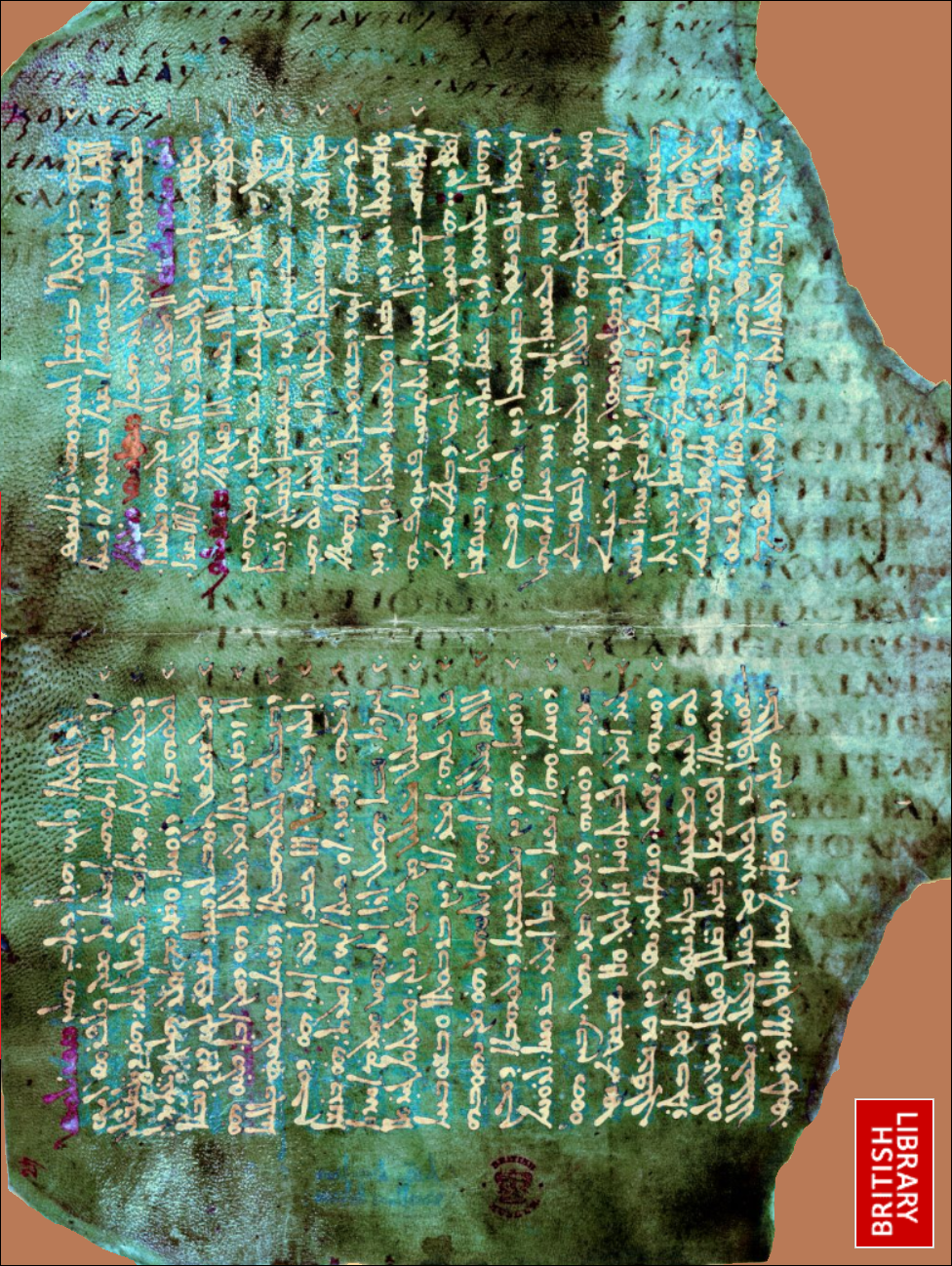
After this manuscript was purchased, William Cureton (the same researcher who discovered and published the Curetonian Syriac manuscript) published its text of part of the Iliad in 1851. Its text of Luke was studied by both Samuel Tregelles and Constantine Tischendorf; the latter published it in 1857 in his series Monumenta Sacra Inedita, volume 2 (beginning on page 56 of the downloadable file), and each page’s contents are identified in his transcription.
Now housed at the British Library (and catalogued as Add. MS 17211), Codex R has been rebound so that the opening pages contain the portion which has text from the Gospel of Luke in the lower writing. Tischendorf managed to not only transcribe the text but also the Eusebian Section-numbers and the marginal note seen here (which accompanies text from Luke 16 but relates to the parable of the Prodigal Son which was on the preceding page). On some pages, quite a bit of the Greek text, written in two columns per page, is in the margins and is not obscured by the Syriac upper writing; on other pages practically all of the Greek text is thoroughly eclipsed. Some of the British Library’s digital images of pages of Luke have been helpfully indexed.
A study of the text of R by Robert Waltz indicated that there is considerable mixture in R’s essentially Byzantine text, especially in chapters 13, 14, and 15. It is one of the relatively few manuscripts which do not include Luke 22:43-44. Despite the importance of Codex R, the compilers of the 27th edition of the Nestle-Aland Novum Testamentum Graece deliberately stopped citing it, as stated in the Introduction of that edition.
● Codex Guelpherbytanus A (024, Pe) and 026 Codex Guelferbytanus B (026, Q) are two early Greek witnesses to the Byzantine text of the Gospels. They are often consulted together, because each one was recycled when someone in the 700s used their pages for writing-material with which to make a copy of the Latin text of Isidore of Seville’s Etymologies, a.k.a. Origins, a highly significant work in its own right.
The person who prepared this palimpsest also recycled pages from a Latin-Gothic copy of Romans (this text is known as Codex Carolinus, a.k.a. Beuron 79) and the lower writing dates to the 500s or 600s), a Vulgate copy of the book of Judges, a Vulgate copy of Job, a copy of Ambrosiaster’s Commentary on Romans, and a copy of the Roman author Galen’s composition On the Properties of Foods.
Tischendorf gave 024 and 026 his attention and transcribed then both: 024’s text of portions of Matthew, Mark, Luke, and John is recorded in Monumenta Sacra Inedita, Volume 6, published in 1869, following the title-page on digital page 276. Tischendorf’s transcript of 026’s text of portions of Luke and John (especially Luke) follows digital page 310 in Monumenta Sacra Inedita, Volume 3, published in 1860.
Unfortunately, few individuals other than readers of Tischendorf’s publications (in which most of the introductions and notes were written in Latin) seem to have paid much attention to Codices 024 and 026. Bruce Metzger did not mention them in the chapter Important Witnesses to the Text of the New Testament in his textbook The Text of the New Testament. 026, but not 024, was consulted for the Tyndale House edition of the Greek New Testament. Hopefully this neglect will not last long. A complete index of 024 and 026 (facilitating comparisons between the online digital images of the manuscript, and Tischendorf’s page-by-page transcript) is available as a free download among the files stored at the NT Textual Criticism group on Facebook.
(Those who page through the digital page-views may also notice Isidore’s comments and diagrams about the spherical shape of the earth, the moon’s rotation around the earth, etc.)
| On this page from Codex Zacynthius (040), an excerpt from the writings of Cyril of Alexandria stands in the upper and lower margins. The text of Luke is written in different lettering. The old parchment was reused to make a medieval lectionary, written in black and ink. |
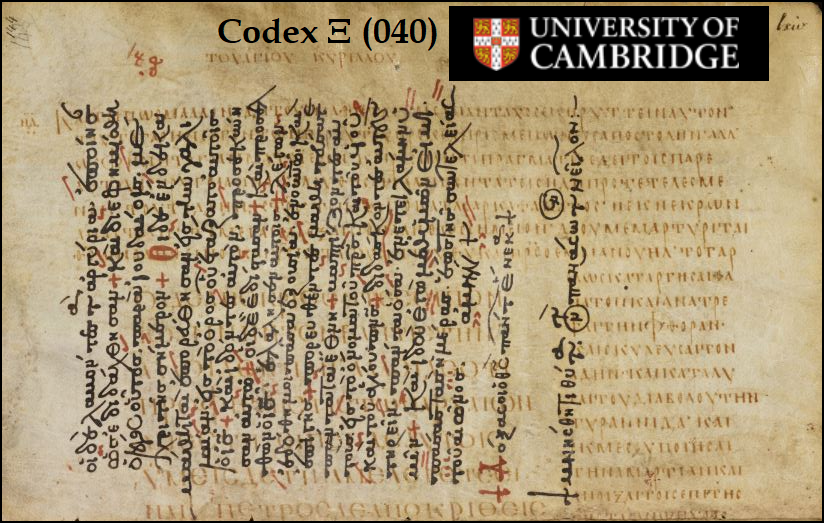
● Codex Zacynthius (040, Ξ) is two New Testament manuscripts in one: the upper writing is Lectionary 299, produced in the 1200s or 1300s. The lower writing contains, in uncial script, text from the first half of the Gospel of Luke, and was probably written in the 700s, although some researchers have proposed that it was made in the 600s or even the 500s. The text of Luke is framed by a catena-commentary in the margins; the excerpts from patristic writings are also written in uncials, but the letters are smaller and vertically elongated so as to avoid confusion between the Scripture-text and the patristic excerpts.
Included among the patristic writers cited in the catena – Chrysostom, Origen, Isidore of Pelusium, Titus of Bostra, Cyril of Alexandria (especially) and more – is Severus of Antioch, who wrote in the 500s (the same person whose composition constitutes the upper writing in Codex Nitriensis); this may seem to weigh in against the idea that the catena in Ξ was made during or very shortly after his lifetime; on the other hand, Severus’ name was erased, which suggests that the manuscript was read and used by someone who was apparently not altogether willing to attribute helpful comments to Severus on account of his problematic Christological views.
One of the notable features of Codex 040 was noticed by Samuel Tregelles in his 1861 publication of its contents: chapter-divisions, accompanied by the letter Ψ, are the same as those found in Codex Vaticanus. This suggested to Tregelles what a detailed study of its text confirmed: it often agrees with the Alexandran uncials. At Luke 4:8, for example, Ξ is allied with Vaticanus and Sinaiticus by not including the phrase “Get behind Me, Satan” (Υπαγε οπισω μου σατανα).
Tregelles avoided using chemicals to restore the text, preferring instead to use “every clear day for about four months” – by which I deduce that he held the pages up to sunlight (or else used a mirror to catch the sunlight and project it onto the pages) to see the lower writing. Modern-day researchers are using new methods, including multi-spectral imaging, to continue to investigate the text of this palimpsest.
[Readers are encouraged to use the embedded links in this post to explore additional resources.]
Posted by James Snapp Jr at 12:30 PM
https://www.thetextofthegospels.com/2018/04/five-palimpsests.html
Friday, March 25, 2022 John 6:15 – An Interesting Little Detail
Near the end of John 6:15 – following John’s account of the feeding of the 5,000 – there is an interesting variant-unit: did John write that Jesus withdrew again (ἀνεχώρησεν πάλιν) to the mountain by himself, or that Jesus withdrew (ἀνεχώρησεν) (without “again”) to the mountain by himself, or that Jesus “fled again” φεύγει πάλιν) to the mountain by himself?
John does not use ἀνεχώρησεν anywhere else, so perhaps there is something to be said in favor of φεύγει: the idea is that copyists changed the wording of Jesus’ movement to avoid giving the impression that Jesus was running away like Brave Sir Robin. On the other hand, John does not use φεύγει anywhere else, either.
Constantine von Tischendorf was willing to let Codex Sinaiticus overrule all other Greek manuscripts in existence in John 6:15, in his eighth edition of the Greek New Testament. Scholars less entranced with À have not concurred, arguing (as Metzger reports in his Textual Commentary) that φεύγει originated as a Western reading. It had to be introduced as a sort of paraphrase fairly early, inasmuch as it is supported by Tertullian, De Rebaptismate, Ambrose, Jerome (who placed fugit in the Vulgate, agreeing with several Old Latin copies) and Augustine. (Tertullian’s reference is not airtight, however: in On Idolatry XVIII, he simply says that Christ “shrank back from being made a king,” without explicitly quoting John 6:15.)

Ἀνεχώρησεν is read in all text-types: Alexandrian (P75, B, L), Western (D), Byzantine (A, K, Λ, Π, N) and Caesarean (f1). But did John write only ἀνεχώρησεν or ἀνεχώρησεν πάλιν? Manuscripts without πάλιν here include W, Δ, Ψ, and most Byzantine copies. The Peshitta, likewise, does not support πάλιν. The word could perhaps have been skipped accidentally, if a copyist’s line of sight slid from the ν at the end of ἀνεχώρησεν to the ν at the end of πάλιν. Or, having just read John 6:3’s account of Jesus going up into the mountain, early copyists couldn’t resist harmlessly adding πάλιν – but one would have to believe this happened at least twice for πάλιν to drift into A, D, Π, N, and Y.
The Curetonian Syriac, interestingly, supports a conflate reading: fled and withdrew again.
Readers of the Nestle-Aland Novum Testamentum Graece compilation would never detect that the reading found in the Byzantine Text, W, and the Peshitta exists: the N-A apparatus mentions the reading in À but not the reading of most manuscripts – an omission that is difficult to explain except as an effect of the editors’ pro-Alexandrian bias. The UBS apparatus doesn’t mention the non-inclusion of πάλιν either; nor does they Tyndale House GNT’s apparatus.

The non-original reading φεύγει is more interesting than it looks – not only because it was temporarily favored by a leading textual critic in the 1800s, but because it reveals that retro-translation sporadically affected the Greek text in the exemplar of the opening chapters of John in Sinaiticus – the same sort of Western phenomenon that has unfortunately affected the NIV 2011’s base-text of Mark 1:41.
Posted by James Snapp Jr at 2:13 PM
https://www.thetextofthegospels.com/2022/03/john-615-interesting-little-detail.html
Tuesday, June 14, 2022 Do Any Textual Variants Impact Doctrine?
Do any textual variants in the New Testament have the potential to make a significant doctrinal impact?
In the past, major champions of the traditional text answered that question with a simple “No.” Robert L. Dabney wrote in 1871, that the received text – the Textus Receptus, the base-text of the KJV, while “not asserted to be above emendation,” “contains undoubtedly all the essential facts and doctrines intended to be set down by the inspired writers,” and “If it were corrected with the severest hand, by the light of the most divergent various readings found in any ancient MS or version, not a single doctrine of Christianity, nor a single cardinal fact, would be thereby expunged.”
More recent writers have expressed similar sentiments. D.A. Carson, for example, has written that the Westminster Confession’s affirmation that the Biblical text has been kept pure in all ages ought to be understood to mean that “nothing we believe to be doctrinally true, and nothing we are commanded to do, is in any way jeopardized by the variants.” (from p. 56 of The KJV-Only Controversy – A Plea for Realism.)
The view of Dan Wallace, however, is better-informed and more nuanced. It amounts to this: no viable and meaningful variant jeopardizes any cardinal doctrine. The adjectives in that sentence are important, so let’s look into what they mean. A viable variant is one which textual critics regard as potentially original; it is favored by weighty (though not necessarily decisive) evidence. A meaningful variant is one which affects the meaning of the passage in which it occurs. And a cardinal doctrine is one that expresses a fundamental point of the Christian faith.
Using this nuanced approach, a question immediately arises: which doctrines are cardinal? Is inerrancy a cardinal doctrine? Looking at the website of Dallas Theological Seminary (where Dr. Wallace has taught), a statement can be seen that requires students to agree with seven beliefs; the seventh is “the authority and inerrancy of Scripture.” And looking at the requisite Statement of Faith – “requisite” in the sense that faculty members at DTS are required to affirm it annually – one sees a statement that “We believe that the whole Bible in the originals is therefore without error.”
Michael Kruger argued at the Ligonier website (in 2015) that the doctrine of inerrancy is essential, and that it supplies “the foundation for why we can trust and obey God’s Word.” Don Stewart has also proposed that “inerrancy is an essential, foundational concept and its importance should not be minimized.” Dan Wallace, meanwhile, has downplayed the centrality of inerrancy, stating in 2006 (in a post that is still online) that “inerrancy and verbal inspiration are more peripheral than core doctrines.” In other words – if I understand him correctly – Dr. Wallace does not, and has not, for some time, regarded inerrancy as a cardinal doctrine – and so his statement to the effect that no viable and meaningful variant significantly affects cardinal doctrines should not be interpreted to mean that no viable and meaningful variants affect the doctrine of inerrancy.
Some apologists have followed the example of Wallace’s nuanced approach very closely; for example, in an article at Stand To Reason’s website, Tim Barnett wrote in 2016 that “No major doctrines depend on any meaningful and viable variants.”
However, I can think of at least two variants that jeopardize the doctrine of inerrancy, both of which occur in the first book of the New Testament: in Matthew 13:35 and Matthew 27:49. Only the one in Matthew 13:35 is acknowledged by a footnote in the NLT, NASB, and ESV. (At least, this is the case in the copies that I have. So many editions of modern versions are in circulation that it would be burdensome to keep track of them all – which might make one wonder how seriously the “Standard” part of their names should be taken.) Neither of these variants is given a footnote in the CSB, nor in the NKJV, nor in the hyper-paraphrase known as The Message. And the Tyndale House Greek New Testament does not have a footnote at Matthew 13:35 or at Matthew 27:49.
Most of the English versions I have named so far are currently ranked among the ten most-popular versions of the Bible in America. So much for the idea that no one is hiding these variants.
Let’s see what those variants in Matthew 13:35 and 27:49 say.
In Matthew 13:35, the scribe of Codex Sinaiticus, rather than writing that a prophecy was spoken by “the prophet,” wrote that it was spoken by “Isaiah the prophet.” This reading collides with reality: the referred-to prophecy is from Psalm 78:2 – a composition by Asaph, and not from Isaiah. In addition to the scribe of Codex Sinaiticus, witnesses that support “Isaiah the prophet” in Mt. 13:35 include (according to the textual apparatus of UBS4) Q, f1, f13, 33, and the reading was known to Jerome; Jerome wrote (in Homily 11 on Psalm 77) that “in all the ancient copies,” the prophecy is explicitly attributed to Asaph, and Jerome offers the theory that scribes who were unfamiliar with Asaph replaced his name with Isaiah’s name. The editors of UBS4 assigned this reading a ranking of “C,” which, as they explain in their Introduction, “indicates that the Committee had difficulty in deciding which variant to place in the text.”
In an earlier generation, F. J. A. Hort – who edited, with Westcott, the primary ancestor of the base-text of the New Testament used for the NIV, ESV, NLT, CSB, NASB and NRSV – argued for including “in Isaiah the prophet” in the text. His argument ran as follows: “It is difficult not to think Ἠσαίου genuine. There was a strong tendency to omit it (cf. xxvii 9; Mc 1 2); and, though its insertion might be accounted for by an impulse to supply the name of the best known prophet, the evidence of the actual operation of such an impulse is much more trifling than might have been anticipated. Out of the 5 (6) other places where the true text has simply τοῦ προφήτου, in two (Mt ii 15 [Hosea]; Acts vii 48 [Isaiah]) , besides the early interpolation in Mt xxvii 35 [Psalms], no name is inserted; in two a name is inserted on trivial evidence (Mt ii 5, Micah rightly, and Isaiah [by a] wrongly ; xxi 4, Isaiah and Zechariah both rightly [Zech by lat.vt]) ; and once (Mt i 22) Isaiah is rightly inserted on various Western evidence. Also for the perplexing Ἰερεμίου of xxvii 9, omitted by many documents, rhe has Ἠσαίου. Thus the erroneous introduction of Isaiah’s name is limited to two passages, and in each case to a single Latin MS. On the other hand the authority of rushw and aeth is lessened by the (right) insertion of Ἠσαίου by one in Mt i 22, and by both in xxi 4. The adverse testimony of B is not decisive, as it has a few widely spread wrong readings in this Gospel.”
Constantine von Tischendorf included Ἠσαίου in Matthew 13:35 in the 8th edition of his compilation of the Greek New Testament. And in 1901, Eberhard Nestle wrote (on p. 251 of his Introduction to the Textual Criticism of the Greek New Testament) that διὰ Ἠσαίου τοῦ προφήτου “is certainly, therefore, original.” Anyone using a Greek New Testament compiled by Tischendorf or Nestle today would be rather challenged if he were to attempt to maintain the doctrine of inerrancy, inasmuch as if Matthew attributed Psalm 78:2 to Isaiah, then Matthew erred.

In Matthew 27:49, major Alexandrian witnesses (Sinaiticus, Vaticanus, Codex C, Codex L), some important versional witnesses (Mae1, Mae2, the Ethiopic version, and assorted witnesses (listed by Willker as U, Γ, 5, 26, 48, 67, 115, 127, 160, 175, 364, 782, 871, 1010, 1057, 1300, 1392, 1416, 1448, 1555, 1566, 1701, 1780, 2117, 2126, 2139, 2283, 2328, 2437*, 2585, 2586, 2622, 2680, 2766, and 2787) support the reading, at the end of the verse, ἄλλος δὲ λαβών λόγχην ἔνυξεν αὐτοῦ τήν πλευράν καί ἐξῆλθεν ὕδωρ καί αἷμα. (In the underlined witnesses the final words are αἷμα καί ὕδωρ instead of ὕδωρ καί αἷμα.) This means: And another [person], taking a spear, pierced his side, and out came water and blood. Then, in Matthew 27:50, Jesus dies.
The adoption of this reading into the text would be fatal to the doctrine of inerrancy, because the Gospel of John candidly states (in 19:34) that Jesus was pierced in His side with a spear, resulting in a flow of blood and water, after He died, and this contradicts the text of Matthew if this reading – supported by the two early manuscripts (À and B) that are the primary basis for the heading and footnote that draw into question Mark 16:9-20 in the ESV, CSB, NRSV, etc. – is adopted.
In 2018, in a post at Evangelical Textual Criticism, Tyndale House GNT editor Dirk Jongkind acknowledged that this variant probably should have been mentioned in the apparatus of the Tyndale House GNT. He also acknowledged that “On external evidence, the addition has definitely a very good shout” – which – I think – is tantamount to granting that the reading is viable. But Jongkind rejects the reading, admitting that “The ‘best and earliest manuscripts’ do not always present us with the ‘best and earliest readings.’” Perhaps this statement should be printed in large letters alongside the ESV’s bracketed heading between Mark 16:8 and 16:9 (which reads, “Some of the earliest manuscripts do no include 16:9-20.”).
But this reading in the most significant manuscripts representative of the Alexandrian Text certainly was treated as viable by Westcott and Hort, who included the variant, within double brackets, in their compilation. In Westcott & Hort’s Notes on Select Readings, after analyzing the evidence pertaining to this variant, they concluded as follows: “Two suppositions alone are compatible with the whole evidence. First, the words ἄλλος δὲ κ.τ.λ. [“κ.τ.λ.” meaning “etc.”] may belong to the genuine text of the extant form of Mt, and have been early omitted (originally by the Western text) on account of the obvious difficulty. Or, secondly, they may be a very early interpolation, absent in the first instance from the Western text only, and thus resembling the Non-Western interpolations in Luke xxii xxiv except in its failure to obtain admission into the prevalent texts of the third and fourth centuries. The prima facie difficulty of the second supposition is lightened by the absence of the words from all the earlier versions, though the defectiveness of African Latin, Old Syriac, and Thebaic evidence somewhat weakens the force of this consideration. We have thought it on the whole right to give expression to this view by including the words within double brackets, though we did not feel justified in removing them from the text, and are not prepared to reject altogether the alternative supposition.”
Competent textual critics – including some who laid the foundation for the compilations of the ESV, CSB, NLT, and NRSV – have treated one or two readings that convey erroneous statements as if they are viable and meaningful. Therefore, the notion that there are no viable and meaningful textual variants in the New Testament that jeopardize any cardinal doctrine can only be maintained by those who do not consider the doctrine of inerrancy to be a “cardinal doctrine.”
So: do any textual variants in the New Testament have the potential to make a significant doctrinal impact? If you consider the doctrine of inerrancy a significant doctrine (which most evangelical Christians do), the answer is yes.
Posted by James Snapp Jr at 12:03 AM
https://www.thetextofthegospels.com/2022/06/do-any-textual-variants-impact-doctrine.html
Sharing is caringFacebookX / TwitterLinkedInWhatsAppTelegramRedditEmail6327 words · 161 views