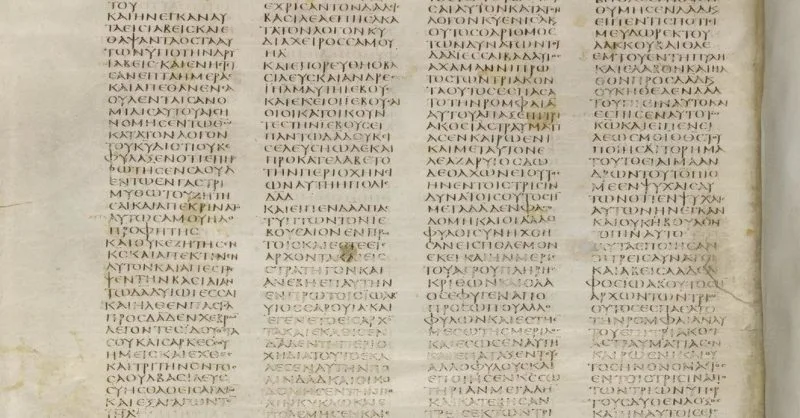
Sinaiticus “in the Old Testament, the text of Judith and Tobit “are of quite a different recension – a recension still preserved principally in old Latin and old Syriac documents.”
In addition to such proofs of Sinaiticus’ antiquity, readers/viewers may consider the features of the manuscript that I pointed out in the debate:
l Multiple scribes worked in the manuscript’s production, shown by their different spelling, use of space-fillers, and replacement-pages. This collides with Simonides’ claim to have written the entire manuscript himself.
l The manuscript was used for centuries, as shown by layers of correction and annotations (some in Arabic).
l Reinforced lettering on multiple pages (in a manuscript that Simonides said was new in 1841).
l Extensive damage to the manuscript in the books on the Pentateuch (in a manuscript that Simonides said was new in 1841).
But I think the plainest evidence the Simonides lied habitually about the manuscript is his claim that after writing the Greek text of the Old and New Testaments, and the book of Barnabas, and the first part of Hermas, “the supply of parchment ran short.” He stated this in print in the 1863 For the 1975 New Finds included pages from Hermas from near the end of the book. Simonides obviously did not know any more about the manuscript in 1863 than what he had read in Tischendorf’s descriptions of it.
People might ask, “Why would Simonides make such a claim?” The answer is simple: his motive was simple revenge; he hoped to besmirch Tischendorf because earlier, in 1856, Tischendorf had exposed his attempt to con German scholars into buying one of his forgeries.
It is no wonder that Tischendorf called Simonides’ claims an “insane fancy.” He concluded his brief note in 1863 by saying, “Sound eyes and ordinary common sense are quite sufficient for the purpose of seeing the absurdity of the Simonides tale” – but, “mundus vulti decepi,” and “volent[i] non fit injuria.”
(These two Latin phrase may be paraphrased as “The world wants to be fooled” and “to a willing person, injury is not done” – a way of saying that those who listen to Simonides, knowing he was a seller of forgeries, have only themselves to blame for being deceived. – A principle similar to, “You knew there was a risk of getting hit by a baseball when you went to the baseball game.”)
Here are links to four earlier blog-posts in which I go into more detail on this subject: One, Two, Three, Four.
Tuesday, March 21, 2017
Sinaiticus Is Not a Forgery – Setting the Stage
Codex Sinaiticus, one of the most important early manuscripts of the New Testament, is over-rated. Even though it is often heralded as “The World’s Oldest Bible,” having been produced in the mid-300’s, its text is so riddled with scribal errors that many much younger manuscripts can be shown to be more accurate – whether one uses the Byzantine Text, or the primarily Alexandrian Nestle-Aland compilation, as the basis of comparison. It does not really deserve the description that so often appears in Bible footnotes that cite “The most reliable manuscripts” when referring to its readings. Its text-critical importance lies in that it constitutes early confirmation of readings found in Codex Vaticanus, which, besides being slightly earlier, was written much more carefully.
In the past few years, a conspiracy theory has developed about Codex Sinaiticus, consisting of the claim that the manuscript is not from the 300’s but is instead from the 1800’s – specifically, that it was made by Constantine Simonides, who was both a scholar and a notorious forger. Before introducing his claims and the evidence against them, let’s review today the basic history of how Codex Sinaiticus was brought to the attention of European researchers.
| Saint Catherine’s Monastery (Photo: Joonas Plaan) |
In May of 1844, the textual critic Constantine Tischendorf visited Saint Catherine’s Monastery on Mount Sinai
, and there, “in the middle of the great hall,” he saw “a large and wide basket full of old parchments.” According to Tischendorf, the librarian informed him that the monks had “already committed to the flames” two heaps of papers like these. Tischendorf examined the contents of the basket, and found there “a considerable number of sheets of a copy of the Old Testament in Greek,” and he was then allowed to take “a third of these parchments, or about forty-three sheets,” which, if it had not been for his intervention, “were destined for the fire.”
Those 43 sheets [more accurately, leaves] containing text from the Greek Old Testament were published in 1846 by Tischendorf as “Codex Frederico-Augustanus,” so-named after Frederick, king of Saxony, who financed his travels. The pages themselves were entrusted to the library at the University of Leipzig, where they remain to this day.
That, at least, is the way Tischendorf tells the tale, in a special chapter of his little book When Were Our Gospels Written?. The monks of the monastery later insisted that Tischendorf’s account was wrong, that the basket was simply a basket used for carrying detached manuscript-pages, and that they were not disposing of the ancient contents of their valuable and extensive library by tossing legible parchments into any fire. Indeed, J. Rendel Harris, who visited the monastery later in the 1800’s, claimed to have seen the basket to which Tischendorf referred, and after investigating the matter, he considered the monks’ protests to be entirely justified, and regarded Tischendorf’s version of events as an amusing myth. (Tischendorf’s view of the monks at Saint Catherine’s Monastery may be deduced from a comment that he wrote in a letter in 1844, when he was at the monastery: “I have now been in the St.
Catherine Monastery eight days. But oh, these monks! If I had the military strength and power I should be doing a good deed if I threw this rabble over the walls.”)
Tischendorf might have lied so as to depict himself as a sort of hero, rescuing the manuscript in the nick of time. Or he might have misunderstood what he had been told, and misunderstood why the pages were in the basket – like someone who sees a library’s book-return box for the first time and assumes that people are throwing away their books in a small dumpster. In any event, he returned to the monastery in 1853, and found no more intact pages of the manuscript – only a fragment from the book of Genesis.
In 1859, Tischendorf again visited Saint Catherine’s monastery, hoping to find the rest of the manuscript of which he had acquired 43 sheets in 1844. (Although he had published the contents of those pages, he had not revealed where they had been acquired.) According to Tischendorf’s account, on February 7 of 1859, “the steward of the convent” showed Tischendorf “a bulky kind of volume wrapped up in a red cloth,” and when it was opened, Tischendorf recognized that its pages included some of the pages that he had seen, but not obtained, in the basket in 1844:
“I unrolled the cover, and discovered, to my great surprise, not only those very fragments which, fifteen years before, I had taken out of the basket, but also other parts of the Old Testament, the New Testament complete, and, in addition, the Epistle of Barnabas and a part of the Pastor of Hermas.” (These last mentioned books are compositions from the early 100’s.) Inwardly Tischendorf was “full of joy,” but he strategically asked in a casual way if he could borrow the manuscript to look at it more closely. His request was granted, and once he was alone with the manuscript, “though my lamp was dim and the night cold,” he writes, “I sat down at once to transcribe the Epistle of Barnabas.”
Not long after this, the manuscript was transferred to Cairo
, and it was eventually deposited in the Russian library at Saint Petersburg
, where it was regarded as a gift to Czar Alexander II. Tischendorf studied the manuscript there. A sample of its script was released in 1860, and the full contents were published in 1862, in a special Greek font that resembled the uncial handwriting of the copyists. Once again, Tischendorf’s account of how this happened contradicts the claims of the monastery’s monks, for some of them insisted that Tischendorf had promised to return the manuscript upon request.
A note to this effect, with Tischendorf’s signature, is still extant at the monastery; in it, Tischendorf states that there has been delivered to him “as a loan an ancient manuscript of both Testaments, being the property of the aforesaid monastery,” and “This manuscript I promise to return, undamaged and in a good state of preservation, to the Holy Confraternity of Mount Sinai at its earliest request.” Eventually, instead of the manuscript, the monks of the monastery received a donation and a collection of medallion-awards.
This brings us up to the time when Constantine Simonides enters the picture. In a letter that was published in The Guardian newspaper on September 3, 1862, Simonides claimed that he had produced Codex Sinaiticus in 1839, while he had resided at Mount Athos (an important monastery-center in Greece which has a vast manuscript-library), using, as its basis, the contents of a printed copy of the text of Codex Alexandrinus, three manuscripts from Mount Athos, and a printed Greek Bible published by Zosima, based in Moscow. He claimed to have obtained the required amount of parchment from an ancient codex at Mount Athos that consisted almost entirely of blank pages.
Simonides claimed that after finishing this large project, he donated it to a retired church-leader, Constantius, whose home was on the Greek island of Antigonus. Constantius, in turn (again – it is claimed by Simonides), after sending a contribution to Simonides, donated the codex to Saint Catherine’s monastery, and that, according to Simonides, is how its pages turned up there in 1844, when its pages were first encountered by Tischendorf. Simonides also claimed that he himself had visited Saint Catherine’s monastery in 1844 and 1852, and had seen the codex there.
With all this in the background, we shall test Simonides’ claims. But first, it should be pointed out that some well-distributed versions of the history of how Tischendorf encountered Codex Sinaiticus are far from accurate. Let us remove these boulders from the field today, or at least one of them. Specifically, James White, in his book The King James Only Controversy, on pages 56-57 of the 2009 edition, describes Tischendorf’s 1844 visit to Saint Catherine’s monastery very differently. White claims that Tischendorf “noticed some parchment scraps in a basket that was to be used to stoke the fires in the monastery’s oven.” And in a footnote, White says, “If you’re wondering why these scraps would be in a trash can, the answer is that ancient books, be they made of papyri or vellum, decay over time. Bits of pages, the final or initial pages in a codex, were very subject to loss; they would, over time, find their way to the floor and need to be picked up or pose a real fire hazard.”
In some online comments, White categorically denies that Codex Sinaiticus was found in a trash can. Yet, with equal confidence, he describes Tischendorf’s 1844 visit to Saint Catherine’s monastery as follows:
“So, they have someone from the outside world there amongst them; that makes them a little bit nervous, and so there’s this monk, and he’s just, you know, carrying a basket with him with some old scraps of stuff that they don’t need anymore, and von Tischendorf looks in there and realizes, ‘That’s a page from the Septuagint.’ And he stops him, and he goes, you know, ‘This freakish guy from Europe is grabbing my trash can, and he’s all excited about the trash in my trash can, and he’s telling me, “Don’t burn this! Don’t burn this!”’”
White continues, moving on to describe the 1859 visit: “On the final night of his visit, in 1859, he decided to be a nice guy. And he had published a version of the Septuagint, the Greek translation of the Old Testament. So he had an extra copy with him. And he decided to be nice to his steward, who had been taking care of him, and he said, ‘I’d like to give this to you as a present. And the monk looked at it, and said, ‘Oh, I have one of these. Let me show it to you. So the monk takes him into his room, and in what we would call a closet, he reaches up, and he pulls something down that is wrapped in a red cloth. Now, monks do not wrap garbage in red cloths. They don’t keep garbage wrapped in red cloths in their closets. And so he pulls this thing out, and he unwraps the red cloth, and there von Tischendorf is staring at Codex Sinaiticus.”
In the same lecture, White says about Codex Sinaiticus: “It was not found in a trash can, despite how many times D. A. Waite or Dave Hunt or anybody else says that it was. It was not.”
It is no credit to D. A. Carson, John MacArthur, Mike Baird, Norman Geisler, and the others who have recommended White’s book, that this twisted version of events not only made it through the initial editing of The King James Only Controversy in 1995, but also survived to be reprinted in the second edition. For in real life, what White refers to as “scraps” were the 43 parchment sheets that Tischendorf published as Codex Frederico-Augustanus. That is, they were (and still are) pages from the Old Testament portion of Codex Sinaiticus.
Stauffer and those like him continue to repeat the story is for its impact upon those ignorant of history and unlikely to actually look into it for themselves. But for anyone serious about the subject, such dishonesty destroys one’s credibility.”
Considering that it is James White who is mixed up, such a confidently worded statement destroys his credibility and makes him a laughingstock. But he should not bear the blame alone, for his colleagues and co-workers have allowed his error to circulate for over 20 years, either because they, too, are ignorant about the history of how Tischendorf first encountered pages from Codex Sinaiticus, or because they find such a combination of bravado and ignorance highly entertaining.
With all that in the background, we shall focus on the claims of Constantine Simonides, and the evidence against them, in the next post.
Friday, March 24, 2017
Ten Reasons Why Sinaiticus Was Not Made By Simonides
Today, we shall explore reasons why Codex Sinaiticus was not made in 1839-1841. I intend to provide twenty such reasons; today I will settle for ten.
In the previous post, we saw that there is some question about the manner in which Codex Sinaiticus, or at least the main portion of it, was obtained by Constantine Tischendorf at Saint Catherine’s Monastery – 43 parchment sheets in 1844, and a much larger portion in 1859, which included every book of the New Testament. Although the exact manner in which it was brought to the attention of European scholars is disputed, there is no question among paleographers – researchers who specialize in the study of ancient handwriting and writing-materials – that the manuscript is genuinely ancient.
In 1862, however, after the text of Codex Sinaiticus was published by Tischendorf, a scholar named Constantine Simonides claimed that this manuscript was not ancient at all. In a letter that appeared in the newspaper called The Guardian on September 3, Simonides claimed that the manuscript that Tischendorf heralded as the pearl of all his researches was actually something that Simonides himself had made. “About the end of 1839,” Simonides wrote, his uncle Benedict, who oversaw a monastery on Mount Athos, wished to present a gift to the Russian Czar, Nicholas I. After Benedict consulted with some colleagues, it was decided that a complete Greek manuscript of the Bible, combined with works of the sub-apostolic age (Barnabas, Hermas, Clement of Rome, etc.), written in ancient lettering on parchment, would be a suitable gift – along with a gold cover. The chief calligrapher of the monastery was very reluctant to begin such an intimidating task, and so Simonides, then 19 years old, began the project, after studying the handwriting in manuscripts at Mount Athos. His uncle Benedict, he claimed, made a sort of exemplar by using a printed Greek Bible (printed by Zosima with the support of the Moscow Bible Society), comparing it with ancient copies at Mount Athos.
And from where did he get the parchment? Simonides stated that at Mount Athos
, he conveniently found a bulky codex consisting almost entirely of blank pages, “prepared apparently many centuries ago.” Simonides filled these pages, he claimed, with the Old Testament and the New Testament, and proceeded to write compositions from the sub-apostolic age (Barnabas and Hermas) until he ran out of parchment. By the time he had gotten that far, his uncle had died, and so instead of presenting it to the czar, he went to Constantinople and consulted two patriarchs, Anthimus and Constantius, who recommended that he donate it to Saint Catherine’s Monastery in the Sinai Peninsula, where Constantius had previously served as bishop. Simonides agreed to this course of action. S
hortly thereafter – according to Simonides – he took the codex to the island of Antigonus
, intending to deliver it to Constantius, whose residence was there. Constantius was, however, away from home, and so Simonides left it there in a packet, with a letter. Later, Simonides claimed, he received a letter from Constantius, written in August of 1841, assuring him that the codex would be donated to Saint Catherine’s Monastery as he had intended.
Simonides then said that in 1852, he had visited Saint Catherine’s Monastery and had seen the manuscript there, and examined it, “and found it much altered, having an older appearance than it ought to have.” Simonides also noted that the preface, in which the manuscript was dedicated to Czar Nicholas I, had been removed. Later, Simonides continued, he had been shown a sample-page of the manuscript that Tischendorf was publishing, and “at once recognized” his own work.
Now that we have an idea of what Simonides’ claims were, let’s look at the reasons why they do not survive close scrutiny.
Bits of Codex Sinaiticus Were Discarded or Recycled. Fragments from Codex Sinaiticus were used to reinforce the bindings of other manuscripts at Saint Catherine’s Monastery. While part of Codex Sinaiticus (the part taken by Tischendorf in 1844) resides at Leipzig
, and a larger portion resides at the British Library, a few pages and fragments are at the National Library of Russia. These portions were obtained by the researcher Porphyry Uspensky when he visited Saint Catherine’s Monastery, no later than 1846. Simonides’ claims would thus require that the monks of Saint Catherine’s Monastery, after receiving a pristine Greek manuscript of the entire Bible in 1841, recycled several of its pages as binding-material in the next few years.
(2) Codex Sinaiticus Is Huge. Simonides claimed to have made the manuscript in a relatively small amount of time, beginning “About the end of the year 1839” and finishing some time before August of 1841. Those who have seen the manuscript, or facsimiles of it, can testify what a massive project this would be for one person to undertake: when in pristine condition, the codex consisted of over 740 leaves (i.e, 1,480 pages). To complete that amount of space with uncial lettering would be a massive undertaking: reckoning that each page had approximately 2,500 letters, the writing of over 3,700,000 letters would be required to complete the codex.
(3) Codex Sinaiticus Has a Note About An Ancient Manuscript Made at Caesarea
. After the book of Esther, a note in Codex Sinaiticus states, “Checked for accuracy using a very old copy corrected by the hand of the martyr Pamphilus. At the end of this ancient book, which begins with the First Book of Kings [i.e., First Samuel], and ends with Esther, is the handwriting of Pamphilus himself; it says: ‘Copied and corrected against the Hexapla of Origen as corrected [or, made accurate] by him. Antoninus the confessor cross-checked it; I, Pamphilus, corrected the volume in prison, by the great grace and ability from God. And if it is not an overstatement, it would not be easy to find a manuscript like this one.” A similar note appears at the end of the book of Second Esdras. Had Simonides made the manuscript as a straightforward transcript of the Greek Bible, with no intent to deceive, he would have no motivation to create this feature, or the 160 corrections added by the “Pamphilian Corrector” in Second Esdras and Esther.
4) Codex Sinaiticus Has Arabic Notes. As David Parker observes in his book on Codex Sinaiticus, Arabic notes appear in Codex Sinaiticus at Isaiah 1:10
, and at Zechariah 14:8, and in parts of Revelation. The scenario described by Simonides provides no motive for the creation of this feature (nor is there evidence that Simonides knew Arabic when he was 19 or 20 years old.)
One of the Arabic notes, as David Parker has pointed out, probably refers to the approach of seven thousand years of earth’s existence, as calculated via the Byzantine Anno Mundi calendar, which reckoned that the universe was created in 5,509 B.C. The completion of 7,000 years was thus expected to come in the late 1400’s, and the fall of Constantinople in 1453 probably caused the Arabic-writing annotator to interpret part of Revelation chapter 8 (by which the note appears in the margin) as a prophecy about Islamic conquests – the star in 8:10 being called, in the note, a star “of the Arabs” – after which he expected persecution to begin.
If Codex Sinaiticus was extant in the second half of the 1400’s, as the existence of this note implies, then it cannot be the work of Simonides in the 1800’s.
(5) Codex Sinaiticus Has Clear Demonstrations of Teamwork Among Scribes. Whereas Simonides claimed to have written the codex from beginning to end, the manuscript shows that three or four copyists produced the manuscript itself, and that other copyists introduced later corrections (or attempted corrections) at much later times. The evidence for this includes the following:
● Different orthography, i.e., spelling. Among three copyists – known as Scribe A, Scribe B, and Scribe D (Scribe C was withdrawn from Tischendorf’s initial appraisal that there were four copyists, but some researchers posit that Scribe B’s work was really the work of two copyists) – Scribe D had reasonably good spelling; Scribe A had bad spelling, and Scribe B’s spelling was atrocious; as Milne & Skeat stated in Scribes & Correctors of Codex Sinaiticus in 1938, “The habits of B [i.e., Scribe B] are difficult to describe in moderate language; still more difficult is it to understand how a scribe so careless and illiterate came to be chosen for such a manuscript. He seems to have had no firm visual impression of Greek, so barbarous and grotesque are the forms which his misspellings can present to the eye, and with such utter inconsistency does he sway from correct to incorrect. His aberrations extend over the whole field.”
The worth – or rather, worthlessness – of Simonides’ story can be obtained by considering that he had no motive to use accurate spelling in one part of the manuscript (those parts made by Scribe D, including six cancel-sheets) and very inaccurate spelling in other parts. Who can believe that with a printed Greek Bible as one of his sources, anyone making a handwritten replica would introduce quirks such as writing κε in place of και (“and”) in Isaiah 22:24, Jeremiah 7:25, and twice in Hermas?
Scribe D, besides having handwriting and orthography discernibly superior to that of the other two copyists, often lined up the right margin of the columns of text that he wrote by adding small “>” symbols to the ends of lines that did not quite extend to the right margin. This symbol is never used by Scribe A.
● The copyists used different decorative designs at the ends of the books they copied. Milne & Skeat, referring to such a decorative design as a “coronis,” observed that “The coronis, in fact, amounts to his signature, so distinctive is the design (or designs) adopted by each and so restricted by the range of individual variation.”
● A gap was left between two sections written by different copyists. Codex Sinaiticus was not produced by starting at one end of the text of the Bible and finishing at the other end. Instead, one copyist was assigned one portion, and another copyist was assigned a different portion, and they worked simultaneously, with the intention that the separate sections would, after being proof-read, be bound together. This meant that the copyists had to estimate how much space each assigned portion of text would occupy – and they didn’t always get it right. They expected that the books of Tobit and of Judith would take up a little more space than they actually did in Scribe D’s handwriting. This is why Scribe A, when he began writing First Maccabees, began in the second column, expecting that Scribe D would place the last bit of the text of Judith in the first column, when he did the proof-reading. Meanwhile, what reason would any copyist working alone have to skip a column in this way, at the beginning of a page?
(6) The Eusebian Sections in Codex Sinaiticus Are a Mess. In many Gospels-manuscripts, numbers appear in the margins. These are part of a cross-reference system devised by Eusebius of Caesarea, in which a chart – the Canon Tables – listed parallel-passages (first, passages found in all four Gospels, followed by passages found in different combinations of Gospels, such as Matthew, Mark, and Luke, and concluding with the tenth canon-table, which listed passages found exclusively in one Gospel) and each passage was given a number, along with the number of the table in which its number was found.
In Codex Sinaiticus, we do not have the Canon Tables, and in the margins, the section-numbers are frequently mismatched, and are incomplete: the section-numbers for Matthew were begun but no more was initially written beyond section 52; another copyist continued the numbering (and wrote over the earlier copyist’s numbers) but he stopped in Luke at section 106. Simonides would have no reason to make such a quirky feature, and at Mount Athos
there were (and are) many resources where a complete form of the section-numbering could be found. Meanwhile, this phenomenon is accounted for by the use of the Eusebian Canons by copyists in the 300’s to whom it was a puzzling novelty.
(7) Codex Sinaiticus Does Not Have Second and Third Maccabees. There would be no motive for Simonides to omit these books, if he were intending to make a complete Bible for the Czar. Copies of Second Maccabees, at least, would be readily available in the resources of Mount Athos. Yet these two books are not in the codex. (Baruch is not there either, but it probably was present when the codex was in pristine condition.)
(8) Sinaiticus Has Marginalia In Acts Shared Only By Vaticanus. In the margins of the text of Acts in Codex Vaticanus there are two different sets of chapter-divisions. In the second set, the text is divided into 69 chapters. Each chapter’s beginning is indicated by the appearance of a Greek numeral (represented by characters of the Greek alphabet). These numerals are not in the same script used in the text, and appear to have been added centuries after the manuscript was initially made. Many other manuscripts also have numbered chapter-divisions (the “Euthalian Sections”), but until the discovery of Codex Sinaiticus, the form of chapter-divisions in Acts in Codex Vaticanus was unique. When Tischendorf’s publication of Codex Sinaiticus was released, however, it did not take long for researchers to notice that in the margins of Acts in Codex Sinaiticus, chapter-divisions appear which very closely resemble the chapter-divisions which are otherwise unique to Codex Vaticanus.
A side-by-side comparison of the chapter-numbers in Acts in Vaticanus, and the chapter-numbers in Sinaiticus, can be found by consulting the detailed and interesting (but highly technical) essay Euthaliana,by J. Armitage Robinson, which appeared in 1895 in the journal-series Texts and Studies. The author’s observance bears heavily on the question of whether Codex Sinaiticus can have been made in the 1800’s:
“Where did this system of numbers, common to א [Aleph, i.e., Sinaiticus] and B, come from? The two codices have got hold of it quite independently of one another. It cannot have been copied from B into א, for א has one number (Μ) [that is, 40] which is not found in B; nor can it have been copied from א into B, for nearly a third of the numbers (from ΜΒ [i.e., 42] onwards) are not found in א. We must go back to a common source – some MS which gave its numeration to them both – and this seems to imply that א and B were, at an early stage of their history, lying side by side in the same library.”
Robinson may have overstated his case, for it is equally possible that the source of this marginalia met each codex separately. But this does not erode the point that Simonides not only had no access to data about Codex Vaticanus’ marginalia, but he also had no motive to imitate it, nor to do so incompletely; the chapter-numbers in Codex Sinaiticus stop at Acts 14:40.
(9) Sinaiticus Is Missing Exact Lines of Text. Occasionally, a copyist’s line of sight drifted from the beginning or end of a line to the beginning or end of the next line (or, of a nearby line further down the page), causing him to accidentally omit the intervening letters. Where the amount of absent text corresponds to a particular line-length, it indicates that an exemplar was in use which had lines of that length. Simonides, however, claimed to have worked from a printed Greek Bible, which would not elicit this kind of omission.
(10) Sinaiticus’ Text-Type Shifts in the First Eight Chapters of John. As Gordon Fee showed in a detailed paper, although the Gospels-text of Codex Sinaiticus is mainly Alexandrian, in John 1:1-8:38 it is Western. Whereas Simonides had no motive to suddenly change exemplars (and gave no indication of ever possessing an exemplar with a Western text of John), and then change back, this is accounted for by a scenario in which copyists in Caesarea in the mid-300’s were transferring texts from decaying papyrus onto parchment – a scenario confirmed to be historical by Jerome in De Viri Illustribus and other sources; the organizers of this project were Acacius and Euzoius.
To be continued . . .
Saturday, March 25, 2017
Ten More Reasons Sinaiticus Was Not Made by Simonides
Continuing from where I left off:
(11) Sinaiticus Has Rare Alexandrian Readings
. As Scrivener observed in his 1864 Full Collation of Codex Sinaiticus, in Matthew 14:30, after the word ανεμον, the word ισχυρὸν is missing. The printed edition of Codex Vaticanus’ text that was available when Simonides claimed to have made the codex reported that Codex Vaticanus included this word. It was not until 1855 that the collation of the text of Codex Vaticanus was revised, and it was found that the main text of Vaticanus did not have this word; it was added by a later corrector.
This agreement between Vaticanus and Sinaiticus is one of many examples of the special affinity of their contents – agreements which would not exist between Codex Vaticanus and any artificially created composite-text based on the sources described by Simonides. Simonides claimed to have used a Greek Bible prepared at Moscow, and printed by the Zosima brothers; this was understood to refer to a Greek Bible published by the Holy Russian Synod in 1821, in which the Old Testament portion is based on Grabe’s edition of the text of Codex Alexandrinus (an edition finished in the early 1700’s by other scholars after Grabe’s death). According to T. C. Skeat, the New Testament portion of this edition consists of the Textus Receptus. It may thus be expected to represent a fifth-century form of the Greek text of the Old Testament books, but the extraction of many Alexandrian readings from its New Testament text would be impossible.
Even if Simonides had somehow acquired a collation of Codex L (a manuscript known from the time of Stephanus (mid-1500’s) to have a text of Mark, Luke, and John which often deviates from the normal Byzantine standard (because, as later researchers discerned, its text in those three Gospels, and in the closing chapters of Matthew, is Alexandrian)), this would not have helped him find Alexandrian readings in the first 20 chapters of Matthew, where L’s text is primarily Byzantine.
Yet we see many agreements between Vaticanus and Sinaiticus in Matthew 1-20 – of which the following are samples – which are inexplicable if the text of Sinaiticus were put together by the process which Simonides claimed to have used:
● The omission of Και (“And”) at the beginning of 3:2.
● The omission of (“his”) αυτου in 3:7.
● The omission of Ἰωάννης (“John”) in 3:14
.
● The omission of ρημα (“word”) in 5:11
.
● The harmonization τασσόμενοος (“placed”) in 8:9.
● The omission of και (“and”) in 8:13a.
● The omission of αυτου (“his”) in 8:13b.
● The omission of αυτου (“his”) in 8:21.
● The omission of πολλα (“often”) in 9:14.
● The omission of ανθρωπον (“a man”) in 9:32.
● The addition of και before Ἰάκωβος (“and” before “James”) in 10:2.
● The omission of εισίν (“are”) at the end of 11:8.
● The omission of οχλοι (“crowds”) in 12:15.
● The inclusion of αυτω (“him”) in 12:38.
● The omission of ἀκούειν (“to hear”) in 13:9.
● The variant φησιν (“says”) in 13:29.
● The omission of ανθρώπω (“a man”) in 13:45.
● The omission of αυτον (“him”) in 14:3.
● The omission of τὸν in 14:10.
● The omission of ισχυρὸν (“strong”) in 14:30.
● The omission of αυτων (“their”) in 15:2.
● The omission of αυτου (“his”) in 15:12.
● The omission of με (“I”) in 16:13.
● The addition of Χριστος (“Christ”) after Ἰησους (“Jesus”) in 16:21.
● The variant εχει (“is ill”) instead of πάσχει (“suffers”) in 17:15.
● The omission of 17:21.
● The omission of εις με (“against you”) in 18:15.
● The omission of ανθρώπω (“a man”) in 19:3.
● The omission of αυτου (“his”) in 19:10.
● The omission of 20:16.
The theory that anyone in the early 1800’s could happen to create all these agreements with Vaticanus is extremely unlikely. Most of them are agreements in error (regardless of whether one’s standard of comparison is the Byzantine Text or the Nestle-Aland compilation).
Sharing is caring
Share
+1
Tweet
Share
Share