

Not One Cup but Four
Yet, how the cup became a Passover symbol remains a mystery. We do know that by the time Jesus observed the Passover, drinking a cup during the meal was an official part of the observance. In fact, an ancient rabbinic source, the Mishnah, instructs those celebrating to drink from the cup four times during the Passover seder (Pesahim 10:1). That tradition remains to this day.
Each time the cup is filled, it has a different name. Opinions vary as to what certain cups actually symbolize. Most agree that the first cup is the Kiddush, which means sanctification. With this cup, we begin the Passover seder. The second cup is called the cup of plagues. The third cup is referred to as either the cup of redemption or the cup of blessing. The fourth cup is often called hallel which means praise, though some traditions call it the cup of acceptance while still others use it as the cup of Elijah. The latter combine the second cup (plagues) with hallel—because we praise God for the plagues He used to bring us out of Egypt.
Jewish tradition says little else about the cups—though we’re told they should be filled with red wine to remind us of the blood of the Passover lamb.
Jesus and the Third Passover Cup The New Testament names one of the cups—the cup taken after supper, which is traditionally the third cup. Jesus calls this cup “the new covenant in My blood, which is shed for you” (Luke 22:20). The Apostle Paul calls it, “the cup of blessing which we bless,” as well as “the cup of the Lord” (1 Corinthians 10:16,21).
Both Jesus and Paul draw on something from Jewish tradition to provide insights not previously understood. By calling the cup “the new covenant in my blood,” Jesus makes a direct reference to the promise of Jeremiah 31. God had declared that He would make a new covenant because the previous covenant had become “broken” (Jeremiah 31:32). To violate a covenant agreement with God would surely incur His wrath and judgment—a terrible cup! But instead, God promised a new covenant of grace and salvation.
Jesus declared that this new covenant would be poured from the cup of salvation in His blood. The cup of redemption stood for more than the Hebrews’ escape from Egypt; it stood for the plan and purpose of God for all the ages. Judgment and salvation, wrath and redemption are brought together in the mystery of one cup, explained by the Messiah in that upper room. Jesus was not speaking of the cup in a purely symbolic manner. He was describing events that would soon occur in His own life.
The Agony of Judgment and the Promise of Blessing
Later that evening in the garden of Gethsemane He cried out to the Lord in anguished prayer, “Father, if it is Your will, take this cup away from Me; nevertheless not My will, but Yours, be done” (Luke 22:42). In His humanity, Jesus could wish that this cup of judgment—the one that everyone except Him deserved for breaking of God’s covenant—would pass over Him. Yet, as the obedient Son of God, Jesus knew that the cup of blessing could only be poured out for the salvation of many if He would first drink the cup of God’s judgment on all humanity.
Despite the agony of separation from the Father, our Lord was willing to drink this cup, to bear this judgment, to suffer this horror and death that we might be free and forgiven. No wonder the Apostle Paul calls this “the cup of blessing which we bless.” What greater blessing can there be than that which Messiah purchased for us in His death, burial and resurrection?
In calling this the cup of blessing as it was known in the Jewish Passover, the Apostle Paul points out the powerful connection between Passover and Holy Communion. The roots of this sacrament are sunk deep in the eternal plan of God, which is unfolded through the pages of Scripture, as well as in the traditions of God’s chosen people, the Jews.
This cup embodies the problem of judgment as well as the promise of redemption. It reminds me of another cup that blends the problem and the promise.
Redemption and Forgiveness: a Pre-Passover Story
Do you remember the story of Joseph and his brothers? After they betrayed and sold him into slavery in Egypt, God exalted Joseph to a place of great prominence and power. During a famine his brothers came to Egypt to buy grain. They didn’t recognize the mighty prince of Egypt as their own brother, yet Joseph recognized them. He kept his identity a secret and demanded that they return with their youngest brother, to prove they weren’t spies.
Joseph had a plan. He hid his own silver cup in his youngest brother’s sack of grain. As the sons of Israel were returning home for the second time, Joseph’s soldiers intercepted them. They found Joseph’s cup and accused Benjamin of theft. That cup became an indictment against Benjamin and a symbol of judgment—certain death, as far as the brothers could see. They all tore their clothes in horror and returned with Benjamin to Egypt.
There they discovered the true identity of the prince of Egypt and were reunited with the brother who had every right to execute all but the youngest—not for his silver cup—but for selling him into slavery. The cup that brought them back to Egypt was, to them, a symbol of judgment and death. Yet, it became the occasion for redemption and forgiveness.
Redemption in the Passover
How I long for my Jewish people to find redemption and healing and forgiveness in the cup of the New Covenant, through Messiah Yeshua (Jesus). I pray that every gospel tract our Jews for Jesus staff distributes, every book or video we mail, every personal visit we conduct may become like that cup of Joseph, hidden away for God’s purpose, leading to final salvation in Jesus. As we remember the story of Passover, as we celebrate the triumph of the Lamb (often during the season of Jesus’ resurrection). Won’t you join me in praying that the mystery of this cup of blessing, which we bless, will be made known to the Jewish people as well?
This content was adapted from an earlier Jews for Jesus article.
In Matthew 26:26-29 why do the disciples not protest Jesus insisting that they drink blood?
The other two answers do a good job of answering the question, but I thought it was worth pointing out the actual ban and its explanation:
Leviticus 17:10 Explicitly makes your point for you; those who consume the blood of animals are cut off from the Jews, but then verse 11 explains the reason for the ban on blood of animals; drinking blood takes upon yourself the life of that being. In Judeo-Christian culture, humans are seen as greater than animals, and God is greater than humans. So to drink the blood of animals is to lower oneself. In the New Testament, it then makes sense to become greater by taking on the life of Jesus, who is God.
So to directly answer your question, yes, the Jews were shocked. This is shown in John 6 when many people who had followed Jesus quarrel with Jesus’ followers and leave. Jesus then goes on to ask the Twelve if they are going to leave as well. But Peter says, “Master, to whom shall we go? You have the words of eternal life. We have come to believe and are convinced that you are the Holy One of God.” By the time that your references in the synoptic Gospels occur, the Twelve have already come to terms with this teaching.
- @WadCheber Except that they’re all Gospel accounts… I agree with this answer. It shows that many of Jesus’ disciples (who were Jews) were put off by the command to drink of His blood and left Him, except the Apostles, who had come to believe He is the Messiah and trusted His teaching. So the answer to the OP’s title “Wouldn’t Jews be taken aback by the suggestion that they should drink blood?”, is “Yes”. – Jacob Aug 18, 2015 at 13:33
Tiqqūn sōferīm (Hebrew: תיקון סופרים, plural תיקוני סופרים tiqqūnēi sōferīm) is a term from rabbinic literature meaning “correction/emendation of the scribes”[2] or “scribal correction” and refers to a change of wording in the Tanakh in order to preserve the honor of God or for a similar reason.
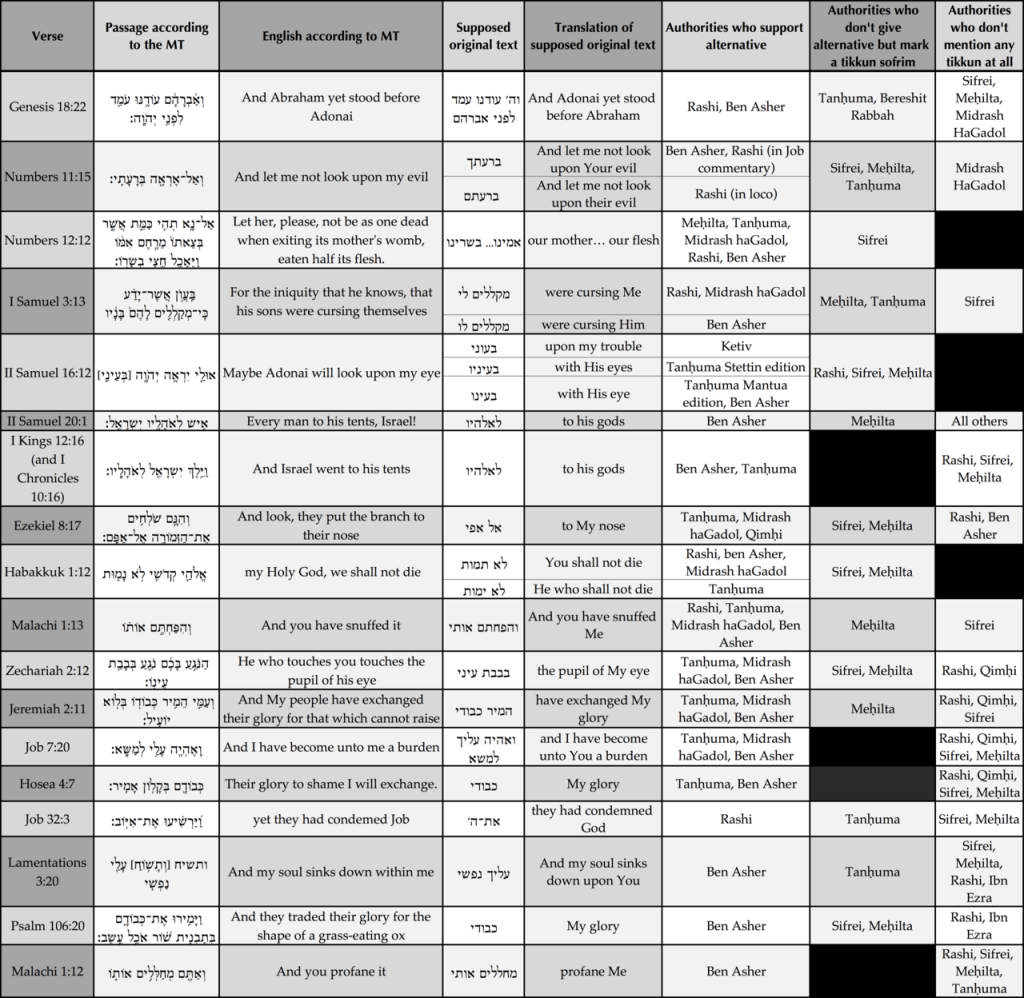
A chart listing 17 examples of tiqqunei sofrim[1]
- Based on “Ancient corrections in the text of the Old Testament”, Journal of Theological Studies, vol. 1, pp.396–401, Macmillan: New York, 1900.
- ^ Jump up to:a b “Tiqqun Soferim”. Oxford Reference. Oxford University Press.
The rabbis mentioned tiqqunei soferim in several places in their writings, with a total of about 18 tiqqunei soferim in all.[4][5][6][7]
- Singer, Isidore; Adler, Cyrus (1912). The Jewish Encyclopedia: A Descriptive Record of the History, Religion, Literature, and Customs of the Jewish People from the Earliest Times to the Present Day. Funk and Wagnalls. pp. 366–368.
- ^ Jump up to:a b “Encyclopaedia Judaica”. www.encyclopedia.com.
- ^ Jump up to:a b Berlin, Adele; Brettler, Marc Zvi (2014). The Jewish Study Bible: Second Edition (2 ed.). Oxford University Press. ISBN 978-0-19-939387-9.
- ^ Jump up to:a b Tov, Emanuel (2004). Scribal Practices and Approaches Reflected in the Texts Found in the Judean Desert. BRILL. p. 12. ISBN 978-90-474-1434-6.
An example of a tiqqun soferim can be seen in I Kings 21:12–13, where Naboth is accused of cursing God, but the text now has “blessed” since it is not fitting that the name of God should appear after the word “cursed”: “Naboth has blessed God and King” instead of “Naboth has cursed God and King”.
REVIEW The Torah Scroll: How the Copying Process Became Sacred https://www.thetorah.com/article/the-torah-scroll-how-the-copying-process-became-sacred
Books
1. The Book of Baruch also Called I Baruch (Greek and Hebrew) (Texts and Translations 8, Pseudepigrapha Series 6; Missoula, Mont.: Scholars Press, 1975).
2. The Septuagint Translation of Jeremiah and Baruch: A Discussion of an Early Revision of Jeremiah 29–52 and Baruch 1:1–3:8 (HSM 8; Missoula, Mont.: Scholars Press, 1976).
3. The Text-Critical Use of the Septuagint in Biblical Research (Jerusalem Biblical Studies 3; Jerusalem: Simor, 1981).
3*. The Text-Critical Use of the Septuagint in Biblical Research (Second Edition, Revised and Enlarged; Jerusalem Biblical Studies 8; Jerusalem: Simor, 1997).
3**. The Text-Critical Use of the Septuagint in Biblical Research (Third Edition, Completely Revised and Enlarged; Winona Lake, IN: Eisenbrauns, 2015).
4. With J. R. Abercrombie, W. Adler, and R. A. Kraft: Computer Assisted Tools for Septuagint Studies (CATSS), Volume 1, Ruth (SCS 20; Atlanta, Georgia: Scholars Press, 1986).
5. A Computerized Data Base for Septuagint Studies: The Parallel Aligned Text of the Greek and Hebrew Bible (CATSS Volume 2; JNSLSup 1; 1986).
6. With D. Barthélemy, D. W. Gooding, and J. Lust: The Story of David and Goliath, Textual and Literary Criticism, Papers of a Joint Venture (OBO 73; Fribourg/Göttingen: Éditions universitaires/Vandenhoeck & Ruprecht, 1986).
7. Textual Criticism of the Bible: An Introduction (Heb.; Jerusalem: Bialik Institute, 1989).
7*. Second corrected printing of: Textual Criticism of the Bible: An Introduction (Heb.; Jerusalem: Bialik Institute, 1997).
7**. Textual Criticism of the Bible: An Introduction (2nd ed., revised and expanded; The Biblical Encyclopaedia Library 31; Heb.; Jerusalem: Bialik Institute, 2013).
7a. Expanded and updated version of 7: Textual Criticism of the Hebrew Bible (Minneapolis and Assen/Maastricht: Fortress Press and Van Gorcum, 1992).
7a*. Textual Criticism of the Hebrew Bible (2d rev. ed.; Minneapolis and Assen: Fortress Press/Royal Van Gorcum, 2001).
7a**. Textual Criticism of the Hebrew Bible (3rd ed., revised and expanded; Minneapolis: Fortress Press, 2012).
7a***. Textual Criticism of the Hebrew Bible (4th ed., revised and expanded; Minneapolis: Fortress Press, 2022).
7b. German version of 7a (revised and updated): Der Text der Hebräischen Bibel: Handbuch der Textkritik (trans. H.-J. Fabry; Stuttgart/Berlin/Cologne: Kohlhammer, 1997).
7c. Russian version of 7b (revised and updated): Tekstologiya Vetchoga Zaveta (trans. K. Burmistrov and G. Jastrebov; Moscow: Biblisko-Bagaslovski Institut Sv. Apostola Andrjeya [St. Andrews Theological Seminary], 2001).
8. With the collaboration of R. A. Kraft: The Greek Minor Prophets Scroll from Nahal Hever (8HevXIIgr) (The Seiyal Collection I) (DJD VIII; Oxford: Clarendon, 1990).
8*. Revised edition of 8: The Greek Minor Prophets Scroll from Nahal Hever (8HevXIIgr) (The Seiyal Collection I) (DJD VIII; Oxford: Clarendon, “Reprinted with corrections 1995”).
9. With the collaboration of S. J. Pfann: The Dead Sea Scrolls on Microfiche: A Comprehensive Facsimile Edition of the Texts from the Judean Desert, with a Companion Volume (Leiden: E.J. Brill/IDC, 1993).
9*. Revised edition of 9: Companion Volume to The Dead Sea Scrolls Microfiche Edition (2d rev. ed.; Leiden: E.J. Brill/IDC, 1995).
10. With C. Rabin and S. Talmon: The Hebrew University Bible, The Book of Jeremiah (Jerusalem: Magnes Press, 1997).
11. The Greek and Hebrew Bible – Collected Essays on the Septuagint (VTSup 72; Leiden/ Boston/Cologne: E.J. Brill, 1999).
11.* Unchanged paperback edition of The Greek and Hebrew Bible – Collected Essays on the Septuagint (Atlanta: Society of Biblical Literature, 2006).
12a. With D. W. Parry: The Dead Sea Scrolls Reader, Part 1, Texts Concerned with Religious Law (Leiden/Boston: E.J. Brill, 2004)
12b. With D. W. Parry: The Dead Sea Scrolls Reader, Part 2, Exegetical Texts (Leiden/ Boston: E.J. Brill, 2004).
12c. With D. W. Parry: The Dead Sea Scrolls Reader, Part 3, Parabiblical Texts (Leiden/ Boston: E.J. Brill, 2005).
12d. With D. W. Parry: The Dead Sea Scrolls Reader, Part 4, Calendrical and Sapiential Texts (Leiden/Boston: E.J. Brill, 2004).
12e. With D. W. Parry: The Dead Sea Scrolls Reader, Part 5, Poetic and Liturgical Texts (Leiden/Boston: E.J. Brill, 2005).
12f. With D. W. Parry: The Dead Sea Scrolls Reader, Part 6, Additional Genres and Unclassified Texts (Leiden/Boston: E.J. Brill, 2005).
12*. With D.W. Parry, and in association with G.I. Clements: The Dead Sea Scrolls Reader, Volumes 1–2 (2nd edition, revised and expanded; Leiden: Brill, 2014).
13. Scribal Practices and Approaches Reflected in the Texts Found in the Judean Desert (STDJ 54; Leiden/Boston: E.J. Brill, 2004).
14. Hebrew Bible, Greek Bible, and Qumran – Collected Essays (TSAJ 121; Tübingen: Mohr Siebeck, 2008).
15. Revised Lists of the Texts from the Judaean Desert (Leiden/Boston: Brill, 2010).
16. Textual Criticism of the Hebrew Bible, Qumran, Septuagint: Collected Writings, Volume 3 (VTSup 167; Leiden: Brill, 2015).
17. Textual Developments, Collected Essays, Volume 4, VTSup 181 (Leiden: Brill, 2019).
https://huji.academia.edu/EmanuelTov
The Book of Baruch is a deuterocanonical book of the Bible, used in most Christian traditions, such as Catholic and Orthodox churches. In Judaism and Protestant Christianity, it is considered not to be part of the canon, with the Protestant Bibles categorizing it as part of the Biblical apocrypha.[1] The book is named after Baruch ben Neriah, the prophet Jeremiah‘s scribe who is mentioned at Baruch 1:1, and has been presumed to be the author of the whole work.[2]
- Apocrypha-KJV-Reader’s. Hendrickson Publishers. 2009. ISBN 978-1-59856-464-8.
- ^ Cp. Jeremiah 36:9–10 and Baruch 1:1–5.
Baruch 1:1–14 gives a narrative account of an occasion when Baruch ben Neriah reads the book of ‘these words’ before the Israelites in Babylon, and then sends that book (together with collected funds) to be read in Jerusalem. Where the Book of Baruch is considered to be a distinct work of scripture, it is commonly identified as the book that Baruch reads; and hence Baruch himself has traditionally been credited as the author of the whole work. However, the syntactical form of Baruch chapter 1 has been held rather to imply that ‘these words’ correspond to a preceding text – which might then be identified with Lamentations or with the Book of Jeremiah; in which case comparison may be made with a corresponding notice of Baruch writing down reading the prophecies of Jeremiah, recorded at Jeremiah chapter 36.[14] These considerations underlie an alternative tradition (found for instance in Augustine) in which all four works (Book of Jeremiah, Baruch, Lamentations, Letter of Jeremiah) are credited to Jeremiah himself as author.
Bogaert, Pierre-Maurice (2005). “Le livre de Baruch dans les manuscrits de la Bible latine. Disparition et réintégration”. Revue Bénédictine. 115 (2): 286–342. doi:10.1484/J.RB.5.100598.
Baruch ben Neriah (Hebrew: בָּרוּךְ בֶּן־נֵרִיָּה Bārūḵ ben Nērīyyā; c. 6th century BC) was the scribe, disciple, secretary, and devoted friend of the BiblicalprophetJeremiah. He is traditionally credited with authoring the Book of Baruch.[1]
[1]Gigot 1907.
Kainan’s Alleged Absence in Papyrus 75 of Luke
It has been repeatedly claimed that Kainan is absent in the (presumed) earliest known manuscript of Luke preserving the genealogy from Jesus back to Adam in chapter three.
This manuscript is known as 75 The papyrus has been paleographically dated between AD 175 and 225, and is presently housed in the Vatican Library. Overall, it is well preserved and contains significant excerpts from both John and Luke. The section of the papyrus pertinent to our discussion, however, is in extremely poor condition, and is largely illegible. Over fifty years ago in his doctoral
dissertation, Gordon Fee correctly stated that Kainan’s absence from 75 is “not demonstrable from the extant text,”
and is an unprovable conjecture most likely based on the unreliable fifth century AD manuscript, Codex Bezae.1 A close examination of the reconstruction of the text by numerous scholars reveals that Kainan’s original inclusion in 75 is also possible. In the end, the presence or absence of Kainan in
75 is ultimately indeterminable. Since opponents of Kainan’s inclusion in Luke 3:36 depend heavily on the age of 75 for their argument, the uncertainty from 75 itself
negates their position.
Kainan’s Inclusion in Papyrus 4 of Luke
4 is housed at the Bibliothèque Nationale in Paris. Its text is close to that of 75, 64, 67 and Codex Vaticanus.
Discovered in the 19th century in the wall of a house in Coptos, Egypt, 4 has been dated to ca. AD 150–200. This papyrus was being used as filler for a third century AD codex of Philo of Alexandria, indicating it was already quite old and had already gone out of use by ca. AD 200. To my knowledge, academic discussions about Kainan have completely overlooked this significant textual witness to Luke’s Gospel.
The standard NT Greek MSS apparatuses, Nestle-Aland 28 and UBS 5, makes no mention of Kainan in Luke 3:36 of 4. A close look at studies of the manuscript evidence for Luke 3, however, reveals that Kainan is indeed present in 4. In fact, Papyrus 4 may actually be the oldest manuscript of Luke.
Philip Comfort’s reconstruction of the
visible text from direct observation in 1998 can be confirmed with certainty in the high-
resolution photographs published in this article.
The bold text here indicates the visible letters,
while brackets are conjectured reconstructions.
The verse numbers from Luke 3 are superscripted for clarity:
The fragment of 75 preserving Luke 3:34–35, now housed in the Vatican and assigned the name, “Papyrus Hanna 1 (Mater Verbi).” Note the tiny size and extremely poor condition of the fragment. It is now almost completely illegible. The Vatican’s notation at the top of the photograph no longer includes verse 36,
further demonstrating that this papyrus cannot be cited as evidence against Kainan’s inclusion in Luke.
Conjectures excluding Kainan from 75 simply cannot be supported by the visual evidence, and an alternative text-critical reconstruction of this fragment could have included Kainan originally.
Line 13 34ΙΑΚΩΒ ΤΟΥ[ΙΣΑΑΚ] 34Jacob, the son of [Isaac]
Line 14 ΤΟΥΑΒΡΑΑΜ Τ[ΟΥΘΑ] the son of Abraham, the [son of Te-]
Line 15 ΡΑ [Τ]ΟΥΝ[AΧΩΡ35ΤΟΥ] rah, [the] son of N[ahor 35the son of]
Line 16 ΣΕΡΟΥ[Χ ΤΟΥΡΑΓΑΥ] Seru[g, the son of Reu]
Line 17 ΤΟΥΦΑΛ[ΕΚ ΤΟ]ΥΕΒΕΡ the son of Pel[eg, the so]n of Eber
Line 18 ΤΟΥΣΑΛ[Α36ΤΟ]ΥΚΑ[Ι]Ν[ΑΜ] the son of Shel[ah,36 the so]n of Ka[i]n[am]
Line 19 ΤΟΥΑΡΦΑΞΑΔ ΤΟΥ[Σ]Η[Μ] the son of Arpachshad the son of [Sh]e[m]2
Papyrus 4, containing Luke 3:20 through
4:2. Dated to the second century AD, this is
the oldest known extant manuscript
preserving Luke 3:36 and the surrounding
text mirroring the genealogies of Genesis 5
and 11. On the middle-right side of the
papyrus, the names of the patriarchs from
Comfort’s reconstruction above can easily be
seen. The enlarged section irrefutably
reveals Kainan the son of Arpachshad as
being extant.
Kainan’s Necessary Inclusion in Chester
Beatty IV: LXX Papyrus 961
Dated to the early fourth century AD, Papyrus 961 contains extensive sections of LXX Genesis 9–44. The papyrus lacks a large section of text where Kainan might have appeared in Genesis 11:13b–14b. At first glance, 961 would seem unhelpful. However, when I began looking more closely at Albert Pietersma’s dissertation3 and an image of the folio at CSNTM containing Genesis 11:8–19,4
I soon realized that a relatively simple test could determine if Kainan was originally
in Genesis 11 of Papyrus 961.
In the left column (one) of the folio, the text abruptly ends at line 23. Column two consists of 33 lines of text, with just three missing at the end, totaling 36 lines in all.5 Thus, approximately 13 lines of text are missing (known as a lacuna) from column one. This lacuna includes part of Genesis 11:11, all of verse 12, and part of verse 13b. The only way to fill out the text missing from the lacuna is to include Kainan, as follows:
[πεθανεν καὶ εζησεν (Shem d)ied. And lived Line 24 Column 1
Aρφαξαδ ετη ρλε καὶ Arpachshad 135 years and Line 25 Column 1
εγεννησεν τον Καιν he fathered Kai- Line 26 Column 1
αν καὶ εζησεν Αρφα nan. And lived Arpa- Line 27 Column 1
ξαδ μετὰ το γεννησ chshad after he father- Line 28 Column 1
αι αὐτον τον Καινα ed Kaina- Line 29 Column 1
ν ετη υλ καὶ εγεννησ n 430 years and he fath- Line 30 Column 1
εν υἱοὺς καὶ θυγατερ ered sons and daughte- Line 31 Column 1
ας καὶ απεθανεν καὶ rs and he died. And Line 32 Column 1
εζησεν Καιναν ετη ρλ Kainan lived 130 years Line 33 Column 1
καὶ εγεννησεν τὸν Σα and fathered She- Line 34 Column 1
λα καὶ εζησεν Καιναν lah and lived Kainan Line 35 Column 1
μετὰ το γεννησαι αὐ] after he fathered Line 36 Column 1
τον τον σαλα ε Shelah Extant, Line 1, top of Col. 2
If Kainan is excluded, then the genealogy from Arpachshad directly to Shelah would only be 6 lines long, less than half the
length required to fill out the 13-line lacuna. Thus, Kainan must have been included in Papyrus 961 originally, but the relevant section was damaged and lost at some unknown time.
Kainan’s Inclusion in the Berlin Fragment of
Genesis: LXX Papyrus 911 Dated to the late third century AD, Papyrus 911 (Folio 66)
is written in an early cursive Greek script and contains Genesis 1:16–22 and 2:5–35:8. It is mutilated with extensive lacunae.
Folio 66I can be seen on the University of Warsaw’s website.6
Folio 66II, which includes Genesis 10 and 11, can be seen in a facsimile published by Henry Sanders in 1927.7 Unfortunately, the original papyrus (66II) was destroyed in Berlin during
the Second World War. From Sanders’ facsimile, there are three instances of Kainan from Genesis 11:13b–14b indisputably visible in Papyrus 911: the earliest extant LXX
manuscript of Genesis.
Kainan’s original inclusion in LXX Genesis 11:13b–14b is further supported by the extensive manuscript evidence found
in the Göttingen Septuagint critical edition of Genesis, produced by the renowned LXX scholar John Wevers. Along with Papyrus 911, Kainan appears in all known LXX manuscripts of Genesis 11:13b–14b before AD 1100, including Codex Alexandrinus (A), Cottonianus (D), Coislinianus (M),
palimpsest Papyrus 833, and numerous additional witnesses.
Kainan is missing for the first time in LXX Genesis 11 in the 12th century AD miniscule 82,8 so late as to render his absence
there virtually meaningless. Add to this Kainan’s necessary inclusion in Papyrus 961, and the independent external evidence (see below), and Kainan’s originality in LXX
Genesis 11:13b–14b can be deemed to be certain.
Kainan’s Inclusion in Early Witnesses
Hippolytus of Rome (ca. AD 225)
Hippolytus was an influential theologian in the church in Rome in the early third century AD. A contemporary of Julius Africanus, Hippolytus produced the Chronicon, a chronology from Adam to his own day, equaling 5738 years.9 Not only did Hippolytus’s chronology and his LXX text of Genesis 10:24 and 11:13b–14b definitively include Kainan, but so did his second century AD text of Luke’s Gospel. He lists “the names
of the created,” a genealogy which begins with Adam and ends with Jesus Christ. Hippolytus’s genealogy mimics Luke 3:31e–38c (but in reverse order), and explicitly
includes Kainan from Luke 3:36 (verse 718.13).10 The Gospel of Luke (ca. AD 60–70)
For his genealogical list of patriarchs from Abraham back to Adam, it is logical to surmise that Luke drew directly from the genealogy in LXX 1 Chronicles chapter one, since it provides a concise list of the patriarchs which Luke could efficiently copy for his particular purposes. Verses 1:1–4 and 24–27 succinctly provide the names from Adam to Abraham. Steyn has also noted the spelling of the patriarchs from Luke 3:34d to 38 closely mirrors the spelling in the LXX of Genesis 5 and 11.11 He concludes that Kainam(n)12 was found in the LXX Genesis text Luke was using in the mid-first century AD.
Since we have established Kainan’s original inclusion in Luke’s Gospel as virtually certain from 4 and 40 additional NT manuscripts, Luke serves as an inspired and infallible external witness to the presence and authenticity of Kainan in his biblical text of LXX Genesis 11:13b–14b and/or LXX 1
Chronicles in the first century AD.
Left: Papyrus 961, housed at the Chester Beatty Library in Dublin, Ireland. This important fourth century AD Septuagint
manuscript contains Genesis 9 through 44. The only way to adequately account for the missing section of text on the left side of
this folio is to include Kainan between Arpachshad and Shelah in the post-Flood genealogy of Genesis 11:13b–14b.
Right: Genesis 11:8–17 from the Berlin Fragment of Genesis, Papyrus 911. Studied extensively by Carl Schmidt and Henry
Sanders in the 1920s, this fragment irrefutably preserves Kainan three times in Genesis 11:13b–14b. Like 4, Papyrus 911 has
been virtually ignored in academic discussions on Kainan’s authenticity. Since it was discovered in Egypt and dates to the late
third century AD, Papyrus 911 serves as another powerful witness against the argument that Kainan originated as a scribal error in a manuscript of Luke.
The Book of Jubilees (ca. 160 BC)
Jubilees 8:1–5 includes a biography of the life of Kainam/n between the lives of Arpachshad and Shelah, and is based on a Hebrew text of Genesis 11. Jubilees was written originally in
Hebrew around 160 BC, and the author used a Hebrew base text of Genesis and Exodus extant in Israel when he was writing this work. Andrew Steinmann claims that Kainan was interpolated into Jubilees by Christian scribes centuries after it was originally written:
… there is good reason to suspect that this text has been inserted into Jubilees at a later date. According to Jub. 2:23, there were twenty-two leaders of humanity from Adam to Jacob. This is the number of persons in the genealogy
without Cainan that traces from Adam through Noah to Jacob, and Jubilees compares it to twenty-two works of God during creation (cf. Jub. 2:15).13 Steinmann’s argument totally depends on the incorrect assumption that the 22 leaders of humanity include Jacob.
–
An Argument for Kainan’s Originality in the
Hebrew OT Text The evidence for Kainan’s inclusion in Hippolytus, the Gospel of Luke, the Hebrew text of Genesis underlying
Jubilees, Demetrius, LXX Genesis 11 and its Hebrew Vorlage, is certain. However, Kainan is missing from the Masoretic Text (MT), the Samaritan Pentateuch (SP), Josephus,
Theophilus of Antioch, Julius Africanus, the Aramaic Targums, and Eusebius. How can Kainan’s absence in these important and significant witnesses be explained?
I propose that a scribal error in a very ancient and major Hebrew archetypal manuscript caused by a combination of parablepsis (slip of the eye) and mental error set off a chain of
events that led to the complex matrix we have presently. This general sequence is the only viable way to explain all of the
overall evidence:
- The deportation to and return from Babylon in the sixth
century BC created geographically separated Hebrew texts.
Many Jews stayed in Babylon, while others eventually returned
to Israel. Egypt also received an influx of Jews as a result of the
Exile. Aramaic papyri and the temple built in Elephantine prove
that Diaspora Jews lived as far south as Aswan in the fifth
century BC. I propose that Kainan accidentally fell out of
Genesis 11:13–14 in a major Hebrew archetypal manuscript
during this time. Since there were major texts in geographically
disparate locations, it would have been possible for one major
line of Hebrew text to preserve Kainan (in Egypt), while
another major line had accidentally lost his name (in Babylon). - When Jewish scribes discovered Kainan was absent from
their archetypal Hebrew text of Genesis 11, they harmonized
Genesis 10:24 and 1 Chronicles 1:18, 24 with Genesis 11 by
removing his name from those verses. Since Genesis 11
already had dropped Kainan completely, removing his name
from these other verses would have been fairly easy, as it
would have only involved a few words. Harmonization with
the (perceived) goal of improving or correcting the text was a
common phenomenon in scribal activity. - This main archetypal line of Hebrew text excluding Kainan
split, eventually leading to the MT and the SP. This probably
occurred in the early post-exilic period, perhaps around the
time the Samaritan Temple was built on Mount Gerizim in the
fifth century BC. - A different Hebrew archetype which had not lost Kainan
was used by the Alexandrian translators in 281 BC. Kainam/n
appeared in their Hebrew Vorlage and was included in the
original LXX translation of Genesis 10:24 and 11:13b–14b. - Demetrius the Chronographer used the LXX in Alexandria
around 220 BC, which necessarily included Kainan. - A Hebrew text which had descended from an archetype
preserving Kainam/n was used by the author of Jubilees in
Israel around 160 BC. - The post-Torah translations (including 1 Chronicles) were
completed around 130 BC, perhaps in Israel. The various
translators used Hebrew texts that differed in numerous
respects from the texts used to translate the law of Moses in
Alexandria, Egypt. If the original translator of 1 Chronicles
was working with a Hebrew text that had already removed
Kainan from 1:18, 24, it is possible that the first Greek
translation of 1 Chronicles from the second century BC may
not have contained his name. The harmonization of LXX
Genesis 11:13b–14b and 10:24 with 1 Chronicles 1:18, 24
either by the removal or addition of Kainan in copies of the
LXX by scribes would have occurred. LXX Codex B
(Vaticanus) excludes Kainan in 1 Chronicles, while LXX
Codex A includes him. - During the second century BC, Jewish scribes began to
modify circulating LXX translations for the purpose of
improving and updating them. This was much like modern
attempts to produce more accurate English translations of the
Bible from known Hebrew and Greek MSS. The Jewish scribes
used proto-Masoretic Hebrew texts for this task, as evidenced
by the Greek Minor Prophets Scroll from Naḥal Hever. During
this period, Jewish scribes would have encountered Kainan in
their LXX of Genesis 10:24 and/or 11:13b–14b, but then
found he was missing in their proto-MT Hebrew texts.
Undoubtedly, some scribes would have removed Kainan from
their updated Greek translations, thinking the name was an
error. Jewish scribes who were more conservative in their text-
critical decisions and/or held the LXX in high regard would
have allowed Kainan to remain in their Greek translation(s). - Under the inspiration of the Holy Spirit, Luke’s Gospel
witnesses to a LXX text of 1 Chronicles and/or Genesis
11:13b–14b that included Kainan in the mid-first century AD. - Josephus (ca. AD 90) used a Hebrew text of Genesis
excluding Kainan (Ant. 1.150). - Theophilus of Antioch (d. AD 183), Julius Africanus (AD 222),
and Eusebius of Caesarea (AD 310) possessed LXX MSS that
excluded Kainan in LXX Genesis 11. - The chronology of Hippolytus of Rome (completed in ca.
AD 225) explicitly includes Kainan in his listing of Shem’s
descendants from LXX Genesis 11:13b–14b, in the Table of Nations
in Genesis 10:24, and in his reiteration of Luke’s genealogy
from Jesus back to Adam. The NT and LXX manuscripts used
by Hippolytus were likely from the second century AD. - Augustine’s (AD 354–430) Genesis LXX text included Kainan.
Instead of being definitive evidence against Kainan, the textual and historical complexities outlined above support a larger argument favoring his original inclusion in both the Old and New Testaments. Conversely, the theory that Kainan originated as a scribal error in Luke and then was interpolated back into both the Greek OT and NT by the Church across the entire Mediterranean world is impossible, based on all the known evidence. Other theories positing a counterfeit origin for Kainan in the LXX and/or Luke cannot even remotely account for all of the textual and historical data. The only viable explanation is that Kainan was originally in the Hebrew text of Genesis 10:24, 11:13–14 and 1 Chronicles 1:18, 24 but disappeared from a major Hebrew archetype of Genesis 11, probably in Babylon in the sixth century BC. This was followed by the removal of Kainan by harmonization in a later archetypal Hebrew text of 1 Chronicles and Genesis 10:24. The subsequent chain of events and totality of complex evidence outlined above can only be explained by this scenario. Editorial note: An extensive and more technical article on the authenticity of Kainan will be submitted to an academic journal for intended publication in 2018 or 2019. The arguments presented here will be documented and defended in detail in that upcoming article. To access the articles published thus far for the Genesis 5 and 11 Research Project, please visit the ABR website and type in “Primeval” into the search box.
A fragment of the Greek Minor Prophet Scrolls found at Naḥal Hever in the Judean Desert. Dated to the first century BC, this translation represents a revision (or
recension) of the original LXX, using a Hebrew text very close to the Masoretic. This important discovery shows how Jewish scribes were revising older translations of
the LXX to conform them to the MT, the dominant text type in Israel at that time. Such (re)translations during this period best explain how Kainan was absent in some LXX manuscripts, such as those being used by
Theophilus, Julius Africanus and Eusebius. By the time of Jerome (AD 347–420), there were three major LXX text types “competing” for primacy in the Church. This textual complexity best explains Kainan’s absence or presence in different sources from antiquity.
The fifth century AD Codex Bezae (pronounced “bee’s eye”) This is the only extant manuscript of Luke preserving verse 36 that definitively excludes Kainan. It often diverges significantly from the original NT text. In the case of Luke’s genealogy, Bezae is
markedly inferior. When the list reaches David, it inserts a reversed version of Matthew 1 into the genealogy. Fascinatingly,
Hippolytus of Rome’s Lukan genealogy includes the same insertion after David. Hippolytus’ manuscript of Luke was possibly a predecessor of Bezae, but it included Kainan in the early third century AD. Thus, it appears that Kainan was deliberately removed from Bezae’s textual predecessor by a scribe after the time of Hippolytus. When weighed against Papyrus 4 and the 40 other NT manuscripts that include Kainan, Bezae’s witness simply cannot stand.
Notes
1 Gordon Fee, “The Significance of Papyrus Bodmer II and Papyrus
Bodmer XIV–XV for Methodology in New Testament Textual
Criticism” (PhD Dissertation, University of Southern California, 1966), 295.
2 Philip W. Comfort and David P. Barrett, The Text of the Earliest New
Testament Greek Manuscripts (Wheaton, IL: Tyndale House Publishers,
2001), 61. The phrase “son of” in English is shortened in the Greek by use of
only the definite article in front of each name, ΤΟΥ.
3 Albert Pietersma, Chester Beatty Biblical Papyri IV and V: A New Critical
Edition with Text-Critical Analysis, vol. 16, American Studies in Papyrology
(Toronto: Samuel Stevens Hakkert and Company, 1977).
4 “Rahlf’s 961,” The Center for the Study of New Testament Manuscripts,
accessed June 9, 2018, http://www.csntm.org/Manuscript/View/Rahlfs_961.
5 For column two, 33 lines are extant, and when compared to the next page
in the manuscript, it is clear that three lines are missing at the end of column
two, for a total of 36 lines of text.
6 “Berlin, Cod. Gr. Fol. 66 I” Papyri in the Department of Papyrology,
University of Warsaw, accessed June 9, 2018, http://
www.papyrology.uw.edu.pl/papyri/berlincodgr.htm.
7 Henry A. Sanders, Facsimile of the Washington Manuscript of the Minor
Prophets in the Freer Collection and the Berlin Fragment of Genesis (Ann
Arbor, MI: The University of Michigan, 1927), 16.
8 John W. Wevers, ed., Septuaginta. Vetus Testamentum Graecum:
Genesis, vol. 1 (Göttingen: Vandenhoeck & Ruprecht, 1974), 14–17.
9 T. C. Schmidt and Nick Nicholas, Hippolytus of Rome: Commentary on
Daniel and ‘Chronicon’ (Piscataway, NJ: Gorgias Press, 2017).
10 Ibid., 278–79.
11 Gert J. Steyn, “The Occurrence of ‘Kainam’ in Luke’s Genealogy:
Evidence of Septuagint Influence?,” ETL 65, no. 4 (1989): 409–11.
12 The manuscripts of Jubilees, the LXX and Luke have variant endings for
his name: Kainan or Kainam. It is actually possible his name originally ended
with the “m.” This spelling variation points to originality, not universal
interpolation. This will be explored in my upcoming journal article.
13 Andrew E. Steinmann, “Challenging the Authenticity of Cainan, Son of
Arpachshad,” JETS 60, no. 4 (2017).
14 Jack Finegan, Handbook of Biblical Chronology, Revised Edition
(Peabody, MA: Hendrickson Publishers, 1998), 141.
15 There is a small scribal error of two years in Demetrius. The figure of 2
has dropped off the end of the Greek abbreviation for 1362.
16 Natalio Fernandez Marcos, The Septuagint in Context: Introduction to
the Greek Version of the Bible, trans. Wilfred G.E. Watson (Leiden: Brill,
2000), 260; Robert J.V. Hiebert, “Translation Technique in the Septuagint of
Genesis and Its Implications for the NETS Version,” BIOSCS 33 (2000): 76–
93; Mark W. Scarlata, “Genesis,” in T&T Clark Companion to the Septuagint,
ed. James K. Aitken (NY: Bloomsbury T&T Clark, 2015), 13–28; John W.
Wevers, Notes on the Greek Text of Genesis, Septuagint and Cognate Studies
Series 35 (Atlanta, GA: Scholars Press, 1993), 1–161; Emanuel Tov, “The
Harmonizing Character of the Septuagint of Genesis 1–11,” in Textual
Criticism of the Hebrew Bible, Qumran, Septuagint, vol. 3, Supplements to
Vetus Testamentum 167 (Leiden: Brill Academic Publishers, 2015), 470–89.
Sharing is caringFacebookX / TwitterLinkedInWhatsAppTelegramRedditEmail6446 words · 153 views