
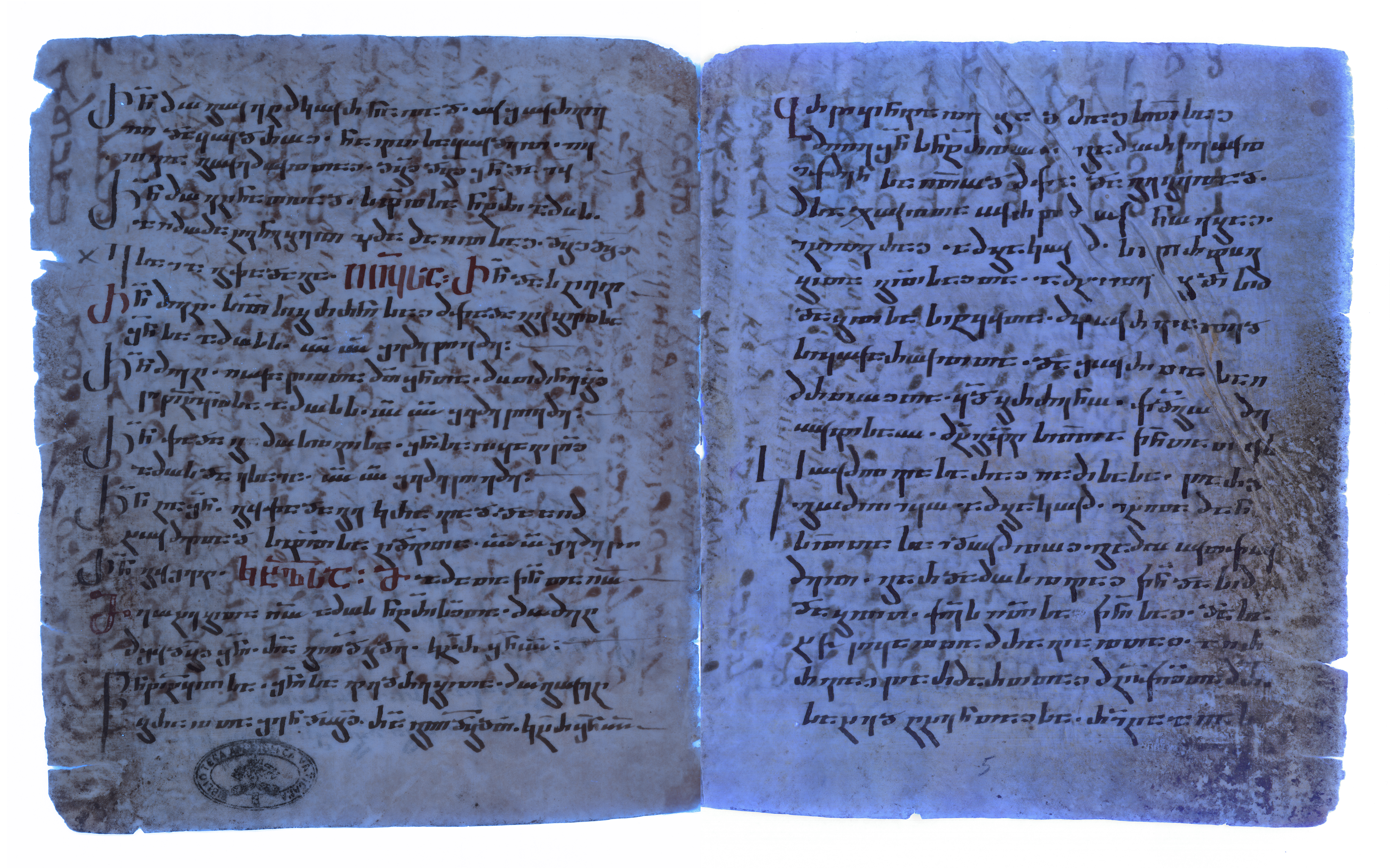
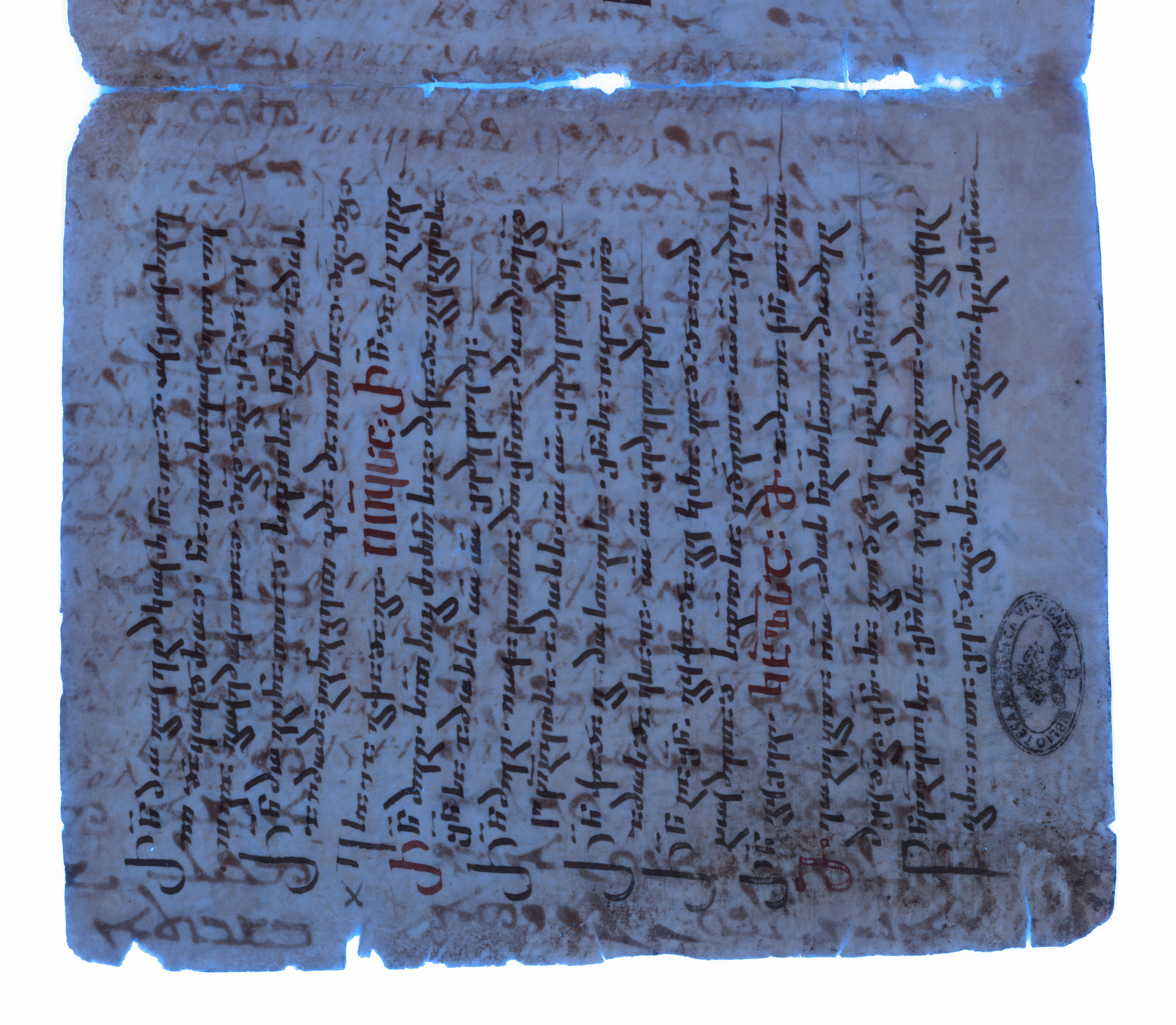
The small manuscript fragment, which can now be considered as the fourth textual witness, was identified by Grigory Kessel using ultraviolet photography as the third layer of text, i.e., double palimpsest, in the Vatican Library manuscript. The fragment is so far the only known remnant of the fourth manuscript that attests to the Old Syriac version – and offers a unique gateway to the very early phase in the history of the textual transmission of the Gospels. For example, while the original Greek of Matthew chapter 12, verse 1 says: “At that time Jesus went through the grainfields on the Sabbath; and his disciples became hungry and began to pick the heads of grain and eat,” the Syriac translation says: “[…] began to pick the heads of grain, rub them in their hands, and eat them.”
OLD SYRIAC TRANSLATION BEFORE CODEX SINAITICUS Claudia Rapp, Director of the Institute for Medieval Research at the OeAW, is also pleased: “Grigory Kessel has made a great discovery thanks to his profound knowledge of old Syriac texts and script characteristics,” she says. The Syriac translation was produced at least a century before the oldest Greek manuscripts that have survived, including the Codex Sinaiticus. The earliest surviving manuscripts with this Syriac translation date from the 6th century and are preserved in the erased layers, so-called palimpsests, of newly written parchment leaves.
“This discovery proves how productive and important the interplay between modern digital technologies and basic research can be when dealing with medieval manuscripts,” Claudia Rapp says.
AT A GLANCE Project info The Sinai Palimpsests Project aims to make the centuries-old valuable palimpsest manuscripts of St. Catherine’s Monastery in Egypt readable again and available in digital form. So far, 74 manuscripts have already been deciphered. Claudia Rapp from the University of Vienna and the Austrian Academy of Sciences (OeAW) is the scientific director of the project. WEBSITE
Publication Kessel, G. (2023). A New (Double Palimpsest) Witness to the Old Syriac Gospels (Vat. iber. 4, ff. 1 & 5). New Testament Studies,69(2), 210-221.
DOI: 10.1017/S0028688522000182 ARTICLE
NAZARETH Bronze and Iron Age The Franciscan priest Bellarmino Bagatti, “Director of Christian Archaeology”, carried out extensive excavation of this “Venerated Area” from 1955 to 1965. Fr. Bagatti uncovered pottery dating from the Middle Bronze Age (2200 to 1500 BC) and ceramics, silos and grinding mills from the Iron Age (1500 to 586 BC) which indicated substantial settlement in the Nazareth basin at that time.

Roman period Archaeological evidence shows the Nazareth was occupied during the late Hellenistic period, through the Roman period and into the Byzantine period.[44][45]
- Yardenna Alexandre (2020). “The Settlement History of Nazareth in the Iron Age and Early Roman Period”. ‘Atiqot. 98. Archived from the original on 2020-05-26. Retrieved 2020-05-26.
- ^ Dark, Ken (2023). Archaeology of Jesus’ Nazareth. Oxford University Press. p. 50. ISBN 978-0-19-268899-6.
The earliest-known mention of Bethlehem is in the Amarna correspondence of ancient Egypt, dated to 1350–1330 BCE, when the town was inhabited by the Canaanites. In the Hebrew Bible, the period of the Israelites is described; it identifies Bethlehem as the birthplace of David as well as the city where he was anointed as the third monarch of the United Kingdom of Israel, and also states that it was built up as a fortified city by Rehoboam, the first monarch of the Kingdom of Judah.[7] In the New Testament, the Gospel of Matthew and the Gospel of Luke identify the city as the birthplace of Jesus of Nazareth. Under the Roman Empire, the city of Bethlehem was destroyed by Hadrian, who was in the process of defeating Jews involved in the Bar Kokhba revolt. However, Bethlehem’s rebuilding was later promoted by Helena, the mother of Constantine the Great; Constantine expanded on his mother’s project by commissioning the Church of the Nativity in 327 CE. In 529, the Church of the Nativity was heavily damaged by Samaritans involved in the Samaritan revolts; following the victory of the Byzantine Empire, it was rebuilt a century later by Justinian I.
[7]2 Chronicles 11:5–6 (Note: Though v. 6 is frequently translated to say simply that Rehoboam built the city, the Hebrew phrase in v. 5, just prior, וַיִּ֧בֶן עָרִ֛ים לְמָצ֖וֹר wayyiḇen ‘ārîm lemāṣôr means “(and) he built cities into fortresses”. Verse 5 is cited by at least one prominent Hebrew lexicon in illustration of this fact. See Koehler, L., Baumgartner, W., Richardson, M. E. J., & Stamm, J. J., The Hebrew and Aramaic Lexicon of the Old Testament (electronic edition; Leiden: E.J. Brill, 1994–2000), entry for the pertinent root בנה bnh, p. 139. Def. 3 reads as follows: “—3. with לְ to develop buildings: עָרִים לְמָצוֹר cities into fortresses 2C[hronicles] 11:5”.)
“Bosom of Abraham” refers to the place of comfort in the biblical Sheol (or Hades in the Greek Septuagint version of the Hebrew scriptures from around 200 BC, and therefore so described in the New Testament)[1] where the righteous dead abided prior to Jesus’ resurrection.
.jpg)
The phrase and concept are found in both Judaism and Christian religions and religious art.
[1]Longenecker, Richard N. (2003). “Cosmology”. In Gowan, Donald E. (ed.). The Westminster Theological Wordbook of the Bible. Westminster John Knox Press. p. 189. ISBN9780664223946.
El seno de Abraham o seno de Abrahán es un concepto judaico en el período del segundo templo.
La locución «seno de Abraham» es común en las fuentes judías.[2][3][4][5]
- John Lightfoot, Horae Hebraicae et Talmudicae, 1671 “Rabh Adah Bar Ahavah said, by way’ of prophecy, This day doth he sit in Abraham’s bosom” 1987 p.161
- ↑ Tommaso d’Aquino La somma teologica. Testo latino e italiano, Vol.26 -nota 1985 p.184
- ↑ Alfonso Maria Di Nola, La nera signora: antrop̂ologia della morte 1995 p234
- ↑ F. Preisigke, Sammelbuch Griechischer Urkunden aus Aegypten 2034:11
Jeremiah https://hermeneutics.stackexchange.com/questions/5810/how-do-the-traditions-of-the-lxx-and-mt-versions-of-jeremiah-relate
In general, there are two main ways in which the MT and LXX can differ: the Hebrew text that the LXX translators were translating from was substantially different from the MT or the LXX translators translated loosely. In this case, we can be pretty confident that much of the difference is caused by the former issue. This is because in the Dead Sea Scrolls there are fragments of Hebrew texts of Jeremiah which agree with the LXX and not the MT.
Job
Discussion: https://www.bible.ca/manuscripts/Book-of-Job-Bible-Manuscript-Textual-Variants-Old-Testament-Tanakh-Septuagint-LXX-Masoretic-Text-MT-scribal-gloss-copying-error.htm
1. The text of the book of Job we use today generally follows the Masoretic Text (MT) which is viewed as superior and closer to the original than the Septuagint (LXX) Greek translation of Job.
a. The book of Job in the Masoretic Text (MT) is longer than the Septuagint (LXX) by 400 lines and contains many unique and unusual words and phrases.
b. However, all the differences make zero difference in the overall message and theme of the book of Job.
2. Various theories as to why the MT differs from the LXX in the book of Job:
a. Perhaps, like the book of Jeremiah, there two different original manuscripts of Job in use at the same time.
b. Perhaps Job was used in liturgy of responsive singing: Perhaps the book was expanded to include repetitious sentences etc. and used in responsive acapella singing in the same way the Song of the Sabbath Service, Daniel 3:49–93 Apocrypha LXX or from the ancient Jewish songbook Psalm 145:1-7, 12-21 from Dead Sea Scroll 11Q5.
c. Perhaps the book of Job was originally written in Aramaic or Arabic and LXX translators abridged the repetitive phrases and simply skipped sections that were difficult to translate.
d. Perhaps there was a single Hebrew original copy of Job and the LXX translators abridged the book by removing repetitive phrases and ignored difficult to translate sections.
The variants in the book of Job date to before 200 BC and are the result of the initial translating of the book from Hebrew into Greek. Job is 400 lines shorter in the LXX because the translators sought to simplify the Oriental poetic style text into a “Cole’s Notes” dynamic equivalent for a target Greek audience. Much of the reduction was the removal of reparative and redundant sentences. The extra words of in 2:9 of Job’s wife that are found in the Septuagint but not in the Masoretic may be original or may come from an imaginative Hebrew scribe (possibly Ezra) unsatisfied with the brevity of her comments. The concluding gloss after 42:17 is clearly scholastic foot notes never intended to be viewed as scripture the same way Christians view the Bible maps, comments and notes throughout their “Study Bible”. None of the variants change any Bible doctrine. The 400 lines of missing text do not change the story and the additional words of Job’s wife can be easily inferred and provide nothing new.
Hell acording to some jews https://www.chabad.org/library/article_cdo/aid/1594422/jewish/Do-Jews-Believe-in-Hell.htm
Hell is not a punishment in the conventional sense; it is, in fact, the expression of a great kindness.
The Jewish mystics described a spiritual place called “Gehinnom.” This is usually translated as “Hell,” but a better translation would be “the Supernal Washing Machine.” Because that’s exactly how it works. The way our soul is cleansed in Gehinnom is similar to the way our clothes are cleansed in a washing machine.
Sharing is caringFacebookX / TwitterLinkedInWhatsAppTelegramRedditEmail1995 words · 134 views