

We know that the early church accepted Revelation as authoritative because the early church leaders such as Papias (c.125), Justin Martyr, Irenaeus, the Muratorian Fragment, Hippolytus, Clement of Alexandria, Tertullian, and Origen. All of these church fathers accepted it because they accepted that the author of the book was the Apostle John.
“B.W. Bacon was so impressed with Revelation’s initial reception that he was able to say, “There is no book in the entire New Testament whose external attestation can compare with that of Revelation, in nearness, clearness, definiteness, and positiveness of statement” (The Making of the New Testament)”
The first time that there is any real objection to the Book comes in the early 3rd century, because it was thought by Gaius that it was a forgery because of some of Revelation’s teachings, not because of its historicity.
Others challenged the authorship, whether it was John the Apostle, yet did not reject it on those grounds.
In the Eastern church Revelation is not accepted as canonical because of the challenge made by Gaius. But the rest of the church accepts its canonicity.
However, later many accepted it as part of the canon. “It was affirmed by the synods of Hippo (c.393) and Carthage (c.397). It was also received by Philastrius of Brescia (c.385), Rufinus of Aquileia (c.404), Jerome (c.414), and Augustine (c.426). And the reason why these groups accepted the book was simple: it was an ancient book quoted by the early church fathers as authoritative. And for this reason, eventually their view prevailed.”
The historical merits of the canonicity of Revelation is sound, even though it went through some challenges in the process of being accepted.
I do not believe that the Bible is exclusively a product of human authors. It is God’s word, and his authorship is primary. Humans wrote “as they were moved along by the Holy Spirit”. The same process was involved for including and excluding books in the canon. The dispute about it is blown out of all proportion: it is accepted by most that Apostle John is the human author, it was widely accepted by the early church, and later theologians also accepted it as a book of the NT. When it was challenged it came because of the views held by some rather than questions about its authorship or historicity.
I am for all the books of the Bible and it is important for them to be included and read. If Revelation were not in the Bible, for the sake of argument, the church would lose a significant revelation of Jesus, because of its high Christology. Do we really want to miss out on that knowledge?
Apocalipse of peter
Of major concern is that the existing manuscripts vary greatly, indicating that the original text of this document cannot be determined with a high degree of confidence.
https://www.compellingtruth.org/apocalypse-of-Peter.html
For the identification of the Apocalypse of Peter and the assessment of its significance and influence, the citations in the Church Fathers are particularly important. Theophilus of Antioch (about 180 CE) alludes to a verse of the Akhmîm fragment (see below). Clement of Alexandria (before 215) twice quotes chapters 4 and 5. Methodius of Olympus (about 311) once quotes chapter 8. Macarius Magnes (about 400) quotes chapters 4 and 5 once each.
The full text has been known to us for only a century. During the excavations instigated by S. Grébaut in the winter of 1886/87 in cemetery A at al-Hawawis in the desert necropolis of Akhmîm, parchment leaves of the Greek version were discovered in the grave of a Christian monk. In addition to this fragment of text, some further unpaginated leaves were found with parts of the Book of Enoch and the Gospel of Peter. The three texts, which are today in Cairo, are all from the same hand and were written in the 8th or 9th century. The Greek text, which occupies not quite half of the original book, was divided by Harnack into 34 verses. The identification of the text results from a quotation adduced by Clement of Alexandria in his Eclogae Propheticae.
The Ethiopic translation has been known since 1910. A. Dillmann had already referred to the extensive Ethiopic translation of the Corpus Clementinum, which may go back to the 7th-8th century. S. Grébaut finally published Pseudo-Clementine literature from MS No 51 of the Abbadie collection, and added a French translation. It was however M. R. James who, in a fundamental study, first succeeded in classifying the Ethiopic text correctly.
We do not know the original text of the Apocalypse, the Greek and Ethiopic texts frequently diverge from each other
http://www.ntcanon.org/Apocalypse_of_Peter.shtml
About MT and LXX
That was a long quote, but the point is clear: Augustine is noting that there are two kinds of differences between the Greek and Hebrew manuscripts. There are those which are most likely the result of a simple scribal error, and there are those which must be intentional, because they are systematic. Augustine argues that the Hebrew manuscripts are too widely spread to be changed uniformly, and in any case, the Jews would not ‘cut off their nose to spite their face’ by corrupting their own Scriptures. This is the Achilles’ heel of the idea that the MT was the result of a deliberate attempt to change the Bible. How could such a change have been made, then disseminated across the entire Jewish world (which ranged at least from Morocco to India14 by that time), without causing a major conflict?
But the Septuagint was originally translated in Alexandria, and very early could have had the ages inflated. Augustine’s reason for this is that the inflator wanted to make the genealogy look more plausible to those who would be skeptical about the ages at which men had their children. By inflating the ages so that one-tenth of the age would put the father post-puberty, they could argue that the pre-Flood genealogy reckoned one of our years as 10 of theirs.
City of God 12:10
https://www.newadvent.org/fathers/120112.htm
The accuracy of the chronologies in Genesis 5 and 11 has been greatly debated. People have proposed various means of adjusting the figures to more realistic values, on the assumption that there has been some textual error. (This is partly motivated by differences between the Masoretic Text and the Septuagint, suggesting some confusion on the part of translators and editors.) Others are happy to assume that the text we have received is essentially correct.
Augustine discusses some such schemes in City of God 15.9-15; he believes that the patriarchs did indeed live to the stated ages (basically, because stranger things have happened). The basic problem he finds with trying to rescale the figures (he discusses several alternatives, such as that one “year” in the text should really be one month, or that all the numbers are inflated by a factor of ten) is that the Genesis account also gives the ages at which each man fathered his son. Enosh was 90 when he had his son (Genesis 5:9) and 905 when he died (5:11). Rescaling either gives him a long lifespan in any case, or has him fathering Kenan at an unusually young age.
Julius Wellhausen in Prolegomena to the History of Israel (1882) suggested a complicated scheme based on a “Great Year” of 4000 years in total from Adam to the rededication of the Temple in 164BC. He puts the Exodus at 2666 years after the creation, with the 26 generations from Adam to Aaron each representing a century (the remaining 66 years are assigned to Eleazar). Many other scholars have since refined this idea, suggesting tweaks and trying to understand the textual influences. Under this family of interpretations, the ages of the patriarchs are purely notional – there may be some symbolic reason for the particular numbers being as they are, but the purpose is simply to express generational decline. This is analogous to documents from surrounding cultures, such as the Sumerian King List, which also feature enormous but decreasing lifespans.
Martin Luther assumes in his Commentaries on Genesis (vol. 2, ch. 5, paragraphs 34-43) that the ages are as stated. He attributes their long lifespans to better diet, and to their righteousness:
35) Though the body was sounder than at present, yet the general vigor and strength of limb which men had in paradise before the advent of sin, had passed away. It is true, however, that their bodily well-being was enhanced when, after the fall, they were renewed and regenerated through faith in the promised seed. For the same reason, also, sin was weakened through faith in the seed. As for us, we have lost their strength and vigor just in proportion as we have departed from their righteousness.
36) With reference to food, who cannot easily believe that one apple, in that primeval age, was more excellent and afforded a greater degree of nourishment than a thousand in our time? The roots, also, on which they fed, contained infinitely more fragrance, virtue and savor, than they possess now. All these conditions, but notably holiness and righteousness, the exercise of moderation, then the excellence of the fruit and the salubrity of the atmosphere – all these tended to produce longevity till the time came for the establishment of a new order by God which resulted in a decided reduction of the length of man’s life.
Luther also points out that the chronology has many of the patriarchs alive at the same time, with Adam dying not long before Noah was born:
43) Truly that primeval time was a “golden age,” in comparison with which our present age is scarcely worthy of being called the age of mud. During those primeval centuries, there lived at the same time nine patriarchs, together with their posterities, and all of them in harmony concerning the faith in the blessed seed! All these glorious things Moses just mentions, but does not explain; otherwise this would be the history of histories.
And as then a mortal and imperfect man was formed from the earth, that he might live a thousand years in this world; so now from this earthly age is formed a perfect man, that being quickened by God, he may bear rule in this same world through a thousand years.[6]
Ibid., 212. Lactantius, the Divine Institutes, bk. VII, ch. XIV.
Eusebius argues for the superiority of the LXX, but as Smith admits in the very same note, “Eusebius does not attribute the motive to messianic chronology and discrediting Jesus, [sic] rather, their purpose was to encourage their contemporaries to lower their age of marrying” (ARJ, note 4).
http://appleeye.org/2015/02/03/the-premillennialism-of-lactantius/#_ftn6
Timelines of world history
The Jewish Encyclopedia claims that Julian of Toledo accused the Jews of falsifying their chronology in connection with an argument that the Messiah was to arrive in the “sixth age”.5
We had to search for this information, however, because Smith did not provide this source as a reference. Rather, his source says that the Jews were basing their eschatological interpretation on the Babylonian Talmud. It also claims that Julian of Toledo’s refutation:
“ … interprets the texts of the New Testament that explicitly point to Jesus Christ as the Messiah foretold by the prophets of the ancient covenant, whose texts are interpreted by the apostolic writers as indicating the fullness of time, and not following the calculation of years. Jesus, the Messiah, was in fact born precisely in the fullness of times. It is, therefore, not the calculation of years that counts, as the Jewish scholars maintain, but rather the whole of the historical facts in which Jesus presents himself as the true Messiah of God.”6
In other words, this LXX-supporting witness defines the “sixth age” by epochs demarcated by events in salvation history, not by calendar dates. This is the same argument that Bede (who was clearly a MT supporter) used in his Letter to Plegwin.7
VITA ADAE ET EVAE
The Life of Adam and Eve 23:5?2-24:1 says that Adam was 130 when Seth was born (the MT figure)–scholars commonly date it to around the end of the first century.
While the surviving versions were composed from the early 3rd to the 5th century CE,[2]:252 the literary units in the work are considered to be older and predominantly of Jewish origin.[3] There is wide agreement[by whom?] that the original was composed in a Semitic language[2]:251 in the 1st century CE.[2]:252
[2] Johnson, M.D. (1985). “Life of Adam and Eve, a new translation and introduction”. In Charlesworth, J.H. (ed.). the Old Testament Pseudepigrapha. 2. ISBN0-385-18813-7.
[3] Sparks, H.F.D. (1984). The Apocryphal Old Testament. p. 143. ISBN0-19-826177-2.
Around the same time 4 Ezra 10:45-46 was written, and it said that there were 3000 years from creation to the building of Solomon’s temple, which is just about what you’d get with an MT chronology combined with a short sojourn, but is not possible at all with an LXX timeframe.
Church History (Eusebius) > Book V https://www.newadvent.org/fathers/250105.htm
Did Abraham leave Haran before or after his father died?
Short Answer: Abram did indeed depart from Haran after his father died, as the Old Testament indicates, and as the New Testament explicitly claims. (Terah was 130 years old when Abram was born.)
Good question. (This happens to be one of the most commonly asked — and addressed — “discrepancies” in Scripture.)
The problem is in the modern Western reading of an ancient Hebrew text. First, a note about Hebrew chronologies…
A lesson from Noah’s sons: Genesis 5:32 states, “Noah was five hundred years old, and Noah became the father of Shem, Ham, and Japheth.” Every time Noah’s sons are listed, they are listed in this order (Genesis 6:10, 7:13, 9:18, 10:1). One might think Shem was the oldest and Japheth was the youngest based on the order in the text, but that is incorrect. Genesis 9:22-24 indicates Ham was the youngest. Genesis 10:21 indicates there was also an “oldest” (There is some question whether Shem or Japheth was older, due to the differences in translation.) So we are not looking at twins or triplets, since there was an oldest, and Ham was the youngest. Thus, the age given probably refers to the age when Noah became a father (i.e. the birth of the firstborn), and is not meant to be read as all three being born in one year, in that order.
A second look at Terah’s sons: Genesis 11:26 is similar. It indicates that Terah was 70 years old when he became a father, and that he was the father of Abram, Nahor, and Haran. Haran was most likely the oldest since Abram was traveling with Lot (Genesis 12:5), Haran’s son (Genesis 11:27), and Nahor married Haran’s daughter (Genesis 11:29.) Regardless, we have a similar situation to Noah’s sons, where we ought not to take this as an indication that three sons were born to him in the same year, in that order. The text is not claiming they were all born when he was 70.
Obvious solution: Abram left after his father died, as you indicated in your question. So, Abram seems to have been born when Terah was 130, which makes him 75 years old when he left.
The most common objection: When this solution is rejected, it is usually out of a difficulty understanding why Abram fell on his face and laughed at the idea of having a son when he was 100 and his wife was 90 (Genesis 17:17). Several things need to be noted here:
Though the chronologies are all bunched together in the text, keep in mind that Abram said this 100 years after Terah fathered a child at an old age — that is a long time! The lifespans had been rapidly declining since the time of the flood (which was very recent for Abraham), so things may very well have looked bleak to Abram — regardless of how old Terah was when Abram was born.
We’re talking about the words of a man struggling with his faith in God’s promises… not exactly something you want to build doctrine on.
Abram didn’t seem to have any trouble believing he could bear a child by Hagar, who was 86 (Genesis 16:16).
We already know that the birth of Isaac had to be miraculous because of Sarah’s physical condition, so it is conceivable that Abram’s health was also deteriorated. This may partially explain his unbelief. (cf. Romans 4:19, Hebrews 11:12)
Some have noted that Abram had now been living with Hagar for 13 years without bearing additional children… he may have had the idea that he was no longer able to “beget.”
After his wife Sarah had died at the age of 127 (Genesis 23:1-2), Abraham — who by now would have been over 140 years old — took another wife and had 6 more kids by her (Genesis 25:1-6)!
Abraham’s grandson, Jacob, became the father of his son Benjamin when he was 100 years old.
In summary, Abram’s comment does not seem to have had as much to do with Terah’s life (or anyone else’s) as it did with his own life and Sarai’s.
http://www.accuracyingenesis.com/chronology.html
Six days and 6000 years
Barnabas, AD First Century (ce)
“Therefore, children, in six days, or in six thousand years, all the prophecies will be fulfilled. Then it says, ‘He rested on the seventh day.’ This signifies at the Second Coming of our Lord Jesus, He will destroy the Antichrist, judge the ungodly, and change the sun, moon, and stars. Then He will truly rest during the Millennial reign, which is the seventh day.” Epistle of Barnabas 15;7-9
Papias, AD First Century (n)
“I was taught by the Apostle John, himself, that after the resurrection of the dead, Jesus will personally reign for one thousand years.” Papias, Fragment 6
Irenaeus, AD 180 (of apostasy)
“The day of the Lord is as a thousand years; and in six days created things were completed. It is evident, therefore, they will come to an end in the six thousandth year.” Against Heresies 5.28
Justin Martyr, AD Second Century (n)
“There will be a literal one-thousand-year reign of Christ.” Justin Martyr, Dialogue 81
Hippolytus, AD 205
“The Sabbath is a type of the future kingdom…For “a day with the Lord is as a thousand years.” Since, then, in six days the Lord created all things, it follows that in six thousand years all will be fulfilled.” Fragment 2; Commentary on Daniel 2.4
Commodianus, AD 240
“We will be immortal when the six thousand years are completed.” Against the Gods of the Heathens 35
http://www.intratext.com/IXT/ENG0244/_PY.HTM
“Resurrection of the body will be when six thousand years are completed, and after one thousand years (millennial reign), the world will come to an end.” Against the God of the Heathens 80
Victorinus, AD 240
“Satan will be bound until the thousand years are finished; that is, after the sixth day.” Commentary on Revelation 20.1-3
Methodius, AD 290
“In the seventh millennium we will be immortal and truly celebrate the Feast of Tabernacles.” Ten Virgins 9.1
Lactantius, AD 304
“The sixth thousandth year is not yet complete. When this number is complete, the consummation must take place.” Divine Institutes 7.14
Containing the interval of 3833 Years.
Flavius Josephus of the Antiquities of the Jews — Book I
https://panampost.com/editor/2021/01/23/el-fin-del-imperio/
https://panampost.com/milagros-boyer/2021/01/22/biden-elimino-52000-empleos-primer-dia/
Questions and answers
Q: Hi. Do u have a response to this article response https://creation.com/smith-response? Specially to the arguments that read “MT already existed before Akiba, he couldn’t have invented it” and “it is hard to get both the MT and the SP from an LXX-like original” in the textual analysis section?
Thanks for writing and for your interest.
I have not written a direct response to this article. There is no evidence for the MT’s complete primeval timeline before the 2nd century AD, so their statement is incorrect. I’ll be writing an extensive critique of their reconstruction theory in my book.
For more, see: https://biblearchaeology.org/abrprojects/4293-the-genesis-5-and-11-genealogy-and-chronology-research-project
Feel free to contact me with any questions.
Q: What is the name of the book? When would it be out?
And what would you say about this cosner quote: “there are two good sources that attest to a Masoretic chronology in Genesis 5 and 11 by the end of the 1st century AD. The Life of Adam and Eve 23:2-24:1 says that Adam was 130 when Seth was born (the MT figure)–scholars commonly date it to around the end of the 1st century AD. Around the same time 4 Ezra was written, and it said that there were 3000 years from creation to the building of Solomon’s temple, which is just about what you’d get with an MT chronology combined with a short sojourn, but is not possible at all with an LXX timeframe”.
Thanks for your additional questions.
The book is scheduled for submission to the publisher on August 1, 2021. See this report:
The Life of Adam and Eve has a very complex literary history. The work has undergone significant redaction, and there are large scale differences in the Greek, Latin and other versions. A date of origin at the end of the 1st century AD cannot even remotely be established. It is based on one statement about the Temple, the interpretation of which is disputed in the literature. The date of origin is more likely to be between 200 and 400 AD.
Even if the date of origin somehow were in the late 1st century, that is not proof that Adam’s begetting age figure of 130 years came from a Hebrew manuscript of Genesis. It is just one data point which could be the result of later scribal editorial activity. The author who wrote the Greek version of LAE utilized the LXX quite a bit, which makes the 130 year reading dubious. Moreover, the 130 year figure has its origin in the book of Jubilees, which the author of LAE also used. You can read more in these in depth studies:
https://kclpure.kcl.ac.uk/ws/files/2935028/326231.pdf
https://core.ac.uk/download/pdf/15598942.pdf
The manuscripts for LAE have not been collated since the 19th century, and so that work needs to be updated as well. In summary, LAE does not provide evidence for the MT’s primeval chronology existing in the 1st century AD.
For 4 Ezra, the 3000 year number is not based on chronological calculations from the biblical text, but is a schematic and artificial figure. It represents 60 jubilees cycles of 50 years each, and is also the mid point of a schematic 6000 year cosmic history. Moreover, later in 4 Ezra, the books of Scripture are restored during Ezra’s lifetime, in the year 5042 AM. If this chronological statement is intended to refer to the time setting of the real Ezra (450 BC), than that would make creation about 5500 BC. If it is intended to place the time setting in the context of the author of 4 Ezra (pseudo Ezra), 30 years after the Temple is destroyed, than the creation date is about 5000 BC. IN either case, the date of the restoration of Scripture in 4 Ezra only fits the primeval chronology of the LXX, not the MT.
In my judgment, 4 Ezra’s two conflicting chronological statements are both schematic and artificial, not based on calculations from any biblical text. 4 Ezra should not and cannot be used to support either the LXX or the MT primeval chronology. 4 Ezra is more evidence, however, of how Second Temple Judaism created artificial, jubilean based chronologies based on messianic and eschatological speculation. You can read more about this in my articles.
Q: Is septuagint vs masoretic a closed topic for you, meaning the most reliable is the septuagint or there is some possibility for the masoretic? If so, why? And why isn’t samaritan pentateuch more reliable than these two?
I assume you are referring only to Gen 5/11. The MT is highly reliable in most areas, outside of Gen 5/11.
After several years of research, I have not seen a theory that account for the data and make the case that the MT is original. You’ll have to read all of my articles carefully to get a sense of my overall argument.
For the SP, I wrote an extensive article explaining its reliability and use in determining the original numbers in Gen 5/11.
See: https://biblearchaeology.org/images/Genesis-5-and-11/Smith-Henry-Winter-2018-BAS_MT-SP-or-LXX.pdf
Q: What do you mean with “The MT is highly reliable in most areas, outside of Gen 5/11”? Is it more reliable than the septuagint in other topics? If so, what would be the most reliable bible version?
I have attached a pdf I found that reads “The Dead Sea Scrolls have revealed to us two texts of the Book of Isaiah. One, written in an archaic square script, deviates considerably from our MT in spelling, in grammar and in contents; the other, written in a later square script, is practically identical with MT, to judge from the scanty specimens so far published”. I have a question about it. What does it mean that one deviates considerably from mt content? By the way, are you Christian? Do you endorse the bible as a historical narrative?
A: I am a Christian and believe the Bible is the Word of God, and has been preserved by God over the millennia. If you want to know more about my thoughts on the subject of inspiration and preservation, see these videos:
And, the videos under point #3 here: https://biblearchaeology.org/research/topics/biblical-chronologies/4767-from-adam-to-abraham-the-latest-on-the-genesis-5-and-11-project
Overall, the MT is the most reliably preserved text of the OT. For the texts of Isaiah that you mention below, I have not studied them, so it is hard for me to comment. I have mainly focused on Gen 5/11. But, I do know that different scribes preserved the text in different ways. Some copied the text very closely, word for word. Others wrote more freely, especially in translation. But the MT is the dominant text from antiquity.
I also recommend this presentation by Dr. Peter Gentry: https://www.youtube.com/watch?v=Cg4NbRHb8iY
Q: By the way, for the gen 5 and 11 the patriarch ages are that of the septuagint right? If so, let me ask you, what would be the most reliable bible version or translation in english? And could you mention some extra biblical narrative about humans living that long on that time please?
A: I often use the NIV and ESV. If I am studying something in depth, then I turn to the original languages and the manuscripts to see if there are significant differences. Long lifespans are found in ancient texts from Mesopotamia, such as the Sumerian King List. I see these works as “shadows” of the truth that people once lived to longer ages, especially before the Flood. You can find what I believe are the original numbers here: https://biblearchaeology.org/images/Genesis-5-and-11/Smith-Henry-Winter-2018-BAS_MT-SP-or-LXX.pdf
Blessings, Henry B. Smith Jr.
About Christ death and resurrection
wednesday
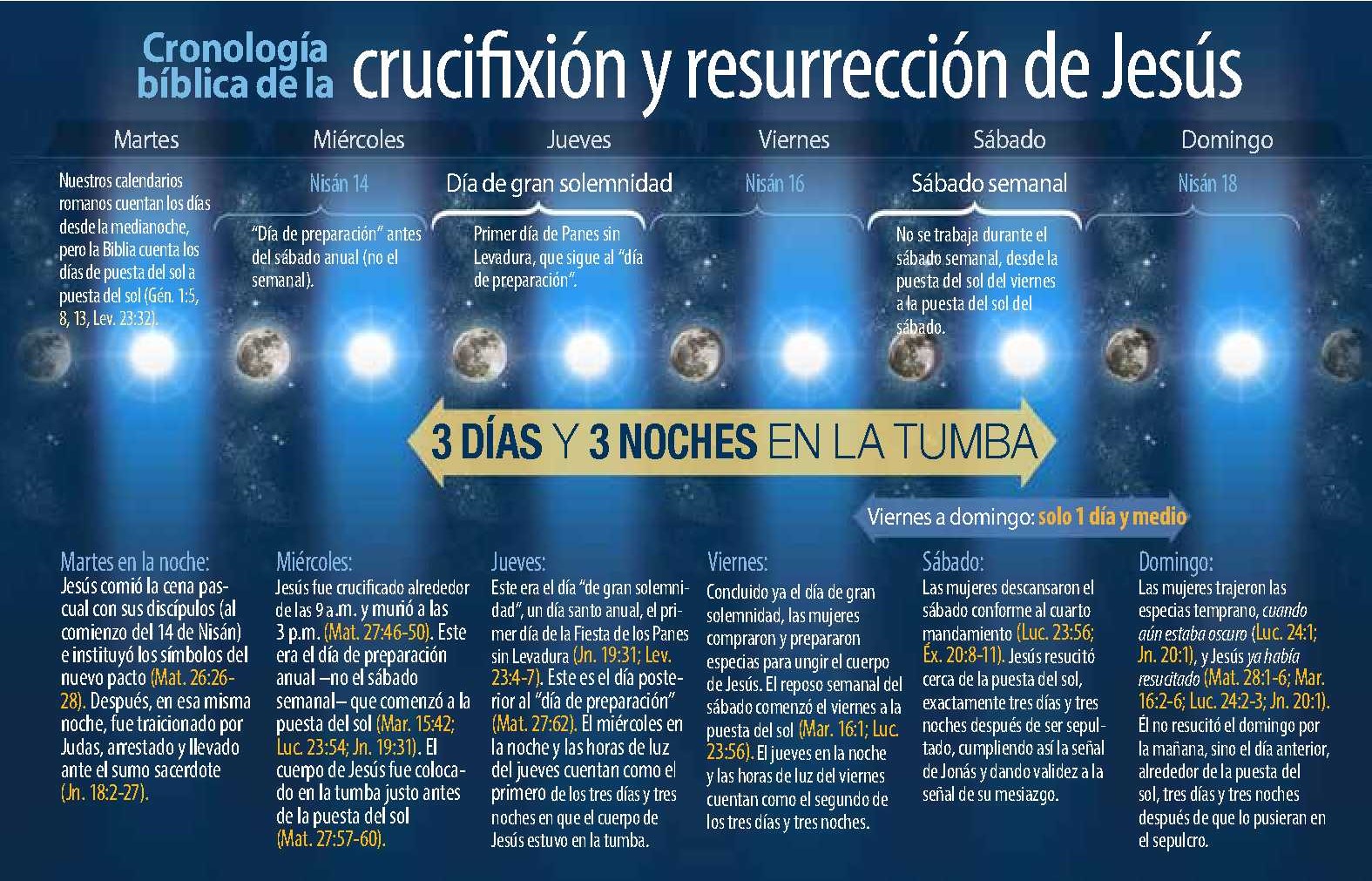
friday https://answersingenesis.org/jesus/resurrection/three-days-and-nights/
https://bible.org/question/were-three-days-and-three-nights-jesus-was-grave-full-72-hours
http://loveandtruth.net/crucified-friday.html
https://bible.org/article/time-jesus-death-and-inerrancy-harmonization-plausible
Mateo 27:46 – Éxodo 12:6 Lo guardaréis hasta el día catorce de este mes, y lo inmolará toda la congregación del pueblo de Israel entre las dos tardes.
Sharing is caringFacebookX / TwitterLinkedInWhatsAppTelegramRedditEmail5020 words · 160 views