These are Biblical figures for which tentative but likely identifications have been found in contemporary sources based on matching names and credentials.
Ahaziah/Amaziah, King of Judah. The Tel Dan Stele contains, according to many scholars, an account by a Syrian king (probably Hazael), claiming to have slain “[Ahaz]iahu, son of [… kin]g of the house of David”, who reigned c. 850 – 849 BCE.[166][167] However, an alternative view, which dates the inscription half a century later, is that the name should be reconstructed as ‘[Amaz]iahu’, who reigned c. 796–767 BCE.[168]Asaiah, servant of king Josiah ([...]
2 Kings 22:12). A seal with the text Asayahu servant of the king probably belonged to him.[169]
Azariah son of Hilkiah and grandfather of Ezra: Mentioned in 1 Chronicles 6:13,14; 9:11 and Ezra 7:1. A bulla reading Azariah son of Hilkiah is likely to be his, according to Tsvi Schneider.[171]
Baalis king of Ammon is mentioned in Jeremiah 40:14. In 1984 an Ammonite seal, dated to c. 600 BCE, was excavated in Tell El-`Umeiri, Jordan that reads “belonging to Milkomor, the servant of Baalisha“. Identification of ‘Baalisha’ with the biblical Baalis is likely,[172] but it is not currently known if there was only one Ammonite king of that name.[173]
David, or more accurately his eponymous royal house, is mentioned in the Tel Dan Stele, see above entry for Ahaziah.
Darius II of Persia, is mentioned by the contemporary historian Xenophon of Athens,[174] in the Elephantine Papyri,[38] and other sources. ‘Darius the Persian’, mentioned in Nehemiah 12:22, is probably Darius II, although some scholars identify him with Darius I or Darius III.[175][176]
Gedaliah son of Ahikam, governor of Judah. A seal impression with the name ‘Gedaliah who is over the house’ is commonly identified with Gedaliah, son of Ahikam.[177]
Gemariah, son of Shaphan the scribe. A bulla was found with the text “To Gemaryahu ben Shaphan”. This may have been the same person as “Gemariah son of Shaphan the scribe” mentioned in Jeremiah 36:10,12.[179]
Geshem (Gusham) the Arab, mentioned in Nehemia 6:1,6 is likely the same person as Gusham, king of Kedar, found in two inscriptions in Dedan and Tell el-Mashkutah (near the Suez Canal)[180]
Isaiah, In February 2018 archaeologist Eilat Mazar announced that she and her team had discovered a small seal impression which reads “[belonging] to Isaiah nvy” (could be reconstructed and read as “[belonging] to Isaiah the prophet”) during the Ophel excavations, just south of the Temple Mount in Jerusalem.[182] The tiny bulla was found “only 10 feet away” from where an intact bulla bearing the inscription “[belonging] to King Hezekiah of Judah” was discovered in 2015 by the same team.[183] Although the name “Isaiah” in Paleo-Hebrew alphabet is unmistakable, the damage on the bottom left part of the seal causes difficulties in confirming the word “prophet” or a common Hebrew name “Navi”, casting some doubts whether this seal really belongs to the prophet Isaiah.[184]
Jehoram, King of Israel (c. 852 – 841 BCE) is probably mentioned in the Tel Dan inscription. According to the usual interpretation, the author of the text, probably Hazael, king of Syria,[185] claims to have slain both Ahaziah of Judah and “[Jeho]ram”.[166][167] However, some scholars, reconstructing the pieces of the stela differently, do not see “[..]ram” as the name of an Israelite king.[186]
Jehucal son of Shelemiah, an opponent of Jeremiah. Archaeologists excavated a bulla with his name,[187] but some scholars question the dating of the seal to the time of Jeremiah. According to Robert Deutsch the bulla is from the late 8th to early 7th century BCE, before the time of Jeremiah.[citation needed]
Jeroboam (II), king of Israel. A seal belonging to ‘Shema, servant of Jeroboam’, probably refers to king Jeroboam II,[189] although some scholars think it was Jeroboam I.[173]
Jezebel, wife of king Ahab of Israel. A seal was found that may bear her name, but the dating and identification with the biblical Jezebel is a subject of debate among scholars.[190]
Josiah, king of Judah. Three seals were found that may have belonged to his son Eliashib.[191]
Nathan-melech, one of Josiah’s officials in 2 Kings 23:11. A clay bulla dated to the middle of the seventh or beginning of the sixth century B.C was found in March 2019 during the Givati Parking Lot dig excavation in the City of the David area of Jerusalem bearing the inscription, “(belonging) to Nathan-melech, servant of the king.”[192][193]
Nergal-sharezer, king of Babylon is probably identical to an official of Nebuchadnezzar II mentioned in Jeremiah 39:3, 13.[129] A record of his war with Syria was found on a tablet from the ‘Neo-Babylonian Chronicle texts’.[194]
Seraiah son of Neriah. He was the brother of Baruch. Nahman Avigad identified him as the owner of a seal with the name ” to Seriahu/Neriyahu”.[171]
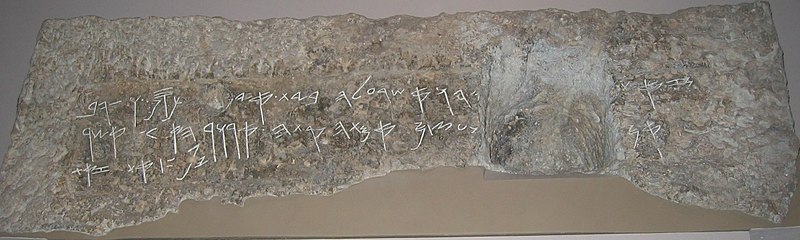
The so-called Shebna Lintel
Shebna (or Shebaniah), royal steward of Hezekiah: only the last two letters of a name (hw) survive on the so-called Shebna lintel, but the title of his position (“over the house” of the king) and the date indicated by the script style, have inclined many scholars to identify the person it refers to with Shebna.[195]
Sheshonq I, Pharaoh of Egypt, is normally identified with king Shishaq in the Hebrew Bible. The account of Shishaq’s invasion in the 5th year of Rehoboam (1 Kings 14:25–28) is thought to correspond to an inscription found at Karnak of Shoshenq’s campaign into Palestine.[196] However, a minority of scholars reject this identification.[197]
Tou/Toi, king of Hamath. Several scholars have argued that Tou/Toi, mentioned in 2 Samuel 8:9 and 1 Chronicles 18:9, is identical with a certain ‘Taita’, king of ‘Palistin’, known from inscriptions found in northern Syria.[198][199] However, others have challenged this identification based on linguistic analysis and the uncertain dating of king Taita.[200]
Uzziah, king of Judah. The writings of Tiglath-Pileser III may refer to him, but this identification is disputed.[201] There is also an inscription that refers to his bones, but it dates from the 1st century CE.
Zedekiah, son of Hananiah (Jeremiah 36:12). A seal was found of “Zedekiah son of Hanani”, identification is likely, but uncertain.[202]
‘The Egyptian‘, who was according to Acts 21:38 the instigator of a rebellion, also appears to be mentioned by Josephus, although this identification is uncertain.[204][205]
Joanna, wife of Chuza An ossuary has been discovered bearing the inscription, “Johanna, granddaughter of Theophilus, the High Priest.”,[206] It is unclear if this was the same Joanna since Johanna was the fifth most popular woman’s name in Jewish Palestine.[207]
Sergius Paulus was proconsul of Cyprus (Acts 13:4–7), when Paul visited the island around 46–48 CE.[208] Although several individuals with this name have been identified, no certain identification can be made. One Quintus Sergius Paulus, who was proconsul of Cyprus probably during the reign of Claudius (41–54 CE) is however compatible with the time and context of Luke’s account.[208][209]
Lysanias, was tetrarch of Abila around 28 CE, according to Luke (3:1). Because Josephus only mentions a Lysanias of Abila who was executed in 36 BCE, some scholars have considered this an error by Luke. However, one inscription from Abila, which is tentatively dated 14–29 CE, appears to record the existence of a later tetrarch called Lysanias.[210][211]
^ ab Irvine, Stuart A. (2002). “The rise of the House of Jehu”. In Dearman, J. Andrew; Graham, M. Patrick (eds.). The Land that I Will Show You: Essays on the History and Archaeology of the Ancient Near East in Honor of J. Maxwell Miller. A&C Black. pp. 113–115. ISBN9780567355805.
^ Heltzer, Michael, THE SEAL OF ˓AŚAYĀHŪ. In Hallo, 2000, Vol. II p. 204
^ Avigad, Nahman (1997). Corpus of West Semitic Stamp Seals (2 ed.). Institute of Archaeology, the Hebrew University of Jerusalem. p. 237. ISBN978-9652081384.; WSS 90, published by the Israel Academy of Sciences & Humanities
^ abc Schneider, Tsvi, Six Biblical Signatures: Seals and seal impressions of six biblical personages recovered’, Biblical Archaeology Review, July/August 1991
^ Grabbe, Lester L., Can a ‘History of Israel’ Be Written?, Continuum International, 1997, pp. 80–82 [27]
^ ab Mykytiuk, Lawrence J., Identifying Biblical persons in Northwest Semitic inscriptions of 1200-539 B.C.E., Society of Biblical Literature, 2004, Baalis: p. 242 [28]; Jeroboam: p. 136 [29]
^ Wright, G. Ernest Judean Lachish in The Biblical Archaeologist, Vol. 18, No. 1 (Feb., 1955), pp. 9–17
^ Josette Elayi, New Light on the Identification of the Seal of Priest Hanan, son of Hilqiyahu (2 Kings 22), Bibliotheca Orientalis, 5/6, September–November 1992, 680–685.
^“Isaiah’s Signature Uncovered in Jerusalem: Evidence of the prophet Isaiah?” By Megan Sauter. Bible History Daily. Biblical Archeology Society. 22 Feb 2018. Quote by Mazar: “Because the bulla has been slightly damaged at end of the word nvy, it is not known if it originally ended with the Hebrew letter aleph, which would have resulted in the Hebrew word for “prophet” and would have definitively identified the seal as the signature of the prophet Isaiah. The absence of this final letter, however, requires that we leave open the possibility that it could just be the name Navi. The name of Isaiah, however, is clear.”
^ Grabbe, Lester L., Israel in transition: from late Bronze II to Iron IIa (c. 1250–850 B.C.E.), Continuum International Publishing Group, 2010, p. 84 [36]
^ Schreiber, N., The Cypro-Phoenician pottery of the Iron Age, Brill, 2003 p. 87 [37]
^ Steitler, Charles (2010). “The Biblical King Toi of Ḥamath and the Late Hittite State “P/Walas(a)tin””. Bibische Notizen (146): 95.
^The History of King David in Light of New Epigraphic and Archeological Data, (link), website of University of Haifa, citing publications by Gershon Galil from 2013-2014
^ Healey, John F., The Religion of the Nabataeans: A Conspectus, Brill, 2001, p. 29 [38]
^ Vanderkam, James C., in The Continuum History of Apocalypticism [39] (edited by McGinn, Bernard J.; Collins, John J.; Stein, Stephen J.), Continuum, 2003, p. 133
^ Frankfurter, David, Pilgrimage and Holy Space in Late Antique Egypt [40], Brill, 1998, p. 206
^ D. Barag and D. Flusser, The Ossuary of Yehohanah Granddaughter of the High Priest Theophilus, Israel Exploration Journal, 36 (1986), 39–44.
^ Richard Bauckham, Gospel Women: Studies of the Named Women in the Gospels (Grand Rapids, MI: Eerdmans, 2002), 143
^ ab Gill, David W. J. (ed.) & Gempf, Conrad (ed.), The Book of Acts in Its Graeco-Roman Setting [41] Wm. B. Eerdmans 1994, p. 282
^ Bromiley, Geoffrey W. (ed.), The International Standard Bible Encyclopedia Vol. III: K–P [42] Wm. B. Eerdmans 1986, pp. 729–730 (entry Paulus, Sergius)
^ Kerr, C. M., International Standard Bible Encyclopedia, Wm. B. Eerdmans 1939, entry Lysanias [43]
^ Morris, Leon, Luke: an introduction and commentary [44] Wm. B. Eerdmans 1988, p. 28