

| Regions with significant populations | |
|---|---|
 Israel | 200,000[1]–250,000[2] |
 United States | 60,000–80,000[1] |
 Iran | 8,300 (2019)[3] |
 Canada | 1,000 |
 Australia | ~740[note 1] |
Today, the vast majority of Persian Jews live in Israel and the United States, especially in Los Angeles, Beverly Hills, and on the North Shore of Long Island. There are smaller Persian Jewish communities in Baltimore, Maryland and the Twin Cities. According to the latest Iranian census, the remaining Jewish population of Iran was 9,826 in 2016.[5]
Terminology
Today the term Iranian Jews is mostly used to refer to Jews from the country of Iran. In various scholarly and historical texts, the term is used to refer to Jews who speak various Iranian languages. Iranian immigrants in Israel (nearly all of whom are Jewish) are referred to as Parsim (Hebrew: פרסים meaning “Persians”). In Iran, Jews and Jewish people in general are referred to by four common terms: Kalīmī (Persian: کلیمی), which is considered the most proper term; Yahūdī (یهودی), which is less formal but correct; Israel (اسرائل) the term by which the Jews refer to themselves; and Johūd (جهود), a term having negative connotations and considered by many Jews as offensive.[6]
History
Main article: History of Jews in Iran
Jews had been residing in Persia since around 727 BCE, having arrived in the region as slaves after being captured by the Assyrian and Babylonian kings. According to one Jewish legend, the first Jew to enter Persia was Sarah bat Asher, grand daughter of the Patriarch Joseph.[7] The biblical books of Isaiah, Daniel, Ezra, Nehemiah, Chronicles, and Esther contain references to the life and experiences of Jews in Persia and accounts of their relations with the Persian kings. In the book of Ezra, the Persian kings are credited with permitting and enabling the Jews to return to Jerusalem and rebuild their Temple; its reconstruction was effected “according to the decree of Cyrus, and Darius, and Artaxerxes king of Persia” (Ezra 6:14). This great event in Jewish history took place in the late sixth-century BCE, by which time there was a well-established and influential Jewish community in Persia.
Jews in ancient Persia mostly lived in their own communities. Persian Jews lived in the ancient (and until the mid-20th century still extant) communities not only of Iran, but also the Armenian, Georgian, Iraqi, Bukharan, and Mountain Jewish communities.[8][9][10][11][12]
REVIEW Some of the communities have been isolated from other Jewish communities, to the extent that their classification as “Persian Jews” is a matter of linguistic or geographical convenience rather than actual historical relationship with one another. Scholars believe that during the peak of the Persian Empire, Jews may have comprised as much as 20% of the population.[13]
REVIEW VIEWPOINT According to Encyclopædia Britannica: “The Jews trace their heritage in Iran to the Babylonian Exile of the 6th century BC and, like the Armenians, have retained their ethnic, linguistic, and religious identity.”[14] But the Library of Congress‘s country study on Iran states that “Over the centuries the Jews of Iran became physically, culturally, and linguistically indistinguishable from the non-Jewish population. The overwhelming majority of Jews speak Persian as their mother language, and a tiny minority, Kurdish.”[15]
Under the Achaemenids
Cyrus the Great and Jews
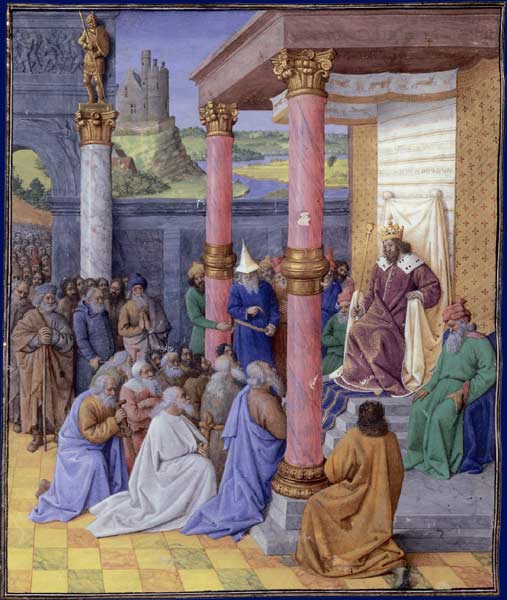
Cyrus the Great allowing Hebrew pilgrims to return to the Land of Israel and rebuild Jerusalem, painting by Jean Fouquet circa 1470
Cyrus the Great was “God’s anointed”, having freed the Jews from Babylonian rule.[biblical ref??] After the conquest of Babylonia by the Persian Achaemenid Empire Cyrus granted all the Jews citizenship. Though he allowed the Jews to return to Israel (around 537 BCE), many chose to remain in Persia. Thus, the events of the Book of Esther are set entirely in Iran. Other Persian cultural influences remain to the present day, such as the Jewish festival of Purim which parallels a springtime Zoroastrian festival called Fravardigan. However, various biblical accounts say that over forty thousand Jews did return (See Jehoiakim; Ezra; Nehemiah and Jews).[16]
Mary Joan Winn Leith believes that the decree in Ezra might be authentic and along with the Cyrus Cylinder that Cyrus, like earlier rulers, was through these decrees trying to gain support from those who might be strategically important, particularly those close to Egypt which Cyrus wished to conquer. She also wrote that “appeals to Marduk in the cylinder and to Yahweh in the biblical decree demonstrate the Persian tendency to co-opt local religious and political traditions in the interest of imperial control.”[19]
By some accounts, the tomb of the prophet Daniel is located in Susa. The Second Temple was eventually (re)built in Jerusalem, with assistance from the Persians, and the Israelites assumed an important position in the Silk Road trade with China.[16]
Under Darius
Main article: Second Temple
Cyrus ordered rebuilding the Second Temple in the same place as the first; however, he died before it was completed. Darius the Great came to power in the Persian empire and ordered the completion of the temple. According to the Bible, the prophets Haggai and Zechariah urged this work. The temple was ready for consecration in the spring of 515 BCE, more than twenty years after the Jews’ return to Jerusalem.
Under Ahasuerus
According to the Book of Esther, in the Tanakh, Haman was an Agagite noble and vizier of the empire under Persian King Ahasuerus, generally identified as Xerxes the Great (son of Darius the Great) in the 6th century BCE.[20] Haman and his wife Zeresh instigated a plot to kill all the Jews of ancient Persia. The plot was foiled by Queen Esther, the Jewish Queen of Persia. As a result, Ahasuerus ordered the hanging of Haman and his ten sons. The events of the Book of Esther are celebrated as the holiday of Purim.
- “Iranian Jews Living in U.S. Have Complex Feelings About Mideast Crisis”. Fox News. 7 August 2006.
- ^ a b Why are people going to Iran?. Jpost.com. Retrieved 2011-05-29.
- ^ “Jewish of Iran”.
- ^ “On Being Persian”. Huffpost. 15 October 2013. Retrieved 6 February 2019.
- ^ a b c “Iranian Census Report 2016” (PDF). Iranian Statistics Agency.
- ^ “Persian Gates”. Forward.com. 28 July 2006. Retrieved 9 March 2013.
- ^ Gorder, Christian (2010). Christianity in Persia and the Status of Non-Muslims in Iran. Lexington Books. p. 8.
- ^ Kevin Alan Brook. The Jews of Khazaria Rowman & Littlefield Publishers, 2006 ISBN 1442203021 p. 233
- ^ “Բեն Օլանդերի հատուկ ներկայացումը Նյու Յորքում նվիրված Ռաուլ Վալլենբերգին,Երեքշաբթի 9 Նոյեմբերի 2010 թ.”Friends-of-armenia.org. Retrieved 30 December 2017.
- ^ “EGHEGIS, [EGHEGIZ, YEGHEGIS, ELEGIS:, Siwnik] – armenia – International Jewish Cemetery Project”. Iajgsjewishcemeteryproject.org. Retrieved 30 December 2017.
- ^ James Stuart Olson, Lee Brigance Pappas, Nicholas Charles Pappas. An Ethnohistorical Dictionary of the Russian and Soviet Empires. Greenwood Publishing Group, 1994 ISBN 0313274975 p. 305
- ^ Begley, Sharon. (7 August 2012) Genetic study offers clues to history of North Africa’s Jews | Reuters. In.reuters.com. Retrieved 2013-04-16.
- ^ The Jews of Iraq. Dangoor.com. Retrieved 2011-05-29.
- ^ Iran on the Britannica Online Encyclopedia. Britannica.com. Retrieved 2011-05-29.
- ^ Iran – Jews. Country-data.com. Retrieved 2011-05-29.
- ^ a b Gorder, Christian (2010). Christianity in Persia and the Status of Non-Muslims in Iran. Lexington Books. p. 17.
^ Grabbe, Lester L. (2004). A History of the Jews and Judaism in the Second Temple Period: Yehud: A History of the Persian Province of Judah. T & T Clark. p. 355. ISBN 978-0-567-08998-4.^ Davies, Philip R. (1995). John D Davies (ed.). Words Remembered, Texts Renewed: Essays in Honour of John F.A. Sawyer. Continuum International Publishing Group. p. 219. ISBN 978-1-85075-542-5.- ^ Winn Leith, Mary Joan (2001) [1998]. “Israel among the Nations: The Persian Period”. In Michael David Coogan (ed.). The Oxford History of the Biblical World(Google Books). Oxford; New York: Oxford University Press. p. 285. ISBN 0-19-513937-2. LCCN 98016042. OCLC 44650958. Retrieved 14 December 2012.
- ^ Johnson, Sara Raup (2005). Historical Fictions and Hellenistic Jewish Identity: Third Maccabees in Its Cultural Context. University of California Press. pp. 16–17. ISBN 978-0-520-23307-2.
Sharing is caringFacebookX / TwitterLinkedInWhatsAppTelegramRedditEmail1383 words · 169 views